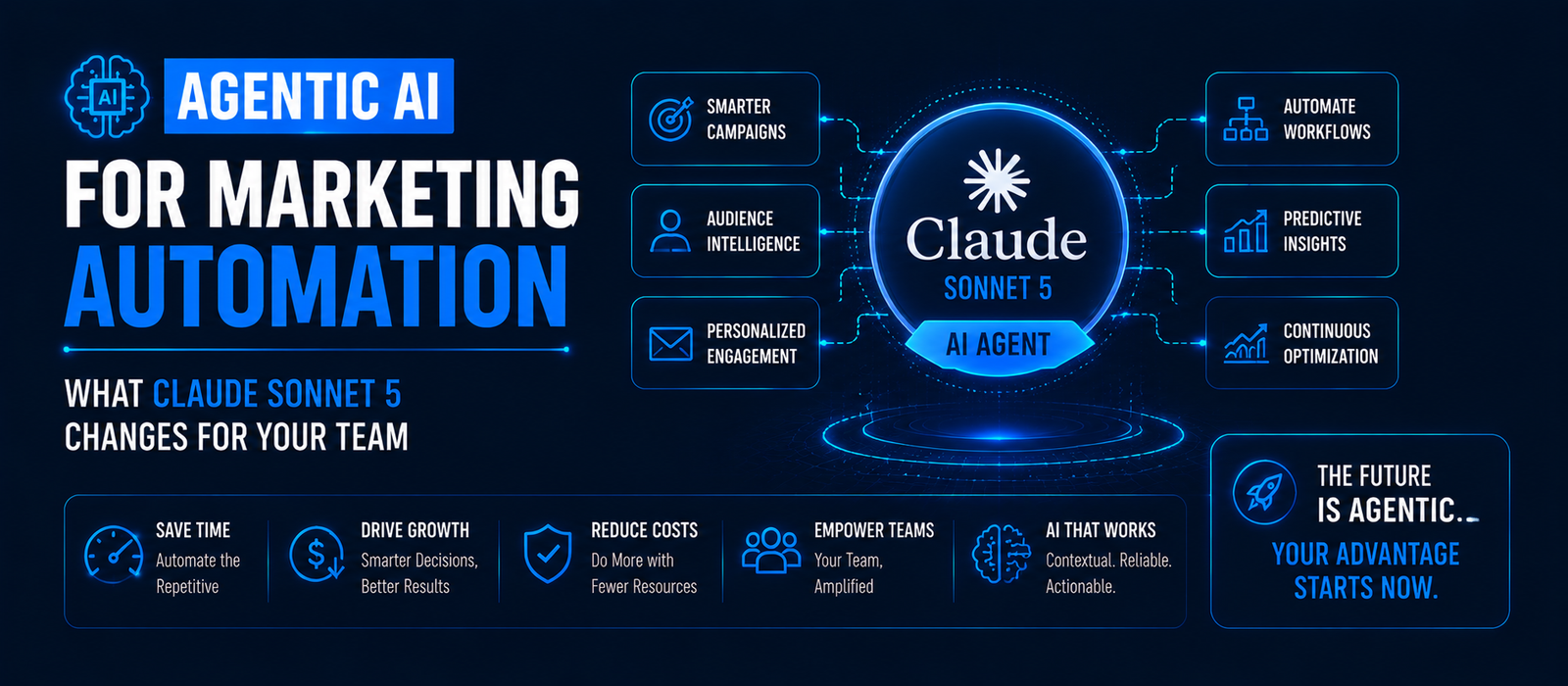
A model that performs near Anthropic's flagship for roughly half the price just shipped — and marketing teams already running agentic workflows are reporting 19% lower cost per qualified lead. That combination is why 2026 is turning into the year agentic AI stopped being a pilot project and started replacing line items in marketing budgets. Agentic AI for marketing automation is no longer a bet on the future; the cost math and adoption data now both point the same direction.
Anthropic's Claude Sonnet 5 launched June 2026 at 40-60% of flagship pricing, accelerating agentic AI adoption in marketing. 45% of marketing teams now use agentic AI (up from 15% in 2024), with reported 30-37% cost reductions and 171% average ROI.
1. Claude Sonnet 5 and Why Cheaper Agentic AI Changes the Math
Anthropic released Claude Sonnet 5 on June 30, 2026, positioning it as, in the company's own words, a cheaper way to run sustained agentic workloads without sacrificing the reasoning quality those workloads need. According to Anthropic's official announcement, Sonnet 5 performs close to where Opus 4.8 sits while costing roughly 40-60% less per token — a gap large enough to change whether always-on marketing agents are financially viable at scale.
The Actual Pricing Breakdown
Reporting from TechCrunch and Anthropic's own documentation confirms Claude Sonnet 5 launched at an introductory rate of $2 per million input tokens and $10 per million output tokens, available through August 31, 2026, before moving to standard pricing of $3 per million input tokens and $15 per million output tokens. It's the default model across Free and Pro plans and available to Max, Team, and Enterprise users, including inside Claude Code and via the Claude API.
Why This Matters Specifically for Marketing Teams
A marketing operations team running agents continuously — monitoring campaign performance, drafting ad variations, triaging customer replies — burns through tokens differently than a single chatbot conversation. A mid-market e-commerce brand running an always-on agent to monitor and rewrite underperforming ad copy across a 200-SKU catalog previously had to ration agent usage to stay within budget; at 40-60% lower cost per task, the same workload becomes affordable to run continuously instead of in scheduled batches.
Pro Tip: Recalculate your agentic AI budget assuming continuous operation, not scheduled batch runs — the cost drop makes "always-on" agents financially realistic for tasks that used to be manual or batched.
2. The 2026 Adoption Data: How Fast Marketing Teams Are Moving
Adoption of agentic AI in marketing has moved from experimental to mainstream faster than most other enterprise software categories, and the year-over-year jump is the clearest evidence of that shift. This is third-party research from marketing technology analysts, not a single official industry census, so treat exact percentages as directional trend data rather than precise counts.
The Adoption Curve
According to 2026 research compiled by Omnibound and corroborating data cited by Accelirate, 45% of marketing teams report using at least one agentic AI system for automation tasks in 2026 — up from just 15% in 2024. Separately, 34% of enterprise marketing teams now run at least one autonomous agent in production, more than double the 14% reported in Q4 2024. Gartner is projecting that by the end of 2026, 40% of enterprise applications will include task-specific AI agents.
Adoption Isn't Uniform
Forrester's *The State of AI Inside US Marketing Agencies, 2026* report found nine in 10 agencies now use generative AI, and roughly half use agentic AI specifically for marketing execution tasks. However, Forrester also flagged that the rapid, cost-driven adoption is straining creative quality at some agencies — a reminder that agentic AI adoption and agentic AI *maturity* are two different curves.
Pro Tip: Track your team's agentic AI maturity separately from adoption — using an agent for one task isn't the same as having governance, QA, and escalation paths built around it.
3. Where Agentic AI Actually Cuts Marketing Costs and Time
The financial case for agentic AI for marketing automation isn't theoretical anymore — 2026 data shows measurable cost and time reductions across several distinct categories of marketing work, and the gains cluster around repetitive, high-volume tasks rather than strategic or creative decision-making. Understanding which category your bottleneck falls into determines whether agentic AI will actually move your numbers.
The Reported Savings, Category by Category
Data compiled by AWS Quality and Second Talent on enterprise AI agent deployments shows a consistent pattern of efficiency and cost gains:
| Metric | Reported Result | Source |
|---|---|---|
| Operational cost reduction | 30-37% | AWS Quality, 2026 |
| Operational efficiency increase | 55% | AWS Quality, 2026 |
| Campaign build time | 27% faster | Omnibound, 2026 |
| Cost per qualified lead | 19% lower | Omnibound, 2026 |
| Average agentic AI ROI | 171% (192% for US enterprises) | Accelirate, 2026 |
| Agency reporting time reduction | 80%+ | BiClaw, 2026 |
A Real Pattern Worth Noting
Agencies that fully integrated agents into client reporting workflows saw reductions of 80%+ in report preparation time, according to BiClaw's 2026 analysis — with one mid-sized agency managing 50 clients reportedly saving around 137 billable hours per month. That's a task category (recurring, templated, data-heavy) where agentic AI's reliability advantage is largest; creative strategy and brand voice decisions show far smaller documented gains.
Pro Tip: Target agentic AI first at recurring, templated, data-heavy tasks (reporting, ad copy variants, lead scoring) before creative or strategic work — that's where 2026 ROI data is strongest.
4. How to Deploy Agentic AI in Your Marketing Operations
Rolling out agentic AI for marketing automation successfully requires sequencing the work so cost, quality, and oversight scale together instead of one outrunning the others. Teams that skip the sequencing tend to either overspend on token usage they can't justify or ship agent output with no review layer, both of which show up fast in Forrester's creativity-quality warning above.
The 6-Step Rollout Process
- Audit recurring, templated tasks first — reporting, ad variant generation, lead triage, and campaign monitoring are the highest-ROI starting points per the data above.
- Choose a cost-efficient model tier — evaluate Claude Sonnet 5's pricing against your expected token volume before committing to a flagship-tier model for routine tasks.
- Build a human-in-the-loop checkpoint — route agent output through a review step for anything customer-facing or brand-voice sensitive.
- Set a token/cost budget per workflow — track spend per agent task type, not just total monthly AI spend, so you can see which workflows justify the investment.
- Measure against a baseline — capture your pre-agent metrics (campaign build time, CPL, report turnaround) so ROI claims are verifiable, not assumed.
- Scale to always-on only after validation — move from scheduled/batch agent runs to continuous operation only once quality and cost hold steady over a full reporting cycle.
The Governance Gap Most Teams Miss
The adoption data above shows plenty of teams turning agents on; it says far less about how many have built escalation paths for when an agent gets something wrong. Before scaling any agentic workflow past a pilot, define explicitly what happens when the agent's output is factually incorrect, off-brand, or outside its intended scope — this is the gap Forrester's 2026 research suggests is being skipped industry-wide.
Pro Tip: Write your agent's escalation and correction path before you write its prompt — most quality failures in production agentic systems trace back to missing that step, not to model capability.
Summary
Agentic AI for marketing automation reached a genuine inflection point in 2026: Claude Sonnet 5's 40-60% cost reduction removed the price barrier that kept always-on agents out of reach for most marketing budgets, and adoption data shows teams responding accordingly — tripling agentic AI usage since 2024. But the same data that shows fast adoption also shows a maturity gap, with Forrester flagging real risk to creative quality when cost-driven rollout outpaces governance. The teams seeing the strongest reported ROI aren't the ones deploying agents everywhere at once; they're the ones targeting recurring, high-volume tasks first and building review checkpoints before scaling to continuous operation.
Key Takeaways
- Claude Sonnet 5 launched at 40-60% of Opus 4.8's cost ($2/$10 per million tokens introductory, $3/$15 standard), per Anthropic's official announcement and TechCrunch reporting.
- 45% of marketing teams now use agentic AI, up from 15% in 2024, per Omnibound's 2026 research.
- 34% of enterprise marketing teams run autonomous agents in production, more than double the 14% reported in Q4 2024, per Accelirate.
- Agentic AI deployments report an average 171% ROI (192% for US enterprises), per Accelirate's 2026 data.
- Agency reporting workflows saw 80%+ time reductions after full agent integration, per BiClaw's 2026 analysis.
- Forrester's 2026 report warns that cost-driven agentic AI adoption is straining creative quality at many US marketing agencies, underscoring the need for governance alongside speed.
Ready to find where agentic AI actually pays off in your marketing stack? Cross Globe Marketing can map your highest-ROI automation opportunities and build the rollout plan around them.
Quick Summary
Agentic AI for marketing automation reached an inflection point in 2026 when Claude Sonnet 5 cut operating costs by 40-60%, removing the price barrier that had kept always-on marketing agents out of reach for most budgets. Adoption responded fast — usage roughly tripled since 2024 — but Forrester has flagged a real maturity gap, warning that creative quality suffers when cost-driven rollout outpaces governance. The strongest reported ROI isn't coming from teams deploying agents everywhere at once; it's coming from teams targeting a small number of high-friction workflows first.