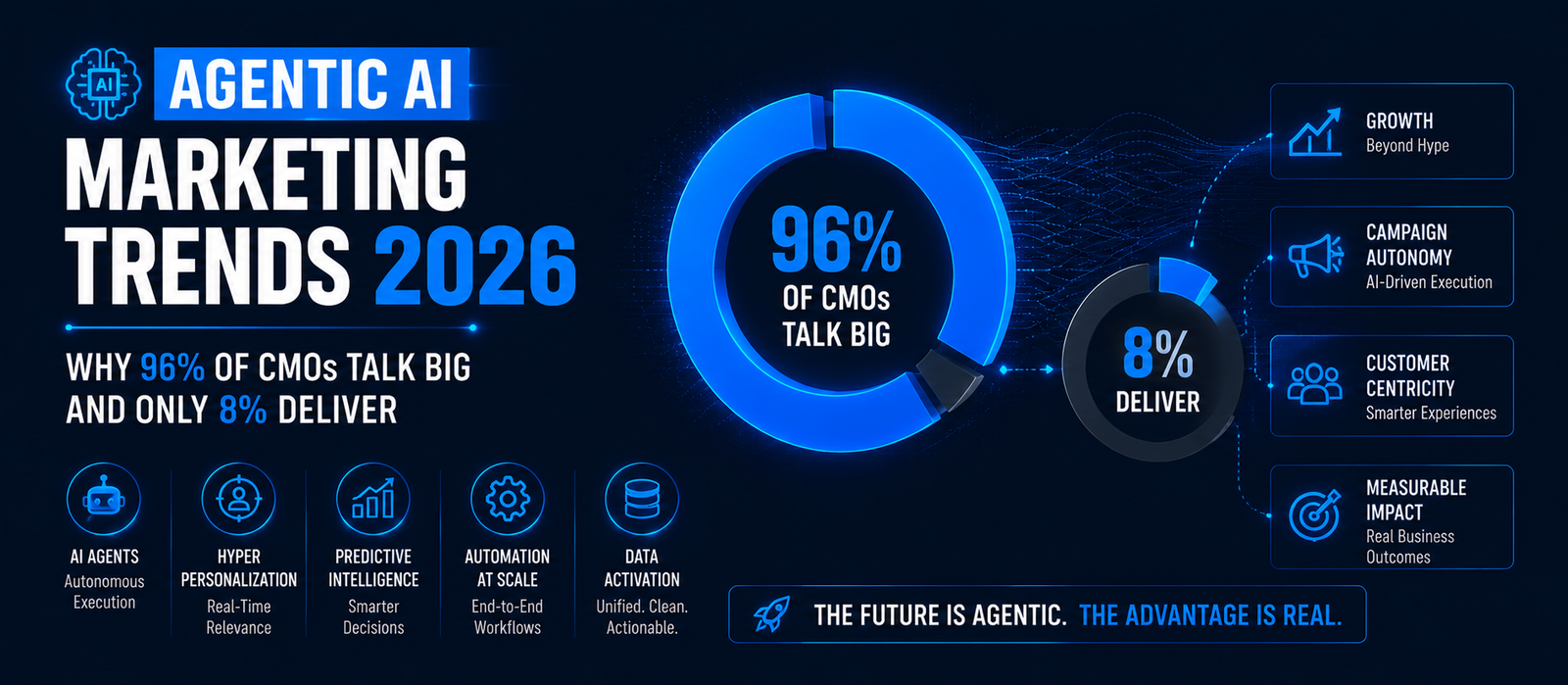
Boston Consulting Group's 2026 survey of 300 global CMOs found 96% say AI is transforming marketing end-to-end — but only 8% run campaigns where multiple AI agents act autonomously. The gap is data, talent, and governance, not technology. Here's what's driving it and how to close it.
Ninety-six percent conviction. Eight percent execution. If your marketing team feels behind on AI, you're actually in the majority — and the data proves it.
Boston Consulting Group (BCG) just published one of the starkest AI reality checks the marketing industry has seen. In its June 2026 report, *Making the Agentic Marketing Transformation a Reality* (released alongside the press release "Mind the Marketing Gap"), BCG surveyed 300 global Chief Marketing Officers (CMOs) and found a jaw-dropping split between belief and behavior. Ninety-six percent said AI is driving end-to-end transformation of their function. Just 8% are actually running campaigns where multiple AI agents operate autonomously — planning, executing, and learning with minimal human oversight. Another 42% admitted they're still using generative AI as a glorified assistant for individual tasks, not a connected system.
This is the CMO "Agentic Gap," and understanding it is now central to any real conversation about Agentic AI Marketing Trends 2026.
1. The Numbers Don't Lie: Inside BCG's "Agentic Gap"
Two numbers anchor everything in this report: 96% and 8%. Before looking at why the gap exists, it's worth being precise about what BCG actually measured — because "agentic AI" gets used loosely, and the bar for clearing it is stricter than most marketing teams assume.
What Does "Agentic AI" Actually Mean in 2026?
Agentic AI isn't a chatbot drafting your ad copy. It's a system of AI agents that can plan a campaign, select an audience, launch creative variants, monitor performance, and reallocate budget — largely without a human approving every single step. That's the bar BCG used, and it's why only 8% of CMOs cleared it. Most teams are still one person, one AI tool, one discrete task at a time: useful, but nowhere near autonomous.
Why Isn't Everyone Already Agentic?
BCG's research points to three root causes, not a technology shortfall:
- Fragmented data foundations — agents can't act autonomously on data scattered across ten disconnected systems.
- Talent gaps — most marketing organizations don't yet have people who can design and govern agentic workflows.
- Governance anxiety — handing budget-reallocation decisions to an autonomous agent is a trust leap most leadership teams haven't made.
BCG managing director Mark Abraham put it plainly: investment has to move beyond individual AI tools and toward connected agentic operating systems — strong data foundations, brand intelligence layers, multi-agent orchestration, and the right talent, together.
Pro Tip: Before buying another point-solution AI tool, audit whether your CRM, ad platforms, and content systems can actually talk to each other. Agentic AI dies in data silos before it ever reaches a live campaign.
Where you stand right now determines everything below — keep reading before you buy another tool.
2. Agentic AI Marketing Trends 2026: What's Actually Changing
The agentic gap isn't standing still — budgets and ambition are climbing fast even where execution hasn't caught up. Two separate 2026 surveys, run by different firms with different methodologies, converge on the same underlying story from different angles.
From Assistant to Autonomous Agent
The direction of travel is unmistakable. Gartner's 2026 CMO Spend Survey (401 CMOs, fielded January–March 2026) found marketing organizations now allocate an average of 15.3% of their budgets to AI initiatives, and 70% of CMOs say becoming an AI leader is a critical 2026 goal. Yet only 30% report their organization has the mature infrastructure to actually scale that ambition. Sound familiar? It's the same gap BCG measured, from a different angle.
Is Agentic AI Just for Enterprise Budgets?
No. Infrastructure quality matters more than budget size. A 12-person e-commerce team with clean data and one well-orchestrated agent workflow — say, autonomous ad-spend reallocation across channels — can outperform an enterprise team running twenty disconnected point tools. BCG's data backs this up: close to a third (31%) of B2C CMOs and 20% of B2B CMOs already report their agentic marketing transformation is producing significant, measurable revenue impact. That's not a pilot-program footnote — that's a P&L line.
| Task-Level AI Assistant | Agentic AI System | |
|---|---|---|
| Who acts | Human acts, AI suggests | AI agent(s) act, human sets guardrails |
| Scope | Single task (copy, image, subject line) | Full campaign loop (plan, launch, optimize) |
| Data requirement | Low — works in isolation | High — needs connected systems |
| 2026 adoption rate | 42% of CMOs (BCG) | 8% of CMOs (BCG) |
| Revenue proof | Mostly anecdotal | 31% B2C / 20% B2B report measurable impact (BCG) |
A 12-person team and clean data can beat an enterprise stack of twenty disconnected tools — size isn't the moat.
Pro Tip: Use the comparison table above as a literal audit checklist. Any row where your team still matches the "Task-Level AI Assistant" column is your next candidate workflow to automate — not a someday project.
3. How to Close the Agentic Gap: A 5-Step Framework
Closing this gap doesn't require an enterprise transformation budget or a 12-month roadmap. It requires a specific, sequenced set of moves — and most teams get stuck because they skip the first one and jump straight to buying tools.
The 5-Step Framework
You don't need a BCG-sized budget to move from the 42% camp toward the 8%. Here's the sequence:
- Audit your data plumbing first. Map every system touching a campaign — CRM, ad accounts, analytics, CMS. If they can't exchange data automatically, agentic AI has nothing to act on.
- Pick one workflow, not ten tools. Choose a single, bounded process — ad budget reallocation, email send-time optimization, creative testing — and fully automate that loop end to end.
- Define guardrails before the agent runs. Set spend caps, brand-safety rules, and approval thresholds up front. Autonomy without guardrails is how budgets get burned overnight.
- Upskill, don't just install. BCG found roughly 80% of leading CMOs made significant investments in AI-specific upskilling this year. Your team needs to supervise agents, not just switch them on.
- Measure the loop, then expand it. Once one workflow proves measurable ROI, extend the same architecture to the next campaign type — that's how a single pilot becomes a genuinely agentic operating model.
Should Small Businesses Wait for the Technology to Mature?
No — waiting is the more expensive bet. Agentic AI Marketing Trends 2026 data shows early movers (BCG's "Leaders" tier) are already capturing revenue impact that competitors can't easily replicate once brand and data advantages compound.
Pro Tip: Start your agentic pilot on a workflow with one clear metric (cost-per-lead, for example), not on brand campaigns where success is subjective. Agents need measurable feedback loops to actually "learn."
Pick your one workflow this week — momentum beats a perfect plan.
4. What This Means for Your Marketing Strategy Right Now
None of this data changes what you should do on Monday morning — it just clarifies which side of the gap your own team is actually standing on. If your organization's "96%" belief in AI is still backed by task-level tools rather than a connected agentic workflow, you're squarely in BCG's 42% camp, not ahead of it. The path from there to the 8% tier isn't about buying more AI — it's about closing the data, talent, and governance gaps covered above, one workflow at a time.
Where Cross Globe Marketing Fits
This is exactly the gap Cross Globe Marketing helps clients close — building the data foundations, campaign workflows, and governance guardrails that turn AI ambition into an actual agentic system, without needing an enterprise-sized team to do it.
The Agentic AI Marketing Trends 2026 story isn't "AI is coming." It already arrived. The only open question is which side of the 96%-versus-8% line your marketing team is standing on a year from now.
Pro Tip: Don't try to fix data, talent, and governance all at once. Pick whichever one is blocking your single highest-value workflow and close that gap first — sequencing beats a simultaneous overhaul every time.
Summary
The 96%-versus-8% split isn't a story about AI capability — every number in this piece points back to data, talent, and governance as the actual blockers. Teams that close those three gaps, even without an enterprise budget, are already capturing measurable revenue impact that the "AI-curious" majority is leaving on the table.
Key Takeaways
- 96% of CMOs believe AI is transforming marketing end-to-end — belief isn't the bottleneck (BCG, 2026).
- Only 8% run genuinely autonomous, multi-agent campaigns; 42% are still at task-level AI assistance (BCG, 2026).
- CMOs allocate an average of 15.3% of marketing budget to AI, yet only 30% feel ready to scale it (Gartner, 2026).
- Revenue impact is real for early movers: 31% of B2C and 20% of B2B leaders already report it (BCG, 2026).
- AI marketing investment already exceeds $15 million annually for 43% of surveyed companies (BCG, 2026).
- Closing the gap is a data, talent, and governance problem — not a tools problem.
Ready to move from AI-curious to agentic-ready? Talk to Cross Globe Marketing about auditing your marketing stack for agentic readiness today.
Quick Summary
Agentic AI marketing trends in 2026 reveal a wide gap between belief and execution: BCG reports 96% of CMOs believe AI is transforming marketing end-to-end, yet only 8% run genuinely autonomous, multi-agent campaigns, with 42% still stuck at task-level AI assistance. That gap isn't about AI capability — it consistently traces back to data readiness, talent, and governance. CMOs who close those three gaps, even without an enterprise-scale budget, are already capturing measurable revenue impact that the "AI-curious" majority is leaving on the table.