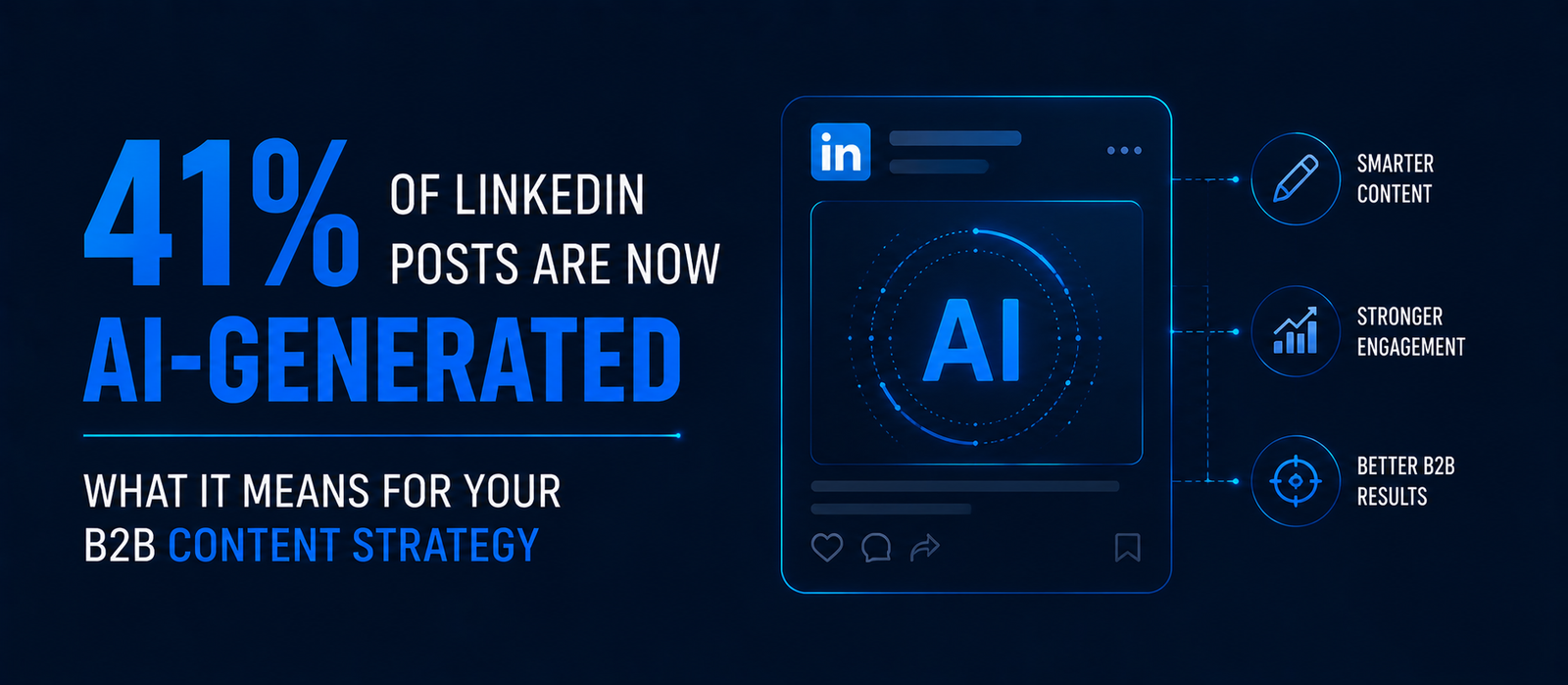
41% of long-form LinkedIn posts are now fully AI-generated (Pangram Labs, 2026), and AI content earns 45% less engagement on average (Originality.ai). For B2B brands, a deliberate AI-Generated LinkedIn Content Strategy — one that uses AI for speed but keeps human judgment in the loop — is now a competitive advantage, not a shortcut.
If four out of every ten long LinkedIn posts in your feed are machine-written, the platform you built your B2B pipeline on has quietly changed. Readers scroll past generic hooks and formulaic "I used to think X, then I learned Y" posts faster than ever, and the data confirms what your gut already suspected: something has shifted. Building a deliberate AI-Generated LinkedIn Content Strategy is no longer a nice-to-have for B2B marketers — it's the difference between showing up in a feed people trust and getting lost in a wave of synthetic sameness.
1. The Data: How Much of LinkedIn Is Actually AI-Generated?
Two independent research firms, using different detection models and sampling methods, arrived at strikingly similar conclusions in 2026 — which is what makes this data worth paying attention to rather than dismissing as hype. When separate methodologies converge on the same number, it stops being a headline and starts being a planning input.
The Pangram Labs Findings
Pangram Labs, an AI-content detection firm, analyzed more than one million social media posts in mid-2026 and found that 41% of long-form LinkedIn posts (generally those over 250 words) were entirely machine-generated. Even more striking: LinkedIn accounted for 62% of all AI-generated content flagged across five major social platforms in the study, despite representing only about a third of the posts scanned. That makes LinkedIn, by a wide margin, the most AI-saturated major social platform — a title it didn't have two years ago.
The Originality.ai Cross-Check
Originality.ai ran a parallel analysis of 3,368 long-form LinkedIn posts from 99 influential profiles across industries and found that 53.7% were "likely AI-written," with some categories like design and architecture content hitting nearly 100%. Wellness and personal-development content wasn't far behind at 92%. The one bright spot: categories built on institutional trust — healthcare, government affairs, innovation strategy — stayed mostly human-written, suggesting professional accountability still shapes how people write in high-stakes categories.
Pro Tip: Before you assume a competitor's high-performing post was AI-written (or human), don't guess — run suspicious content through a detection tool like Originality.ai or Pangram before drawing strategic conclusions from it.
2. Why AI-Generated Content Is Already Underperforming on LinkedIn
The instinct to use AI to scale content output makes sense on paper — more posts, less time, lower cost. But the engagement data tells a more complicated story, and it's one every B2B content team needs to internalize before doubling down on automation.
The Engagement Gap by Content Type
Originality.ai's research found that AI-generated LinkedIn posts received, on average, 45% less engagement than human-authored posts. But the gap isn't uniform. In the "leadership and inspiration" category, AI-flagged posts actually outperformed human posts by 75% — likely because motivational, listicle-style content is easy for AI to mimic convincingly. Meanwhile, in healthcare and government/public affairs, human-written posts beat AI-flagged content by 44% and 40%, respectively — categories where audiences are primed to scrutinize credibility.
What This Means for the LinkedIn Algorithm
LinkedIn hasn't published an official AI-detection penalty, but the engagement data functions as one anyway: posts that read as generic, over-polished, or formulaic get less initial engagement, and LinkedIn's algorithm heavily weights early engagement velocity to decide how far a post travels. In practice, low-signal AI content throttles itself before the algorithm even has to intervene.
Pro Tip: Track your own posts' first-hour engagement rate. A steep drop-off compared to your historical average is often an early signal that a post reads as generic — rewrite the hook before pushing more spend or effort behind it.
3. Building an AI-Generated LinkedIn Content Strategy That Doesn't Backfire
The goal isn't to abandon AI tools — it's to use them where they add real value (research, drafting speed, editing) and keep humans in control of the parts that build trust: original insight, specific stories, and a recognizable voice. Here's a workflow B2B teams can put into practice this week.
What Does a Hybrid Human-AI Content Workflow Look Like?
- Source the idea from a real event. Pull from a client call, a data point from your own campaigns, or a genuine opinion — not a generic trend prompt.
- Draft with AI for structure only. Use AI to organize a rough outline or first-pass draft, not final language.
- Rewrite the hook and first two lines by hand. These are what LinkedIn shows before "see more," and they're the easiest thing for readers (and algorithms) to flag as generic.
- Add one specific, non-generalizable detail. A number, a client name (with permission), a screenshot, or a contrarian take AI wouldn't generate unprompted.
- Edit for voice, not just grammar. Read it aloud — if it sounds like anyone could have written it, it needs another pass.
- Publish and monitor first-hour engagement. Use the data from Section 2 as your benchmark for what "underperforming" looks like.
Where Should You Use AI vs. Keep It Human?
| Task | Use AI | Keep Human |
|---|---|---|
| Research and data-gathering | Yes | — |
| First-draft outlining | Yes | — |
| Hooks and opening lines | No | Yes |
| Personal stories/case studies | No | Yes |
| Grammar and formatting checks | Yes | — |
| Final voice and tone pass | No | Yes |
| Comment replies and engagement | No | Yes |
Pro Tip: Keep a running "swipe file" of your own best-performing hooks and rewrite new AI drafts to match that voice pattern — consistency builds recognition faster than any single viral post.
4. Signals B2B Buyers and Algorithms Use to Detect AI Content
B2B buyers are more skeptical readers than the average LinkedIn scroller — they're evaluating whether to trust a vendor, not just whether to like a post. That makes authenticity signals a buying-trust issue, not just a content-style preference.
What Are the Tell-Tale Signs of AI-Generated LinkedIn Posts?
Common patterns readers (and detection tools) flag include: uniform sentence rhythm, overuse of em dashes and rhetorical questions, vague "I learned three things" structures without specific numbers or names, and hashtag clusters that feel bolted on rather than relevant. None of these single-handedly prove AI authorship, but stacked together they erode reader trust fast — especially with a B2B audience evaluating credibility before a sales conversation.
How Can B2B Brands Build Authenticity Signals Into Content?
Specificity is the strongest counter-signal available: real numbers instead of round ones, named clients (with approval), screenshots of actual results, and opinions that could get pushback rather than safe consensus statements. Content authenticity isn't a vibe — it's a set of concrete editorial choices your team can apply consistently.
Pro Tip: Add one verifiable, checkable claim (a stat, a source, a specific result) to every post — it's the single fastest way to separate your content from the AI-generated median.
Summary
The LinkedIn feed of 2026 is a different environment than the one B2B marketers built their playbooks on just two years ago — nearly half of what people scroll past in long-form posts is now machine-written, and it's earning less trust and less engagement for it. That gap is an opportunity: brands willing to keep real judgment, real stories, and real voice in their content have a clearer path to standing out than they did when everyone's writing looked roughly the same. Getting there requires treating your AI-Generated LinkedIn Content Strategy as a deliberate system, not an afterthought bolted onto a content calendar.
Key Takeaways
- 41% of long-form LinkedIn posts are fully AI-generated, and LinkedIn carries 62% of all AI-flagged content across five major platforms (Pangram Labs, 2026).
- 53.7% of long-form posts from 99 influential profiles were classified "likely AI-written," with design/architecture content hitting nearly 100% (Originality.ai).
- AI-generated posts earn 45% less engagement on average than human-authored posts (Originality.ai).
- In leadership/inspiration content, AI-flagged posts outperformed human posts by 75% — but in healthcare and government affairs, human content beat AI by 40–44% (Originality.ai).
- 39% of B2B marketers expect their organizations to increase AI investment in content creation in 2025–2026 (Content Marketing Institute).
- A hybrid workflow — AI for structure and research, humans for hooks, stories, and voice — is the most defensible approach given current engagement data.
Ready to build a content system that uses AI without losing the voice that actually converts B2B buyers? That's exactly what our team helps clients do every day.
Quick Summary
AI-Generated LinkedIn Content Strategy matters now because 41% of long-form LinkedIn posts are fully AI-generated (Pangram Labs, 2026), LinkedIn carries 62% of all AI-flagged content across major platforms, and AI-generated posts earn 45% less engagement on average than human-written ones (Originality.ai). The exception is leadership/inspiration content, where AI-flagged posts outperform human posts by 75%, while trust-sensitive categories like healthcare see the opposite. For B2B brands, the practical response is a hybrid workflow: use AI for research and drafting structure, but keep hooks, stories, and final voice human to protect engagement and buyer trust.