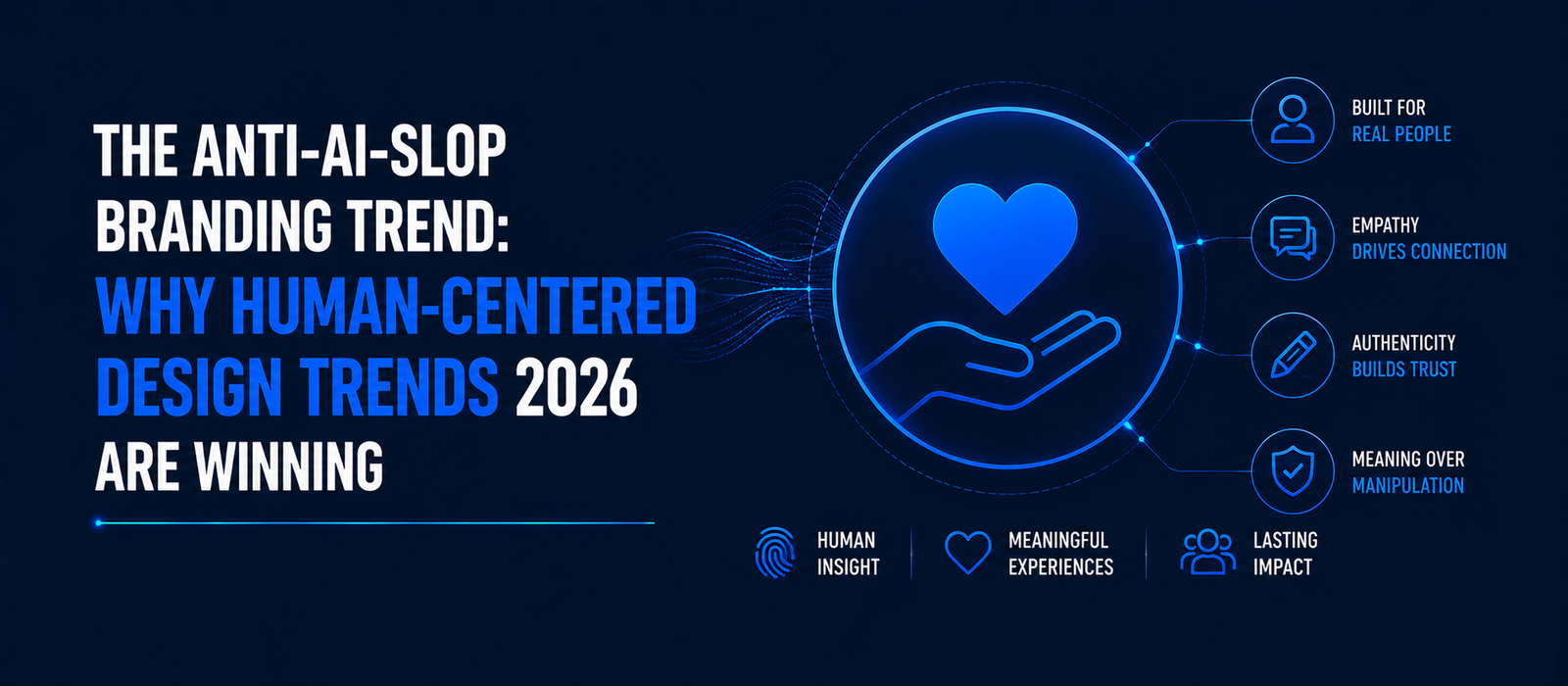
Consumers are getting better at spotting AI-generated content and disengaging when they do. Human-centered design trends 2026 favor hand-drawn type, visible texture, and imperfect edges over polished AI visuals — because imperfection now signals a real person made the decision.
82% of consumers say they can spot AI-generated content — and the moment they do, they stop paying attention. That single figure, from the 2026 Edelman Trust Barometer, explains why the smartest brands are quietly abandoning the flawless, algorithm-perfect look they chased for the last three years. Welcome to the anti-AI-slop movement: the most consequential of the human-centered design trends 2026 has produced so far, where hand-drawn logos, uneven type, and visible brushstrokes are outperforming polished, machine-generated visuals. This isn't nostalgia for imperfection — it's a direct market response to audience fatigue, and it's already changing how brands brief their designers.
1. What the AI-Slop Backlash Actually Reveals
The term "AI slop" describes the flood of fast, cheap, visually generic content that AI tools made possible — and consumers have started naming it out loud. According to the 2026 Edelman Trust Barometer, 36% of consumers now say they're less likely to buy from a brand that uses AI in its advertising, up from 32% in December 2024. That's not a rounding error; it's a trend line moving in the wrong direction for brands leaning harder into automation-first creative.
Why does imperfect design build more trust?
Design that shows visible human decision-making — a slightly uneven line, a hand-lettered word, a texture that doesn't tile perfectly — signals that a person, not a model, made a judgment call. HubSpot's 2026 State of Marketing report found that 76% of marketers say authentic content now outperforms highly produced content, a direct reversal of the "bigger budget, cleaner output" logic that dominated branding for a decade.
The McDonald's cautionary tale
In December 2025, McDonald's Netherlands published an AI-generated holiday ad titled "It's the Most Terrible Time of the Year." Within three days, social media had labeled it "AI slop," and McDonald's pulled the campaign entirely, later calling it "an important learning" in how the company understands effective AI use. It's one of the clearest real-world signals yet that AI-generated creative can actively damage a beloved brand's reputation when it replaces, rather than assists, human judgment.
Pro Tip: Before publishing AI-assisted creative, ask whether a human made a visible, intentional decision somewhere in the final asset. If the answer is no, audiences are increasingly likely to notice — and penalize you for it.
2. The Visual Language of Human-Centered Design in 2026
Human-centered design trends 2026 have a recognizable visual vocabulary, and it's built almost entirely around evidence of a human hand. Grain overlays, ink bleed, hand-drawn icons, and deliberately imperfect kerning are showing up across packaging, web design, and social creative — not as a retro aesthetic, but as a trust signal.
Texture, grain, and deliberate irregularity
Designers are layering film grain, paper texture, and subtle noise onto otherwise clean layouts to break the "too smooth" quality that reads as synthetic. Warm, tactile color palettes and serif fonts on cream or off-white backgrounds are replacing the cool gradients and glassy surfaces associated with AI-native design tools.
Hand-drawn typography and iconography
Custom, slightly imperfect lettering — logos with visible pen strokes, icons that don't quite align to a perfect grid — is being used specifically because it can't be mistaken for machine output. Pinterest's Predicts 2026 report identifies a related consumer shift toward intentional imperfection in aesthetics, noting that Gen Z, who drive the majority of the platform's 2026 trend signals, are prioritizing personal expression and authenticity over polished status signaling.
Pro Tip: Commission at least one hand-drawn or hand-lettered brand asset (a wordmark, an icon set, a packaging illustration) that becomes a recognizable, unreplicable signature — something a prompt alone can't recreate.
3. Why Imperfect Design Is Winning the Business Case
This trend isn't just an aesthetic preference — it's showing up in marketer behavior and budget decisions. HubSpot's 2026 data found that 65% of marketers now say consumers are getting better at identifying and ignoring AI-generated content, and 61% agree that expressing a brand's distinct taste and point of view matters more now than at any point in the last several years.
AI-polished vs. human-centered design at a glance
| Attribute | AI-Polished Default | Human-Centered Design |
|---|---|---|
| Visual signature | Generic, replicable by prompt | Distinct, hard to copy |
| Consumer reaction (Edelman 2026) | 36% less likely to buy when detected | Signals human judgment, builds trust |
| Marketer sentiment (HubSpot 2026) | Seen as commoditized | 76% say it outperforms |
| Brand differentiation | Low — same tools, same outputs | High — tied to real creative decisions |
| Risk profile | Reputational risk if labeled "slop" | Lower risk, higher perceived authenticity |
What this means for smaller brands
Small businesses and freelancers without big production budgets are, counterintuitively, well positioned here. A hand-drawn logo tweak or a genuinely imperfect product photo often costs less than a full AI-generated campaign — and it reads as more credible to the 82% of consumers who say they can now tell the difference.
Pro Tip: Audit your last five pieces of published creative and ask a colleague, unprompted, whether any of it "feels AI." If they hesitate, that asset needs a human pass before it goes out again.
4. How to Apply Human-Centered Design Without Rejecting AI
Anti-AI-slop design is not anti-technology — it's anti-laziness. The winning approach, per HubSpot's 2026 data, is brands that use AI heavily in operations and personalization while keeping customer-facing creative visibly human-led. AI adoption among marketing teams reached 86.4% in 2026, up from 67% in 2025, so the goal isn't avoidance — it's disciplined, visible human refinement.
How do you keep AI in the workflow without it showing?
Use AI for drafts, variations, and speed — then route every customer-facing asset through a human editing pass that changes something material: hand-adjusted type, a re-photographed product shot, or a genuinely edited (not just re-prompted) headline.
- Audit current creative assets and flag anything that reads as fully AI-generated with no visible human edit.
- Identify one signature brand element (a logo mark, an illustration style, a packaging texture) to redesign by hand.
- Set an internal rule: no customer-facing asset ships without a documented human edit or decision.
- Brief designers to intentionally preserve small imperfections rather than "cleaning up" every irregularity.
- Test human-refined versions against AI-only versions in a small campaign and compare engagement.
- Scale the human-centered approach to the assets that performed better, and repeat the process quarterly.
Pro Tip: Document *what* a human changed on each asset (not just that they reviewed it). That paper trail becomes useful proof of authenticity if a campaign is ever questioned publicly.
Summary
The data points in one direction: audiences are no longer neutral about AI-generated creative, and human-centered design trends 2026 are rewarding brands that let imperfection show. This isn't a rejection of AI tools — it's a recalibration of where human judgment needs to stay visible in the final product, from a hand-drawn wordmark to an editing pass no algorithm would make on its own.
Key Takeaways
- 82% of consumers say they can detect AI-generated content, per the 2026 Edelman Trust Barometer.
- 36% of consumers are less likely to buy from brands using AI in ads, up from 32% in December 2024 (Edelman, 2026).
- 76% of marketers say authentic content now outperforms highly produced content (HubSpot 2026 State of Marketing).
- 65% of marketers report consumers are getting better at spotting and ignoring AI content (HubSpot, 2026).
- McDonald's Netherlands pulled its AI-generated "It's the Most Terrible Time of the Year" ad within three days after backlash labeled it "AI slop."
- Marketing-team AI adoption hit 86.4% in 2026 (HubSpot), showing the shift is about visible human judgment, not AI avoidance.
Ready to make your brand feel unmistakably human again? Cross Globe Marketing can help you audit your current creative and build a design system that earns trust instead of triggering skepticism.
Quick Summary
Human-centered design trends 2026 are the branding industry's direct response to consumer fatigue with AI-generated visuals: as 82% of consumers report being able to detect AI content (2026 Edelman Trust Barometer) and 36% say they're less likely to buy from brands using it in ads, brands are shifting toward hand-drawn type, visible texture, and intentional imperfection to signal authentic human judgment. This isn't an anti-AI stance — 86.4% of marketing teams still use AI operationally (HubSpot, 2026) — but customer-facing creative is increasingly expected to carry a visible, undeniable human fingerprint, as cautionary cases like McDonald's pulled AI holiday ad make clear.