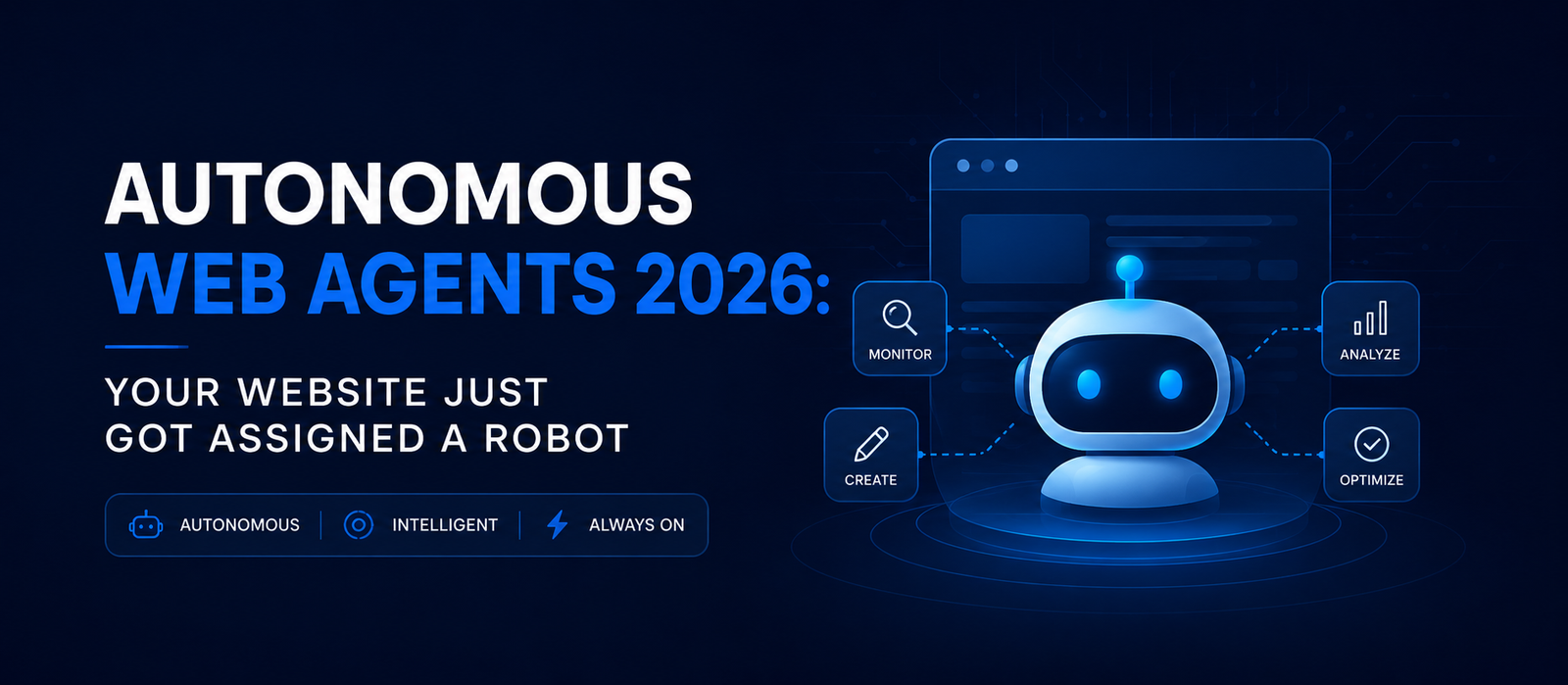
Somewhere right now, an AI agent is comparing four versions of the same hoodie across three websites, picking the cheapest one with free shipping, and checking out — without a human touching a mouse. No, that's not a hypothetical from a keynote slide. It's Tuesday. Welcome to autonomous web agents 2026, the year websites quietly got their own AI agents, and stopped being built for humans only.
Autonomous web agents 2026 are AI systems that browse, compare, and buy on websites without human clicks. Gartner predicts 40% of enterprise apps will feature them by year-end, bot traffic already exceeds human traffic online, and checkout protocols from OpenAI, Stripe, Mastercard, and Visa are already live. Here's what it means for your site.
1. What "Autonomous Web Agents" Actually Means in 2026
Let's kill the confusion first: an autonomous web agent isn't a chatbot with a fancier name. A chatbot answers questions inside a box on your screen. An autonomous web agent leaves the box — it navigates real websites, reads real pages, fills real forms, and completes real transactions on a person's behalf, checking in with a human only when something genuinely needs a decision. Think less "digital assistant that talks," more "digital employee that does."
From Chatbot to Doer
The shift is structural, not cosmetic. Earlier AI tools like the original ChatGPT could describe how to book a flight; today's agentic browsers and shopping assistants actually open the airline's site, enter the dates, and hold a seat. That leap — from advice to action — is why marketers, SEO professionals, and e-commerce teams can't treat this as "just another chatbot trend" and move on.
The Protocol Stack Making It Possible
None of this works without plumbing most business owners have never heard of. Model Context Protocol (MCP), an open standard released by Anthropic, lets an AI agent connect to outside tools and data the same way a browser connects to a website — it's quickly become the common language agents use to read your site's content and structure. Layered on top are commerce-specific standards like OpenAI and Stripe's Agentic Commerce Protocol (ACP), which lets an agent complete a purchase directly inside a chat interface instead of redirecting a human to a checkout page.
Pro Tip: If your dev team has never said the words "MCP" or "agentic commerce protocol" out loud, that's your first sign your site isn't agent-ready yet — put it on next quarter's roadmap review, not the "someday" list.
2. The Data: Why This Isn't Marketing Hype
Skeptical this is more than a buzzword cycle? Fair — 2025 produced plenty of AI hype that didn't survive contact with reality. But the numbers behind autonomous web agents are coming from analyst firms and security researchers, not vendor pitch decks, and they point the same direction from every angle.
Enterprise Adoption Is Already Here
Gartner projects that 40% of enterprise applications will feature task-specific AI agents by the end of 2026, up from under 5% in 2025 — a roughly eightfold jump in a single year, according to Gartner's August 2025 forecast. That's not a distant prediction; it's a build cycle already underway inside the software your business likely already uses for CRM, support, and commerce.
Bots Have Quietly Out-Numbered Humans
Here's the stat that should reframe how you think about your own site's traffic logs: Imperva's 2025 Bad Bot Report found that automated traffic now makes up more than half of all global internet traffic, with AI directly supercharging the growth of harder-to-detect bots. Separately, Sensor Tower data cited by eMarketer found ChatGPT shopping-related queries grew faster than any other query category between December 2024 and June 2025 — and a July 2025 Wildfire Systems survey found 54% of consumers already use generative AI tools to compare prices, with 41% using them to find deals and 41% to check reviews. Translation: a meaningful slice of your "visitors" may not be human anymore, and a growing slice of your human customers are letting AI do the legwork before they ever land on your page.
Pro Tip: Pull your last 30 days of server logs and check the user-agent strings for known AI crawlers and agents (GPTBot, PerplexityBot, ClaudeBot, and similar) — most teams are shocked to see how much of their "traffic" already isn't human.
3. Real-World Example: Checkout Without a Cursor
Theory is nice, but autonomous web agents already have receipts — literally. The clearest proof this isn't a 2027 problem is that real purchases are already completing through agents today, on platforms your customers use daily.
OpenAI's Instant Checkout, Live Since Fall 2025
OpenAI launched Instant Checkout inside ChatGPT, built on the Agentic Commerce Protocol codeveloped with Stripe, letting users complete a purchase without ever leaving the chat window. Etsy was a launch partner, with Shopify merchants following shortly after — meaning a shopper can now describe what they want in a chat, and ChatGPT itself finds it, presents it, and completes the transaction. No product page click. No cart icon. No "add to bag" animation.
The Agent Payment Rails Race
Payment giants aren't waiting on the sidelines. Multiple competing standards are being built simultaneously so agents can pay for what they buy:
| Protocol | Built By | What It Does |
|---|---|---|
| Agentic Commerce Protocol (ACP) | OpenAI + Stripe | Lets AI agents complete checkout inside a chat interface |
| Agent Pay | Mastercard | Tokenized agent-initiated payments across merchant networks |
| Trusted Agent Protocol | Visa | Verifies an AI agent is authorized to transact on a cardholder's behalf |
| AP2 (Agent Payments Protocol) | Open standard for agent-to-merchant payment authorization |
Is one of these protocols going to "win" outright? Too early to call — but the fact that OpenAI, Stripe, Mastercard, Visa, and Google are all shipping competing standards in the same window tells you the money is already moving, regardless of which rail eventually dominates.
Pro Tip: Don't bet your entire agent strategy on one protocol yet — instead, make sure your product data and pricing are structured cleanly enough (accurate schema markup, consistent SKUs, real-time inventory) that any of these systems can read them correctly once you plug in.
4. What Autonomous Web Agents 2026 Means for Your Business
Here's the part that matters more than the trend piece: if agents are already browsing and buying on other companies' sites, your site is either ready for that traffic or invisible to it. There's no neutral middle ground — a site an agent can't parse cleanly just gets skipped in favor of a competitor's that it can.
The 5-Step Agent-Readiness Checklist
- Audit your structured data. Agents lean on schema markup (Product, FAQPage, Organization) far more than a human skimming a page ever would — broken or missing schema is often the difference between being "read" and being ignored.
- Publish an llms.txt file. This emerging convention gives AI agents a clean, plain-language map of your site's key pages, similar to how robots.txt guides search crawlers.
- Simplify your checkout data flow. If a human needs seven form fields to buy something, assume an agent will bail at field four — trim what's not essential.
- Monitor agent user-agents separately from human analytics. Lumping GPTBot or ClaudeBot traffic into your regular visitor stats hides both a threat (scraping) and an opportunity (discovery) in the same number.
- Assign one person to own "agent experience." The same way someone owns mobile UX or page speed, someone on your team needs to own how well your site performs when the visitor isn't human.
The Risk Nobody's Pricing In Yet
Does this create new problems, or just new customers? Both. An agent that can buy from your site can also scrape your pricing, compare it against every competitor in milliseconds, and route the sale elsewhere the moment you're a cent higher — with zero brand loyalty involved. Autonomous web agents 2026 aren't just a new acquisition channel; they're a new, faster, more ruthless form of price competition, and businesses that only prepare for the upside will get blindsided by the downside.
Pro Tip: Run a pricing audit assuming an agent — not a person — is the one comparing you to competitors in real time; "good enough" pricing pages built for human patience won't survive agent-speed comparison shopping.
Summary
Autonomous web agents 2026 didn't arrive with a single dramatic launch — they arrived quietly, through enterprise software updates, a checkout button inside ChatGPT, and payment protocols most shoppers will never notice by name. But the underlying shift is real: analyst data, bot-traffic reports, and live checkout integrations all point the same direction at once, which is rare enough in tech forecasting to take seriously. The businesses that treat this as infrastructure work now — clean data, clear schema, a real owner for "agent experience" — will be the ones agents actually find, read, and recommend when a human never even opens the tab.
Key Takeaways
- Gartner projects 40% of enterprise apps will feature task-specific AI agents by the end of 2026, up from under 5% in 2025 (source: Gartner, August 2025).
- Automated traffic now makes up more than half of all global internet traffic, with AI accelerating bot growth (source: Imperva 2025 Bad Bot Report).
- ChatGPT shopping-related queries grew faster than any other query category between December 2024 and June 2025 (source: Sensor Tower data via eMarketer).
- 54% of consumers already use generative AI tools to compare prices, and 41% to find deals (source: Wildfire Systems survey, July 2025).
- OpenAI's Instant Checkout, built on the Agentic Commerce Protocol with Stripe, is already live with Etsy and Shopify merchants (source: OpenAI / Stripe newsroom).
- Mastercard's Agent Pay, Visa's Trusted Agent Protocol, and Google's AP2 are all competing agent-payment standards shipping in the same window (source: respective company announcements).
Ready to find out whether your site is actually visible to autonomous web agents 2026 — or just invisible to the customers using them? Talk to Cross Globe Marketing about an agent-readiness audit before your competitors get there first.
Quick Summary
Autonomous web agents 2026 are AI systems that browse, compare, and complete purchases on websites without a human clicking anything, powered by standards like Model Context Protocol and the Agentic Commerce Protocol. Gartner projects 40% of enterprise apps will carry task-specific agents by year-end 2026, and Imperva's 2025 data already shows automated traffic outnumbering human traffic online. Real checkout is already live through OpenAI's Instant Checkout with Etsy and Shopify, while Mastercard, Visa, and Google build competing agent-payment rails. Businesses that clean up structured data, publish an llms.txt file, and assign ownership of "agent experience" will be the ones these agents actually find and recommend.