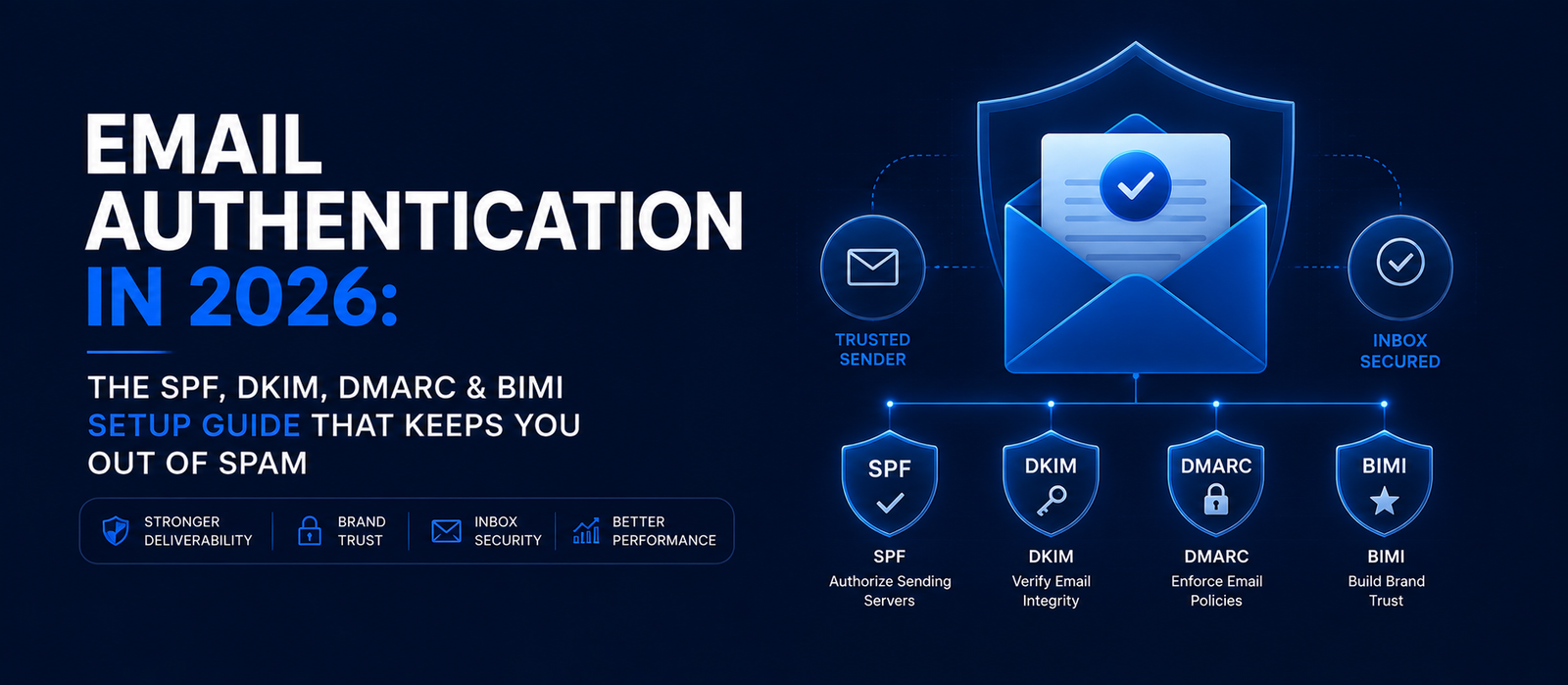
Gmail and Yahoo now reject unauthenticated bulk mail outright, and Microsoft joined them in 2025. Getting your SPF, DKIM, and DMARC setup right — plus adding BIMI — is no longer optional for anyone sending marketing or transactional email in 2026. Here's exactly what to fix, in what order.
193,407. That's how many phishing and spoofing complaints the FBI's Internet Crime Complaint Center logged in 2024 alone, the single most-reported cybercrime category that year, per the FBI IC3 2024 Internet Crime Report. Every one of those attacks exploited the same weakness: email anyone can forge because nobody locked down email authentication. That's why email authentication in 2026 has stopped being a "get to it eventually" line item. Gmail, Yahoo, and Microsoft have all moved from asking nicely to rejecting mail outright, and the SPF DKIM DMARC setup you've been putting off now decides whether your customer ever sees your email at all.
If you're a founder, marketer, or growth lead who's been told "authentication is an IT thing," forward this to whoever owns your DNS. It isn't optional anymore, and the rules keep tightening.
1. Why Email Authentication Became a 2026 Business Requirement, Not an IT Checkbox
This didn't happen overnight. Google and Yahoo announced bulk sender requirements in October 2023, gave senders until February 2024 to comply, then spent nearly two years moving from soft warnings to hard rejections. Email authentication — the DNS-based protocols proving an email actually came from who it claims — is now the baseline mailbox providers use to decide whether your mail even gets evaluated for the inbox.
The Rules That Started It All (2024)
Any sender pushing more than 5,000 emails per day to Gmail or Yahoo addresses must have SPF and DKIM configured and passing, with the From-header domain aligned to at least one of them, a DMARC record published at minimum policy p=none, one-click unsubscribe headers on promotional mail, and a spam complaint rate under 0.3% (ideally under 0.1%), per Mailgun's breakdown of the "Yahoogle" requirements and PowerDMARC's 2026 sender rules guide.
Enforcement Went Live in 2025 — and the Cost of Ignoring It
Do these rules apply to businesses sending under 5,000/day too? Not the strict enforcement tier, but mailbox providers still score authentication on every message regardless of volume. As of November 2025, Google shifted from spam-foldering noncompliant bulk mail to outright rejections (error codes like 550-5.7.26), per Proofpoint's enforcement timeline. Microsoft followed on May 5, 2025, rejecting noncompliant mail from 5,000+/day senders with error 550 5.7.515, per dmarcian. Neither provider has announced a brand-new "2026" mandate — this year is the full-strength enforcement of rules announced in 2023–2024, arguably scarier since no grace period remains. The stakes are real money: the FBI IC3's 2024 report logged $16.6 billion in total reported losses, a 33% jump over 2023, with business email compromise (BEC) alone costing $2.77 billion across 21,442 complaints — and Verizon's 2025 DBIR SMB snapshot found the human element involved in roughly 60% of breaches, phishing chief among the tactics.
Consider a mid-sized SaaS company that ran a re-engagement campaign in early 2026 with DMARC still parked at p=none. Nothing bounced outright, but open rates cratered as Gmail quietly routed more mail to spam — the record existed, but it wasn't doing any enforcement work.
Talk to whoever manages your sending infrastructure this week, and confirm your enforcement status, not just whether a DMARC record exists.
Pro Tip: A DMARC record at
p=nonetells mailbox providers "just watch and report" — it does nothing to stop spoofed mail. Enforcement only starts atp=quarantineorp=reject.
2. SPF, DKIM, and DMARC: What Each Protocol Actually Does (and Why You Need All Three)
These three protocols solve different pieces of the same problem, and mailbox providers increasingly penalize you if even one is missing. Skipping one doesn't mean you're two-thirds protected — DMARC alignment requires at least one of the other two to actually pass, not just exist.
SPF, DKIM, and DMARC Compared
| Protocol | What It Does | What It Prevents | Required Under 2024–2026 Bulk Sender Rules |
|---|---|---|---|
| SPF (Sender Policy Framework) | Publishes a DNS list of servers allowed to send mail for your domain | Unauthorized servers sending as "you" | Yes — must pass and align |
| DKIM (DomainKeys Identified Mail) | Cryptographically signs each message so receivers can verify it wasn't altered | Message tampering and some spoofing | Yes — must pass and align |
| DMARC (Domain-based Message Authentication, Reporting & Conformance) | Tells receivers what to do when SPF/DKIM fail, and sends you reporting data | Domain spoofing and phishing that slips past SPF/DKIM alone | Yes — record required at minimum p=none |
| BIMI (Brand Indicators for Message Identification) | Displays your verified logo next to authenticated mail in the inbox | Nothing directly — a trust signal layered on enforced DMARC | Not required, but needs DMARC at enforcement to activate |
Why "Having DMARC" Isn't the Same as "Being Protected"
The gap between adoption and protection is enormous. EasyDMARC's 2026 DMARC Adoption & Enforcement Report, based on 1.8 million top domains, found 52.1% now have a valid DMARC record — but only 22.9% sit at an enforcement policy (p=quarantine or p=reject); the rest are at p=none, collecting reports and doing nothing else. A separate April 2026 analysis from DMARC Report/DuoCircle, covering nearly 938,000 valid records globally, found only 10.7% at full p=reject. Even Fortune 500 companies lag: EasyDMARC puts 95% of them with a valid record, but DMARC Report's dataset shows just 62.7% actually at p=reject.
Ready to check where you stand? Most free DMARC lookup tools will show your policy in seconds — the fix from there is the harder part.
Pro Tip: Query your own domain's DMARC record today (
dig TXT _dmarc.yourdomain.com). If the policy tag readsp=none, you're publishing data, not enforcing protection.
3. BIMI: Turning Authentication Into a Trust Signal Buyers Actually See
Once your DMARC is at enforcement, BIMI turns that compliance into something visible: your verified logo next to your emails in the inbox. It's the one part of this stack customers notice directly, rather than something that quietly prevents bad things from happening.
VMC vs. CMC: Which Certificate Do You Actually Need
Do I need a registered trademark to get a BIMI checkmark? Not necessarily anymore. A Verified Mark Certificate (VMC) requires a registered trademark and starts around $1,550/year through issuers like DigiCert, per The SSL Store's 2025 pricing breakdown. The newer Common Mark Certificate (CMC), introduced in early 2025, drops the trademark requirement in favor of proving your logo has been publicly displayed on your domain for 12+ months, starting around $1,089/year — though Gmail is currently the only major provider confirmed to accept CMCs, per Mailhardener's tracking.
Where BIMI Actually Shows Up (and How Fast Adoption Is Moving)
Support spans Gmail, Yahoo Mail, and — since iOS 16, iPadOS 16, and macOS Ventura 13, not the commonly assumed iOS 18 — Apple Mail and iCloud.com, per Apple's own support documentation. Adoption is climbing but still niche: URIports' January 2025 analysis of the top 1 million domains found 9,661 with valid BIMI records (under 1%), up 28% year over year, with roughly 31% pairing the record with a VMC or CMC. The same analysis flagged a real caveat: the share of BIMI domains with at least one implementation error rose from 41.8% to 53.6% — adoption is outpacing correct setup. An e-commerce brand rolling out BIMI without first confirming its DMARC was at p=reject is a common failure mode: the certificate gets bought, the DNS record gets published, and the logo never appears, because BIMI won't activate without enforced DMARC underneath it.
Pro Tip: Don't buy a VMC or CMC until your DMARC policy has sat at
p=quarantineorp=rejectfor at least a few weeks. BIMI logos won't render without it, no matter what you spent on the certificate.
4. How to Set Up SPF, DKIM, DMARC, and BIMI: A 2026 Implementation Roadmap
There's a right order to do this in, and skipping steps is exactly how companies end up with a DMARC record still sitting at p=none a year later. Here's the sequence that gets you from zero to fully authenticated without breaking existing mail flow.
The 6-Step Rollout Sequence
- Inventory every sending source — ESP, CRM, helpdesk, invoicing tool, any transactional mail service — before touching DNS.
- Publish or correct your SPF record, listing every authorized sender, staying under the 10-DNS-lookup limit that breaks SPF silently.
- Enable DKIM signing on every platform from step 1 and verify each passes independently.
- Publish DMARC at
p=nonewith reporting (rua) on, and let it run 2–4 weeks to see what the reports reveal. - Fix every unauthorized source the reports surface, then move to
p=quarantineas a safer middle step. - Move to
p=rejectonce quarantine is clean, then layer on BIMI with a VMC or CMC once enforcement has been stable.
Common Mistakes That Stall Enforcement
What happens if I never move off p=none? Nothing dramatic — that's the trap. Your domain stays technically "compliant" for the bulk sender rules while remaining fully exploitable by spoofers, with zero warning until a phishing campaign impersonating your brand lands in a customer's inbox. The most common stall point is skipping the reporting-review step and jumping straight to p=reject, which breaks legitimate mail from forgotten sources — an old marketing tool, a sales rep's CRM plugin, an invoicing platform nobody remembers connecting.
Don't let this sit on a backlog — a two-week reporting window before each policy jump is cheap insurance against breaking real mail.
Pro Tip: Never jump straight to
p=reject. Review DMARC aggregate reports atp=noneandp=quarantinefirst, or you risk silently blocking your own legitimate transactional email.
Summary
Email authentication went from technical afterthought to hard gate in two enforcement cycles — Google and Yahoo in 2024–2025, Microsoft close behind. The businesses feeling the least pain in 2026 aren't the ones with the fanciest email stack; they're the ones who moved past p=none, fixed what their DMARC reports surfaced, and treated BIMI as the reward for enforcement done right rather than a shortcut around it.
Key Takeaways
- Google's bulk sender rules moved from soft enforcement to outright mail rejection starting November 2025, per Proofpoint's enforcement timeline.
- Microsoft now requires SPF, DKIM, and aligned DMARC for senders of 5,000+ daily messages to Outlook/Hotmail addresses, enforced since May 5, 2025, per dmarcian.
- Only 22.9% of domains with a DMARC record are actually at an enforcement policy — the rest sit at
p=none, per EasyDMARC's 2026 DMARC Adoption & Enforcement Report. - BIMI adoption remains under 1% of top domains, and implementation error rates rose from 41.8% to 53.6% year over year, per URIports' January 2025 analysis.
- Phishing and spoofing were the most-reported cybercrime category in 2024, with BEC losses alone reaching $2.77 billion, per the FBI IC3 2024 Internet Crime Report.
- A Common Mark Certificate now offers a trademark-free path to a BIMI checkmark starting around $1,089/year, though Gmail is currently the only major provider confirmed to accept it, per Mailhardener.
If your DMARC policy is still sitting at p=none, that's the one thing on this page worth fixing before you send another campaign — and the team at Cross Globe Marketing can walk your domain through the full authentication audit if you'd rather not do it alone.
Quick Summary
Email authentication in 2026 has moved from best practice to enforced requirement: Gmail and Yahoo reject noncompliant bulk mail outright as of late 2025, and Microsoft enforces the same SPF, DKIM, and DMARC alignment standard for 5,000+ daily senders since May 2025. Despite this, only 22.9% of domains with DMARC records sit at an actual enforcement policy rather than the passive p=none setting, and BIMI — the verified-logo trust signal available once DMARC enforcement is active — remains adopted by under 1% of top domains. Getting the SPF DKIM DMARC setup right, in the correct sequence, is now the baseline for inbox placement, brand protection against spoofing, and eligibility for BIMI's visible checkmark.