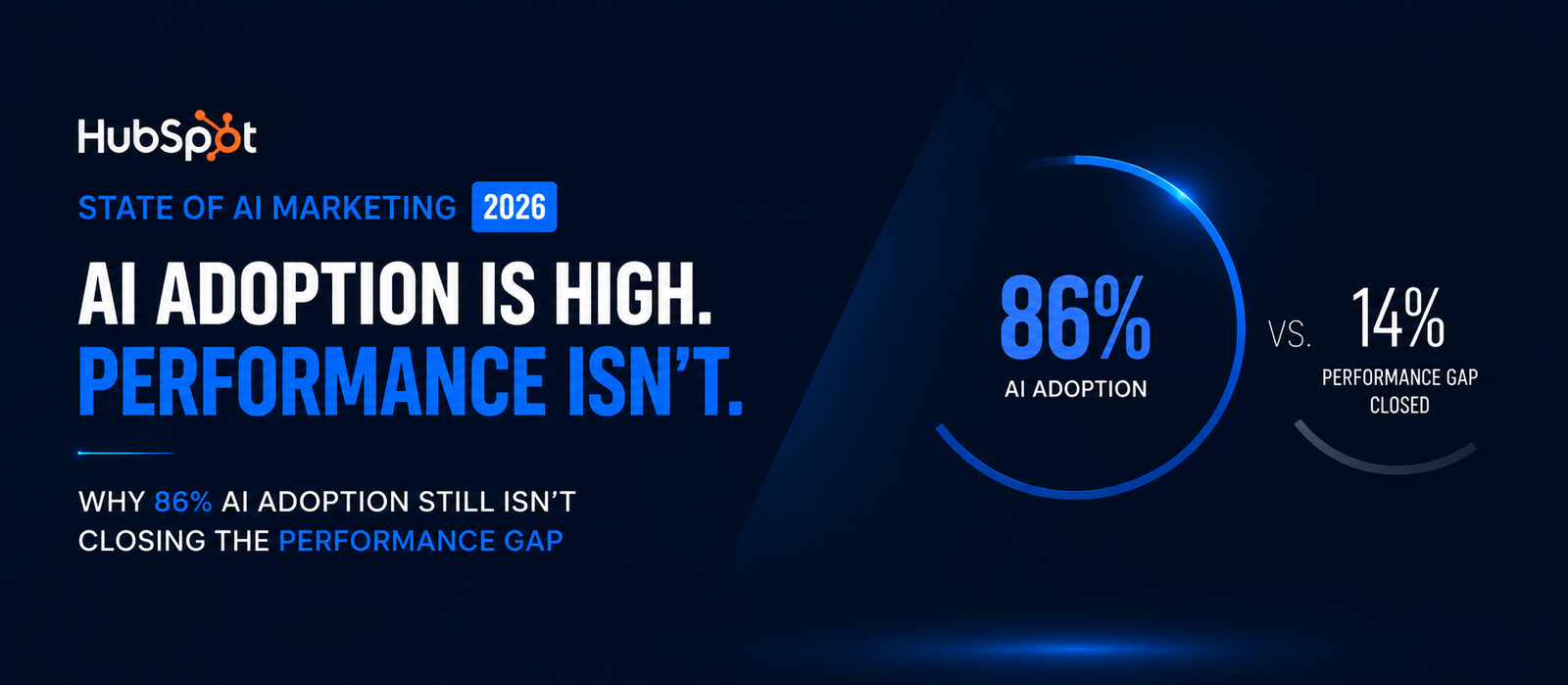
86.4% of marketing teams now use AI. Only 1.7% say they have no plans to. By almost any measure, the AI adoption race in marketing is over — and AI won.
So why are 33% of marketers still naming "measuring marketing ROI" as their single biggest challenge in 2026? Why do 53% say it's harder than ever to make their content stand out?
According to HubSpot's State of AI Marketing Trends 2026 report — based on survey data from more than 1,500 global marketers — adoption and performance have quietly split into two different stories. Everyone has the tool. Not everyone has the result. This post walks through what HubSpot's 2026 data actually shows, why the gap exists, and the concrete steps that separate teams who are compounding gains from teams who are just generating more content into a noisier market.
HubSpot's 2026 State of Marketing report shows 86.4% AI adoption in marketing teams, but ROI measurement, thin audience data, and content sameness are keeping results flat for most. Closing the gap requires better data, disciplined measurement, and human-led differentiation — not more AI tools.
1. HubSpot's 2026 Data: What AI Adoption Actually Looks Like
The headline number is impressive, but the texture underneath it is where the real story lives. HubSpot's 2026 survey didn't just ask "do you use AI" — it asked how, where, and how confidently, and the answers show a market that has moved fast on access but unevenly on mastery.
The adoption numbers, unpacked
AI adoption in marketing has climbed sharply and consistently over three report cycles. According to HubSpot's blog coverage of the 2026 State of Marketing report, adoption sat at 41% in the 2024 report, jumped to 67% in 2025, and now stands at 86.4% in 2026 — with just 1.7% of marketers saying they have no plans to adopt it at all.
The most common use cases cluster around content and operations rather than strategy. Content creation leads at 42.5% extensive use, followed by media creation (37.2%), administrative task automation (35.6%), and learning and skill development (34.6%). Roughly a third of teams say AI now saves them 10 to 14 hours a week, and another third report saving more than 15 hours.
Confidence is rising faster than mastery
Marketer confidence has jumped too — 68.2% now say they understand how to use AI in marketing, up from just 47% a year earlier, and 67.5% say they know how to measure AI's impact, up from 48% in 2025. That's real progress. But flip those numbers around: roughly one in three marketers still can't confidently measure whether their AI investment is actually working, even after two years of rapid adoption.
Pro Tip: Before adding another AI tool to your stack, audit which of your existing tools you can already measure the impact of. Adoption without measurement is just spend.
2. Why Using AI Isn't the Same as Getting Results From It
This is the core tension behind HubSpot's 2026 findings: AI adoption and AI-driven performance are not the same metric, and treating them as interchangeable is where most marketing teams lose the thread. A tool being installed says nothing about whether it's wired into a workflow that actually changes an outcome.
The productivity-to-impact drop-off
HubSpot's data shows 26.5% of marketers say AI has significantly increased their productivity, while another 66.2% say it's slightly or moderately increased productivity — meaning the overwhelming majority feel some lift, but only about a quarter feel a transformational one. That's a wide gap between "AI helps" and "AI moves the business." Most teams are living in the middle of that range: busier, faster, but not obviously more profitable.
Does more AI usage actually mean better marketing results?
Not automatically. The report's own top-challenge data makes this explicit: measuring marketing ROI is the number one challenge marketers cite in 2026, named by 33% of respondents, ahead of keeping up with platform changes (29.8%) and generating leads (29.6%). Consider a mid-size e-commerce team that adopts an AI copywriting tool, an AI ad-optimization tool, and an AI reporting dashboard within the same quarter. Output triples. But without a shared measurement framework connecting AI-assisted activity to pipeline and revenue, leadership can't tell which tool — if any — actually moved the number, and the "AI is working" narrative becomes a feeling instead of a fact.
Pro Tip: Pick one KPI per AI tool before you roll it out — not after. If you can't name the metric it should move, you can't prove it worked.
3. The Data Quality Problem Hiding Behind the AI Headlines
AI-enabled personalization is the top marketing trend for 2026, and for good reason: 93.2% of marketers say personalized or segmented experiences have led to more leads and purchases. But personalization at scale runs on data, and HubSpot's report shows that layer hasn't kept pace with the AI layer sitting on top of it.
Audience data hasn't improved in a year
Just 65% of marketers say they have high-quality audience data — a figure that, per HubSpot's report, didn't move at all from the previous year. That flat line matters more in 2026 than it did in 2025, because more AI tools are now depending on that data to personalize, target, and optimize. Feeding sophisticated AI systems the same unreliable inputs just produces confident-sounding output built on a shaky foundation.
Personalization sophistication is still shallow
The gap shows up again at the execution layer: only 12.6% of brands are using hyper-personalization — things like behavior-based messaging or dynamic product recommendations — while most still rely on basic personalization like simple dynamic fields (first name, company name, and little else). A B2B software company might use AI to generate hundreds of email variants, yet if all of them pull from the same shallow, unsegmented list, the AI is optimizing copy, not outcomes.
Pro Tip: Run a data audit before your next AI rollout. Clean, well-segmented data compounds every AI investment that touches it; dirty data compounds the opposite.
4. What Marketers Say Is Actually Blocking Their ROI
When HubSpot's 2026 survey asked marketers directly what's standing in their way, the answers weren't really about AI capability at all — they were about proof, differentiation, and capacity. This section is where the "performance gap" in the report title stops being abstract and starts looking like a punch list.
The top four blockers, ranked
Marketers ranked their top challenges for 2026 as: measuring marketing ROI (33%), keeping up with trends and new platforms (29.8%), generating quality leads (29.6%), and sales-marketing alignment (27.6%). None of these are solved by simply adding more AI output — several, like alignment and ROI measurement, are made harder by more output arriving faster than teams can validate it.
Content sameness and burnout are compounding the problem
Two human-side pressures are showing up alongside the AI numbers. First, 62.7% of marketers say the market now needs more unique, human-centered content to compete with the volume of AI-generated content flooding every channel — a direct signal that differentiation, not output volume, is becoming the scarce resource. Second, 70% of marketers believe marketing has changed more in the past three years than in the previous fifty, a pace of disruption HubSpot links directly to rising burnout risk. A freelance content agency scaling output with AI might hit its publishing targets and still lose client trust if every piece reads like every competitor's AI-generated piece.
Pro Tip: Ask your team to flag one piece of content per week that "sounds like AI wrote it" — even if AI didn't. That's your differentiation gap made visible.
5. A Practical Framework for Closing the Gap in 2026
Closing the gap between AI adoption and AI performance isn't about adopting less — HubSpot's data makes clear that near-universal adoption is now the baseline cost of competing. It's about sequencing: measurement before scale, data quality before personalization, and human judgment layered on top of AI output rather than replaced by it.
The five-step closing-the-gap process
- Audit current AI use against measurable KPIs. List every AI tool in use and the specific metric each one is supposed to move — if a tool has no attached metric, that's your first fix.
- Fix the data layer before scaling personalization. Prioritize audience data quality and segmentation ahead of adding hyper-personalization features that will only amplify existing data gaps.
- Set one shared ROI definition across marketing and sales. Sales-marketing alignment (a top-four challenge at 27.6%) usually traces back to teams measuring success differently.
- Build a human-review checkpoint into every AI content workflow. Given that 62.7% of marketers say differentiation now requires more human-centered content, this isn't optional polish — it's the product.
- Reassess tool spend quarterly against the KPIs from step one. Cut or consolidate tools that can't show measurable impact; reinvest in the ones that can.
AI-heavy vs. framework-led approach
| Factor | AI-Heavy, Unstructured Approach | Framework-Led Approach |
|---|---|---|
| Tool adoption | Fast, reactive, tool-first | Deliberate, KPI-first |
| Data quality | Assumed sufficient | Audited and improved before scaling |
| ROI visibility | Unclear which tool drove results | Tied to a single shared metric |
| Content differentiation | Generic, high-volume output | Human-reviewed, brand-distinct output |
| Team alignment | Marketing and sales track separately | One shared ROI definition |
Where teams get this wrong
The most common mistake isn't under-adopting AI — HubSpot's 86.4% figure shows that ship has sailed. It's sequencing personalization and content scale ahead of the measurement and data-quality work that makes those investments pay off. Teams that reverse the order, fixing the foundation first, tend to show up in the 26.5% reporting significant productivity gains rather than the wider group reporting only a slight lift.
Pro Tip: Run the five-step process as a quarterly ritual, not a one-time cleanup. HubSpot's report is annual — your measurement discipline shouldn't wait that long to check itself.
Summary
HubSpot's 2026 data tells a consistent story once you connect the sections: adoption climbed from 41% to 86.4% in two years, confidence in using AI rose right alongside it, and yet the top challenge marketers report is still proving that any of it works. The gap isn't a tooling problem — it's a sequencing problem, and it's closable with the same discipline marketers already apply to every other channel: define the metric, fix the data, keep a human in the loop, and review the spend.
Key Takeaways
- 86.4% of marketing teams now use AI in at least some workflows, up from 67% in 2025 and 41% in 2024 (HubSpot, 2026 State of Marketing report).
- Measuring marketing ROI is the top challenge for 33% of marketers in 2026, ahead of keeping up with platform changes (29.8%) and lead generation (29.6%) (HubSpot, 2026 State of Marketing report).
- Only 65% of marketers report high-quality audience data, a figure that didn't improve year-over-year (HubSpot, 2026 State of Marketing report).
- Just 12.6% of brands use hyper-personalization, while most still rely on basic personalization tactics (HubSpot, 2026 State of Marketing report).
- 62.7% of marketers say the market needs more unique, human-centered content to compete with AI-generated volume (HubSpot, 2026 State of Marketing report).
- 26.5% of marketers report AI has significantly increased productivity, versus 66.2% who report only a slight or moderate lift (HubSpot, 2026 State of Marketing report).
If your team has the AI tools but not the results to match, start with the audit in Section 5 — knowing exactly where your HubSpot State of AI Marketing Trends 2026 benchmarks put you is the fastest way to find out what's actually holding your performance back.
Quick Summary
HubSpot's State of AI Marketing Trends 2026 report finds that 86.4% of marketing teams now use AI, up from 67% in 2025 and 41% in 2024, yet 33% of marketers still rank measuring marketing ROI as their top challenge. The gap traces back to flat audience data quality (65%, unchanged year-over-year), shallow personalization (just 12.6% using hyper-personalization), and a growing need for human-centered content, which 62.7% of marketers say is necessary to stand out against AI-generated volume. Closing the gap requires sequencing — fixing data and measurement before scaling AI-driven content and personalization — rather than simply adding more AI tools.