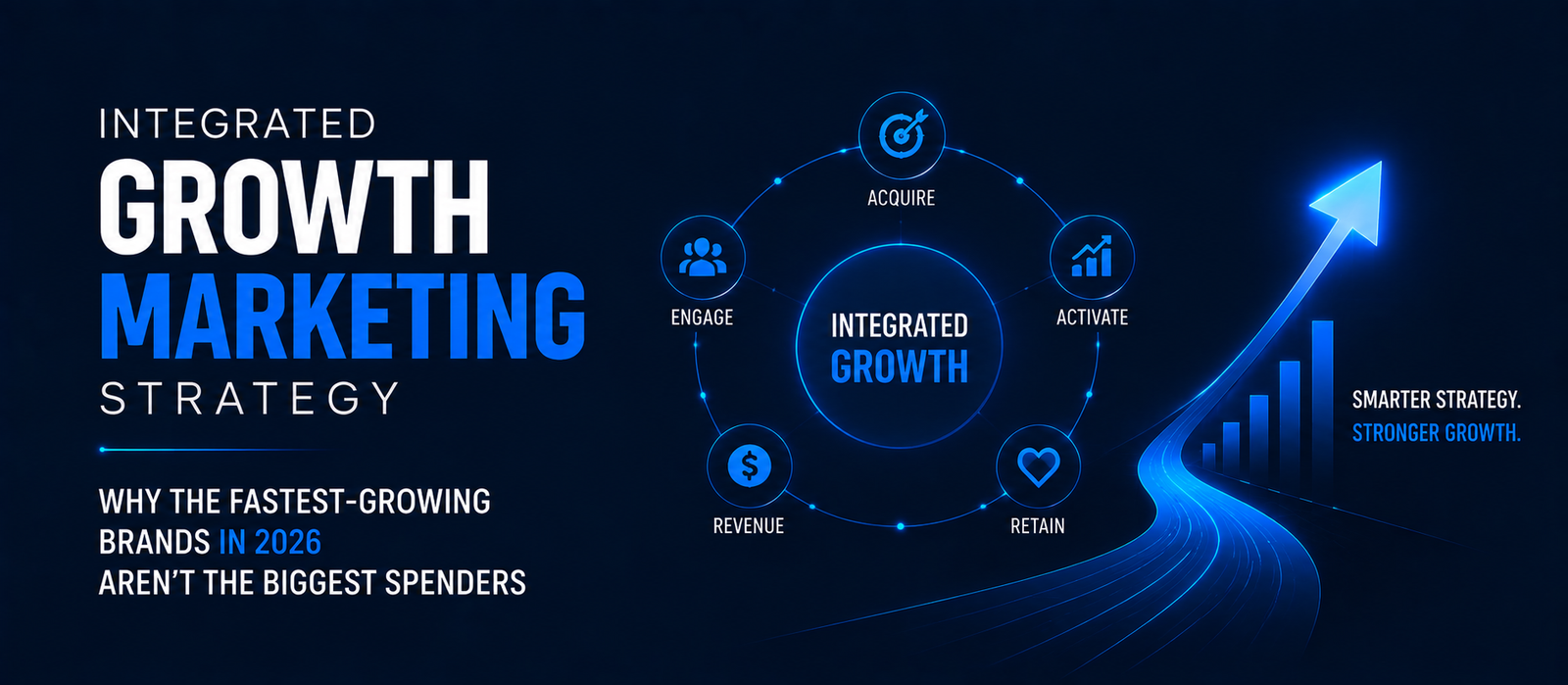
Marketing budgets have been stuck at 7.7% of company revenue for two years running, according to Gartner's 2025 CMO Spend Survey — yet growth outcomes between brands keep pulling further apart. If bigger budgets aren't explaining the gap, what is? The answer, increasingly, is system design: whether a brand runs a true Integrated Growth Marketing Strategy or a pile of disconnected channels competing for the same customer's attention.
This isn't a motivational claim. It's a budget math problem. Half of CMOs surveyed by Gartner report budgets at 6% of revenue or less, and paid media alone consumes roughly 30.6% of whatever budget exists. There's no meaningful room left to out-spend a competitor. The only lever still available to most marketing teams is efficiency — and efficiency is exactly what an integrated system is built to deliver.
Marketing budgets are flat at 7.7% of revenue (Gartner, 2025), yet growth outcomes keep diverging between brands. The real gap is system design, not spend — fragmented martech and siloed channels leak budget, while an Integrated Growth Marketing Strategy compounds every dollar across channels, data, and creative. Below: the data, a comparison table, and a 5-step framework.
1. The Budget Plateau: Why Bigger Spend No Longer Buys Bigger Growth
For two consecutive years, Gartner's CMO Spend Survey has measured marketing budgets at 7.7% of overall company revenue — a figure that isn't rising even as channel count, competition, and customer acquisition costs climb. When the input (budget) stays flat but the environment gets harder, the only variable left to move is marketing efficiency: how much growth you extract per dollar already committed, not how many new dollars you can find.
The Real Distribution Behind the Average
The 7.7% figure is an average, and averages hide the real story:
- Half of CMOs report budgets at 6% of revenue or less — meaningfully tighter than the headline number suggests (Gartner, 2025 CMO Spend Survey).
- Paid media alone accounts for 30.6% of marketing budgets, or roughly 2.4% of total company revenue, leaving thin margins for everything else — brand, content, retention, and martech (Gartner, 2025 CMO Spend Survey).
- Nearly 4 in 10 CMOs say they plan to cut agency allocations or labor costs to protect what budget remains (Chief Marketer, reporting on Gartner's 2025 survey).
Illustrative Example: Same Budget, Different Outcome
Consider two hypothetical B2B SaaS companies, each spending roughly $40,000 a month on marketing — a composite scenario, not real client data. Company A runs paid social, SEO, and email as three separate line items with three separate vendors and no shared measurement. Company B routes the same budget through one connected system: SEO content feeds paid social retargeting audiences, email nurtures leads generated by both, and a single dashboard attributes revenue back to the full path. Company B isn't spending more. It's spending the same dollar multiple times across a connected funnel instead of once per channel.
Pro Tip: Before asking for more budget, audit how many times your existing budget is actually being reused across channels. Most fragmented stacks are spending each dollar exactly once.
2. The Hidden Cost of Marketing Fragmentation
While budgets have flatlined, the number of tools marketing teams manage has kept climbing — and that sprawl is quietly taxing every dollar spent. Disconnected tools don't just create admin overhead; they actively suppress the return on the channels feeding them, because no single system can see the full customer journey.
The Martech Sprawl Problem
- 62.1% of marketers now use more martech tools than they did two years ago, according to the 2025 State of Your Stack Survey, as reported by MarTech.
- 65.7% of respondents cite data integration as one of their biggest stack-management challenges — more than any other issue in the same survey (MarTech, State of Your Stack 2025).
- Gartner's 2025 Marketing Technology Survey found that martech utilization has dropped to just 49% — marketing teams are actively using roughly half of the capability they're already paying for.
When Tools Don't Talk, Budget Leaks
Fragmentation doesn't just waste license fees — it breaks the ability to see and act on the customer journey as a whole. Forrester's Q4 2024 Identity Resolution Survey found that two-thirds of marketing teams struggle to manage 16 or more martech tools at once, and 70% say it's harder than ever to identify a single audience across every touchpoint. That's not a tooling problem alone; it's a strategy problem, because disconnected data makes it structurally impossible to run a coherent Integrated Growth Marketing Strategy, no matter how good any one channel's execution is.
Pro Tip: Run a quarterly "tool audit" — list every martech tool by name, ask who actually logs in weekly, and cut or consolidate anything under 50% utilization before buying anything new.
3. What an Integrated Growth Marketing Strategy Actually Looks Like
An Integrated Growth Marketing Strategy is a marketing system where channels, data, and creative are deliberately connected so that performance in one area compounds performance in another — rather than a collection of channels that happen to share a budget line. The distinction matters because the data shows connection, not channel count, is what correlates with effectiveness.
What Is an Integrated Growth Marketing Strategy?
It's the operating model where a single customer data layer, a shared measurement framework, and a consistent brand voice sit underneath every channel — SEO, paid, email, social, and content — so that a lead touched by three channels is recognized as one journey, not three disconnected events.
The Data Behind Integration
- HubSpot's 2025 State of Marketing Report found that 87% of marketers using a connected CRM report their overall strategy is effective, compared to just 52% of those without one — a 35-point gap tied directly to whether systems are unified.
- Lucidpress (now Marq), in its State of Brand Consistency Report, found that presenting a brand consistently across every channel was associated with a revenue increase of 23% to 33% across its 2016 and 2019 studies — evidence that connection compounds even without new spend.
A 5-Step Process to Build an Integrated Growth Marketing Strategy
- Audit your current stack and channels. List every tool and channel in use, who owns it, and whether its data connects anywhere else.
- Unify the data layer first. Before adding any new channel or tool, make sure customer and campaign data flow into one shared source of truth (a CRM, CDP, or reporting hub).
- Align messaging and offers across channels. Ensure SEO content, paid creative, email, and social are saying the same thing to the same audience at each funnel stage.
- Build one shared measurement framework. Replace channel-by-channel reporting with a single attribution view so budget decisions reflect the full customer journey.
- Review and reallocate quarterly. Use the shared data to shift budget toward what's compounding across channels, not just what looks good in isolation.
Pro Tip: Start with step 2, not step 1. Teams that jump straight to messaging alignment without a unified data layer end up guessing at what's actually working.
4. Building Your Integrated System: A Practical Framework for Any Budget
You don't need an enterprise budget to run an integrated system — you need fewer, better-connected pieces. The comparison below shows why siloed marketing structurally underperforms even a modest integrated setup, and where to focus first if resources are tight.
Siloed Marketing vs. Integrated Growth Marketing Strategy
| Dimension | Siloed Marketing | Integrated Growth Marketing Strategy |
|---|---|---|
| Data | Each channel tracks its own metrics separately | Single shared data layer across all channels |
| Messaging | Inconsistent voice and offers by channel | Aligned messaging reinforced across touchpoints |
| Attribution | Last-click or channel-only credit | Full-journey, cross-channel attribution |
| Budget efficiency | Each dollar spent once, in one channel | Each dollar reused across connected touchpoints |
| Martech utilization | Often below 49% (Gartner, 2025) | Actively monitored and consolidated |
| Reported effectiveness | 52% report strategy is effective (HubSpot, 2025) | 87% report strategy is effective (HubSpot, 2025) |
Where to Start If You're Resource-Constrained
- Pick one shared measurement tool before buying any new channel tool. A single spreadsheet with unified UTM tracking beats five disconnected dashboards.
- Consolidate before you expand. Cutting two underused tools often frees more budget than a new channel would add in revenue.
- Standardize messaging in a single brand brief that every channel owner — even freelancers and contractors — works from.
Pro Tip: If you can only fix one thing this quarter, fix attribution. You can't run an integrated growth marketing strategy on data you can't see in one place.
Summary
The pattern across every data point here is the same: budgets stopped growing, tool counts kept growing, and the brands still compounding growth are the ones that connected what they already had instead of buying more. An Integrated Growth Marketing Strategy isn't a bigger-budget tactic — it's a response to a flat-budget reality, and it's measurable in effectiveness scores, revenue lift, and utilization rates alike.
Key Takeaways
- Marketing budgets have held flat at 7.7% of company revenue for two straight years (Gartner, 2025 CMO Spend Survey).
- Paid media alone consumes about 30.6% of marketing budgets, leaving little room to simply outspend competitors (Gartner, 2025 CMO Spend Survey).
- Martech utilization has dropped to roughly 49%, meaning teams use only about half of what they already pay for (Gartner, 2025 Marketing Technology Survey).
- 65.7% of marketers cite data integration as one of their biggest stack challenges (MarTech, State of Your Stack 2025).
- Marketers with a connected CRM report effective strategies at nearly double the rate of those without one — 87% vs. 52% (HubSpot, 2025 State of Marketing Report).
- Consistent, connected branding has been linked to revenue increases of 23–33% (Lucidpress/Marq, State of Brand Consistency Report).
If your budget isn't growing next year either, the fastest way to grow anyway is to connect what you're already spending — and if you want a second set of eyes on where your current stack is leaking, that's exactly the audit Cross Globe Marketing runs for clients every day.
Quick Summary
Integrated Growth Marketing Strategy is the practice of unifying data, messaging, and measurement across marketing channels so budget compounds instead of being spent once per channel — and it matters because marketing budgets have held flat at 7.7% of company revenue for two straight years (Gartner, 2025) while martech utilization has dropped to about 49% (Gartner, 2025). Brands using connected systems, such as a unified CRM, report effective strategies at nearly double the rate of those that don't — 87% versus 52% (HubSpot, 2025) — and consistent, integrated branding has been linked to revenue gains of 23–33% (Lucidpress/Marq). The data points to the same conclusion: with budgets no longer rising, integration — not spend — is the primary growth lever left.