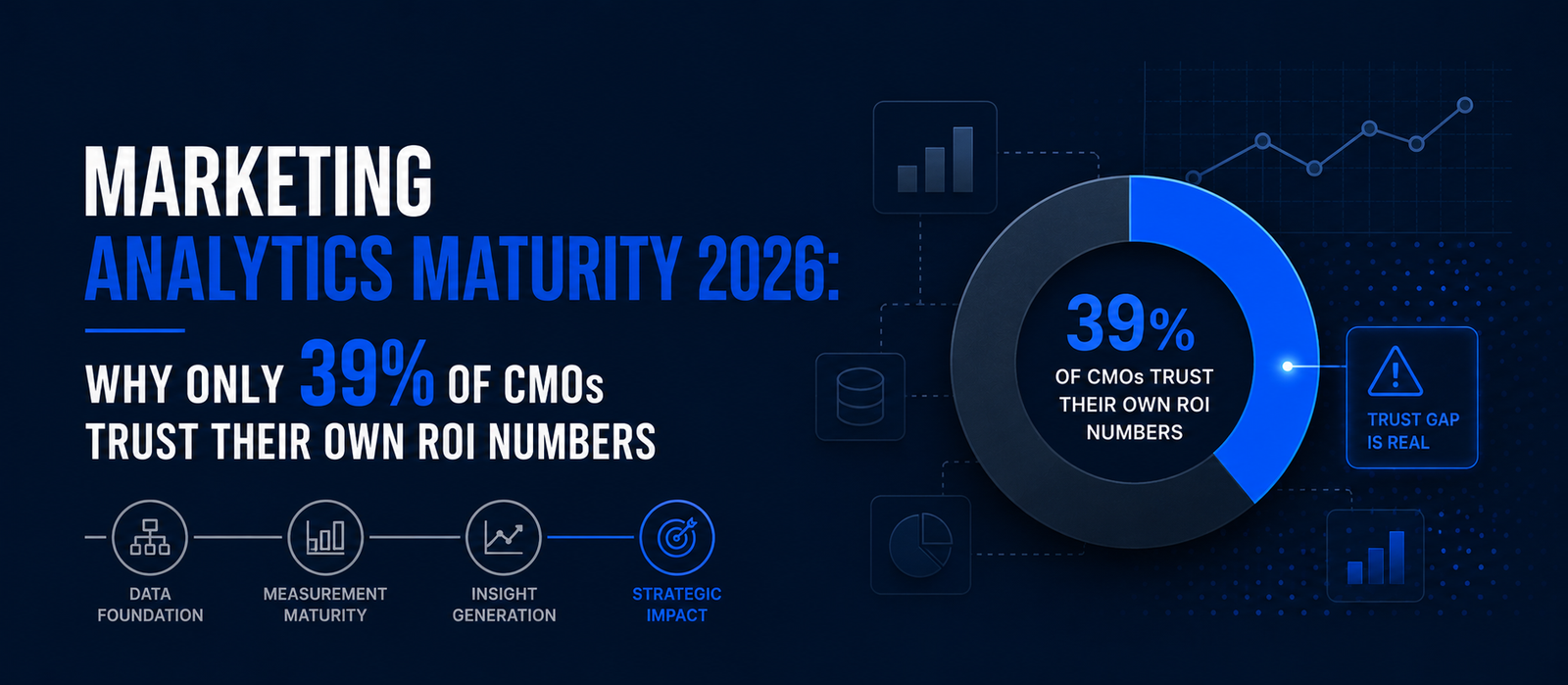
Only 39%. That's the share of marketers who say they can accurately measure their overall marketing ROI, according to a 2026 compilation of marketing analytics research from Digital Applied. Pair that with Gartner's finding that just 52% of senior marketing leaders can prove marketing's value to the C-suite at all, and a hard truth comes into focus: most CMOs are reporting numbers they wouldn't bet their job on. Marketing analytics maturity 2026 isn't a buzzword — it's the difference between a marketing org that gets more budget and one that gets audited.
Only 39% of marketers say they can accurately measure overall marketing ROI (Digital Applied, 2026), and just 52% of senior marketing leaders can prove marketing's value to leadership at all (Gartner, 2024). The root causes: fragmented data stacks, weak attribution, and unvalidated AI tools. Here's the data and a framework to fix it.
1. The Trust Gap: What Marketing Analytics Maturity Actually Measures
Marketing analytics maturity describes how far an organization has moved from gut-feel reporting toward measurement it can defend in a board meeting — and in 2026, most companies are stuck somewhere in the middle. The gap isn't about ambition; CMOs know ROI matters more than ever, they just don't have the infrastructure or confidence to prove it consistently.
The Numbers Behind the Skepticism
Gartner's 2024 Marketing Data and Analytics Survey, fielded across 378 senior marketing leaders in April-May 2024 alongside a separate survey of 395 CMOs, found that only 52% of respondents successfully proved marketing's value and received credit for its contribution to business outcomes. That means nearly half walked into a budget conversation unable to make their case. The skepticism runs both ways: the same research found CEOs (39%) and CFOs (40%) rank among the executives most doubtful that marketing drives real business results, and 47% of CMOs admit marketing is still viewed internally as an expense rather than a strategic investment.
Why "Measuring ROI" and "Trusting the Number" Aren't the Same Thing
If a CMO has a dashboard, why don't they trust it? Because a dashboard reporting a number isn't the same as a CMO believing that number would survive scrutiny. NIQ's 2026 CMO Outlook, surveying more than 250 CMOs and senior marketing decision-makers across 14 countries, found 84% now treat ROI as their primary metric for allocating budget — yet only 37% have a centralized, easily accessible data repository for that same reporting. When the underlying data lives in a dozen disconnected systems, the ROI figure on the slide is a best guess dressed up as a fact.
Pro Tip: Before presenting an ROI number to leadership, ask your team to name every data source that fed it. If nobody can list all of them without checking, the number is a synthesis of guesses, not a measurement.
2. Why CMOs Don't Trust Their Own ROI Numbers
The distrust isn't paranoia — it's a rational response to how marketing ROI actually gets calculated at most companies. Three structural problems show up repeatedly across 2026 research: fragmented data infrastructure, weak attribution modeling, and AI tools layered on top of both without anyone validating what they output.
Fragmented Data, Fragmented Confidence
NIQ's 2026 research found 54% of CMOs cite connecting data from different sources as a major barrier to generating any usable insight, and a third of organizations rely on 5 to 15 separate tools just to measure ROI, with some using more than 15. Every extra tool in that chain is another place for definitions to drift — one platform's "conversion" isn't another platform's "conversion," and by the time the numbers get blended into one report, nobody can say with certainty what's actually being counted.
The Attribution Blind Spot
Multi-touch attribution was supposed to solve this, but most implementations aren't trusted by the very teams that built them. Consider a mid-sized B2B SaaS company running paid search, LinkedIn ads, email nurture, and a content program simultaneously: without a shared identity layer connecting those channels, its attribution model can only guess at which touchpoint actually closed the deal, and the marketing team knows it. That's the pattern behind Gartner's finding that CMOs using two or more sophisticated performance metrics were up to 1.8 times more likely to successfully prove marketing's value than those relying on a single simplistic number — complexity done right builds trust, but complexity done badly just multiplies the places a number can be wrong.
Pro Tip: Run a "definitions audit" once a quarter — pull the metric definitions from every platform feeding your ROI report and confirm they still match. Silent definition drift is one of the most common causes of numbers that quietly stop being trustworthy.
3. The Data Infrastructure Problem Behind the Trust Gap
Even CMOs who want to fix their measurement often discover the real blocker isn't strategy, it's plumbing. Marketing analytics maturity 2026 research consistently points to the same root issue: data infrastructure built for reporting speed, not reporting accuracy, and AI tools bolted onto that shaky foundation.
Data Silos Are Still the Default, Not the Exception
Despite years of martech investment, NIQ found only 37% of CMOs have a centralized data repository accessible to all stakeholders — meaning nearly two-thirds are still assembling ROI reports by hand-stitching exports from separate platforms. Gartner's 2026 CMO Spend Survey of 401 CMOs adds another layer to the problem: even as CMOs now allocate 15.3% of their marketing budget to AI, only 30% report their organization's AI readiness as mature or fully developed, and 56% say they lack sufficient budget to execute their 2026 strategy at all. Companies are buying more measurement and AI tooling without fixing the foundation those tools sit on.
AI Is Making the Trust Problem Worse, Not Better
Doesn't AI-powered analytics fix the accuracy problem? Not automatically — it often hides it. When an AI attribution model outputs a number, few teams have the process to independently validate whether that number is right, so an inaccurate figure produced by an algorithm can look more authoritative than one a human built by hand, even when it's wrong in the same ways. This isn't a new problem: Adverity's 2021 global survey of 964 marketers, analysts, and executives across the US, UK, and Germany already found 34% of CMOs didn't fully trust their own marketing data — long before generative AI tools added another unvalidated layer on top of the pipeline.
Pro Tip: Treat any AI-generated attribution or forecasting number the same way you'd treat a junior analyst's first draft — spot-check it against a manual calculation on a sample of campaigns before it goes into a board deck.
4. Building Real Marketing Analytics Maturity: A Framework for 2026
Closing the trust gap doesn't require ripping out every tool in the stack — it requires a deliberate, staged process for making the numbers defensible again. The framework below is built directly around the root causes identified above: fragmented data, unclear attribution, and unvalidated tooling.
Marketing Analytics Maturity Levels: A Quick Comparison
| Maturity Level | Data Infrastructure | ROI Confidence | Typical CMO Behavior |
|---|---|---|---|
| Level 1: Ad Hoc | Manual exports, spreadsheets | Low — numbers questioned internally | Reports vanity metrics to avoid scrutiny |
| Level 2: Consolidated | Centralized dashboard, some silos remain | Moderate — directional trust only | Presents ranges instead of precise figures |
| Level 3: Validated | Centralized data repository, defined metrics, spot-checked AI outputs | High — numbers survive C-suite questioning | Uses ROI as the primary budget-allocation metric with confidence |
A 5-Step Process to Build Marketing Analytics Maturity
- Inventory every tool feeding your ROI number — NIQ found some organizations use more than 15 separate systems just for this calculation, and you can't fix what you haven't mapped.
- Standardize metric definitions across platforms before touching attribution modeling, since mismatched definitions upstream guarantee an untrustworthy number downstream.
- Build or buy a centralized data repository — only 37% of CMOs currently have one, according to NIQ's 2026 research, making this the single highest-leverage infrastructure investment available.
- Pair every AI-generated metric with a manual validation step on a rotating sample of campaigns, so errors get caught before they reach leadership.
- Report a confidence range alongside the headline ROI number when full validation isn't yet possible — a defensible range builds more trust than a precise number nobody can back up.
Pro Tip: Don't wait for a "perfect" data stack before reporting ROI with confidence — start by validating your three highest-spend channels first, since that's where a wrong number does the most budget damage.
Summary
The data across Gartner, NIQ, Adverity, and Digital Applied's 2026 research all points to the same conclusion: the CMO trust gap isn't a confidence problem, it's an infrastructure problem wearing a confidence problem's clothes. Fragmented tools, drifting metric definitions, and unvalidated AI outputs are the real reasons only a minority of marketing leaders can stand behind their own ROI figures, and marketing analytics maturity 2026 is ultimately a measure of how deliberately an organization has fixed those root causes rather than how much martech it has bought.
Key Takeaways
- Only 39% of marketers say they can accurately measure overall marketing ROI (source: Digital Applied, 2026 marketing analytics research compilation).
- Just 52% of senior marketing leaders can prove marketing's value and receive credit for it from the C-suite (source: Gartner 2024 Marketing Data and Analytics Survey, n=378).
- 84% of CMOs treat ROI as their primary budget-allocation metric, but only 37% have a centralized data repository to support that reporting (source: NIQ 2026 CMO Outlook, 250+ CMOs, 14 countries).
- 54% of CMOs cite connecting data from different sources as a major barrier to generating insight, and some organizations use more than 15 tools just to measure ROI (source: NIQ 2026 CMO Outlook).
- Only 30% of CMOs report their organization's AI readiness as mature, even as AI now takes 15.3% of the average marketing budget (source: Gartner 2026 CMO Spend Survey, n=401).
- 34% of CMOs already said they didn't fully trust their own marketing data back in 2021, showing this gap predates the current AI wave (source: Adverity, 2021 global survey, n=964).
If your team can't say with confidence where your last dollar of marketing spend actually went, talk to Cross Globe Marketing about a marketing analytics maturity audit before your next budget review.
Quick Summary
Marketing analytics maturity 2026 remains low across most organizations because only 39% of marketers can accurately measure overall marketing ROI (Digital Applied, 2026), and just 52% of senior marketing leaders can prove marketing's value to the C-suite at all (Gartner, 2024). The root causes are structural rather than a lack of effort: 84% of CMOs rely on ROI as their top budget metric while only 37% have a centralized data repository to support it, and a third of organizations stitch together more than 15 separate tools just to produce that number (NIQ, 2026). Layering unvalidated AI attribution on top of this fragmented foundation, as only 30% of CMOs report mature AI readiness, compounds rather than resolves the trust gap (Gartner 2026 CMO Spend Survey).