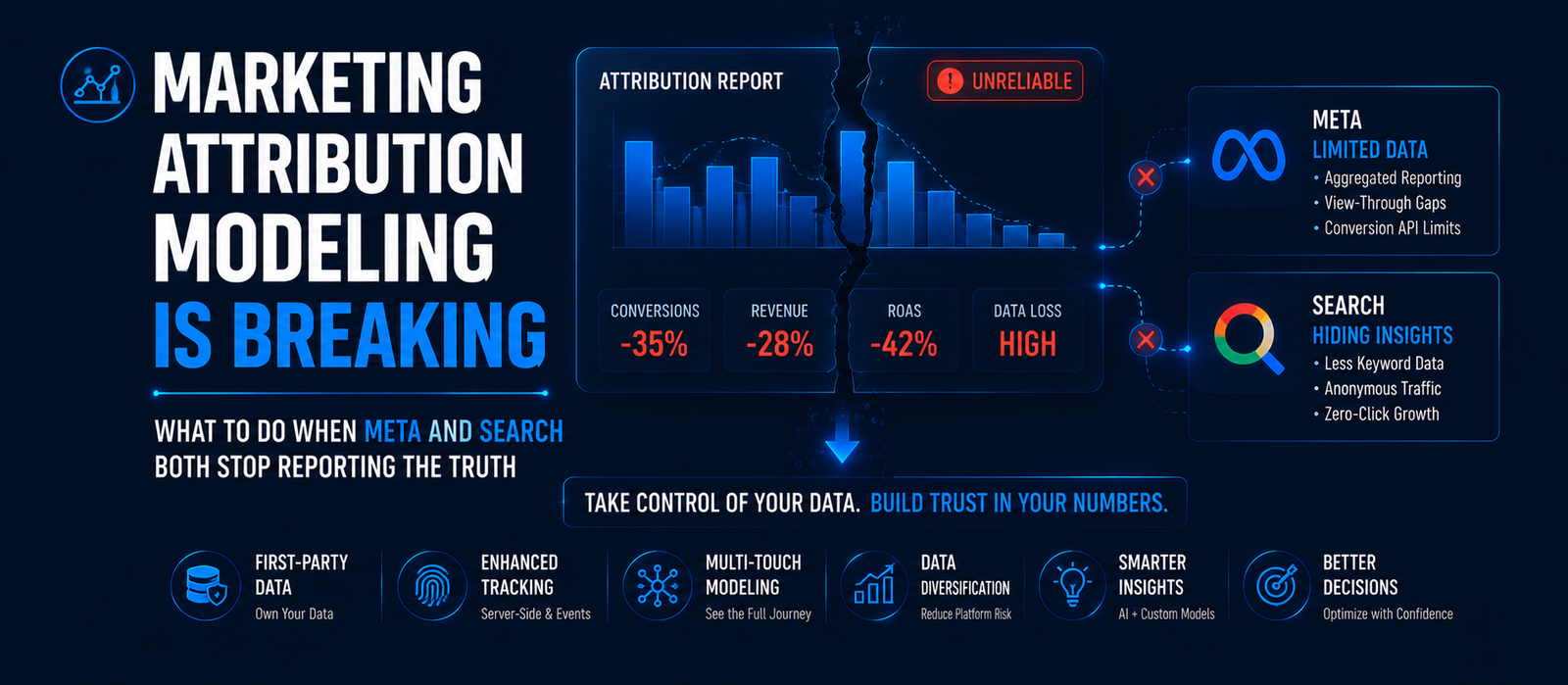
Two of the biggest inputs into your marketing attribution modeling just changed at the same time, and almost nobody adjusted their dashboards for it. In January 2026, Meta permanently removed its 7-day and 28-day view-through attribution windows, leaving a maximum one-day view window where advertisers used to get a month. Two months later, Meta narrowed the definition of a "click" itself. Meanwhile, roughly 68% of Google searches now end without any click at all, according to a 2026 SparkToro and Similarweb study. If your attribution model still trusts platform-reported conversions at face value, it's now measuring noise, not performance.
Meta cut its view-through window to one day and redefined "click" in 2026, while 68% of searches end zero-click. Platform-reported attribution is now structurally unreliable — marketing attribution modeling needs to shift toward multi-touch models, incrementality testing, and brand-level metrics.
1. Why Marketing Attribution Modeling Is Under Pressure Right Now
Two independent shifts collided in the same year, and each one alone would have been disruptive. Together, they've made single-platform, click-based attribution close to meaningless for a large share of advertisers, especially those running awareness or upper-funnel campaigns on Meta while also publishing organic content.
What Changed in Meta's Attribution Windows
On January 12, 2026, Meta removed the 7-day and 28-day view-through attribution windows from Ads Manager and the Ads Insights API, according to reporting from Jon Loomer Digital and Dataslayer. The default attribution window is now 7-day click plus 1-day view. Advertisers who relied on longer view-through windows to justify awareness and video spend reportedly saw recorded conversions drop by 15% to 40%, per the same reporting — with no actual change in sales or delivery. Then, on March 3, 2026, Meta redefined "click-through" to require an actual link click to a website, app, lead form, or shop; likes, shares, saves, comments, and video views were moved into a new one-day "engage-through" category, further shrinking reported click conversions.
How Zero-Click Search Compounds the Problem
At the same time, organic and paid search attribution is facing its own collapse. A 2026 SparkToro and Similarweb study found 68.01% of US Google searches ended without a click in the first four months of the year, up from 60.45% in 2024. That means a growing share of your brand's discovery happens through AI Overviews, featured snippets, and impressions your attribution tool never logs as a touchpoint, because there was no click to log. A regional e-commerce brand is a useful working example here: teams that saw Meta ROAS drop and organic clicks flatten in the same quarter often assume performance declined, when in reality both platforms simply stopped reporting activity that still happened.
Pro Tip: Before reacting to a sudden ROAS or conversion drop, check whether it coincides with a platform attribution-window or click-definition change before assuming your creative or targeting failed.
2. The Core Marketing Attribution Models You're Choosing Between
Every marketing attribution modeling decision starts with picking how credit gets assigned across touchpoints, and this choice matters more now that individual platforms can't be trusted to report their own contribution accurately. Single-touch models are fastest to set up but most exposed to the platform-level distortions described above.
Single-Touch vs. Multi-Touch Attribution
First-touch attribution gives 100% of credit to the first interaction a customer had with your brand, while last-touch attribution gives all credit to the final touchpoint before conversion. Multi-touch attribution — including linear, U-shaped, and time-decay variants — splits credit across multiple touchpoints in the customer journey, which is more resilient when any single platform's tracking degrades.
Which Attribution Model Should Small Businesses Use?
Smaller teams without dedicated analytics resources often start with last-touch because it's simple, but that simplicity is exactly what makes it most vulnerable to Meta's shortened view window and zero-click search — both remove "touches" from the recorded journey. A linear or U-shaped multi-touch model, even a lightweight spreadsheet version, captures more of the real path and is less distorted when one platform's data goes dark.
| Model | Credit Assignment | Best Fit | Biggest Risk in 2026 |
|---|---|---|---|
| First-Touch | 100% to first interaction | Brand awareness measurement | Misses late-funnel platform changes |
| Last-Touch | 100% to final interaction | Simple, fast-moving teams | Most exposed to Meta's shorter view window |
| Linear (Multi-Touch) | Equal credit across touchpoints | Longer B2B sales cycles | Requires more data sources to populate |
| U-Shaped (Multi-Touch) | 40% first, 40% last, 20% middle | Balancing awareness and conversion | Needs consistent cross-channel tracking |
| Time-Decay | More credit to recent touches | Short sales cycles, promotions | Still undercounts zero-click discovery |
Pro Tip: Run your current attribution model alongside one alternative model for a full quarter before switching — a side-by-side comparison shows you exactly how much credit shifts and where.
3. Build an Attribution Stack That Survives Platform Changes
The practical fix isn't picking one perfect model; it's building a stack that doesn't collapse when any single platform changes its rules again, which — given two changes from Meta in one year — should now be treated as a recurring risk, not a one-time event.
A 5-Step Process to Rebuild Your Attribution Stack
- Export at least 12 months of historical platform data before older attribution windows disappear entirely from reporting tools.
- Layer in a first-party analytics source (server-side tracking or a CDP) that isn't dependent on any single ad platform's definitions.
- Set up UTM-based tracking consistently across every campaign, including organic and email, so multi-touch models have complete data.
- Reconcile platform-reported conversions against your own CRM or e-commerce backend monthly, not quarterly.
- Document every platform attribution-window or click-definition change in a shared log so future dips are diagnosed correctly.
Do I Still Need Third-Party Attribution Tools?
Yes, increasingly so. First-party, server-side tracking and CDPs reduce dependence on any one platform's internal attribution logic, which matters directly given how much Meta's definitions shifted in a single year. Even a lightweight setup — UTM discipline plus a shared CRM reconciliation habit — meaningfully reduces exposure to the next platform change.
Pro Tip: Set a recurring calendar reminder to check Meta's, Google's, and TikTok's attribution documentation quarterly — these platforms now change definitions with far less warning than they used to.
4. Redefine What You Measure: Incrementality Over Platform-Reported Numbers
The deepest fix isn't a model at all — it's accepting that platform-reported conversions were never a perfect measure of causation, and treating that as more urgent now that the gap between reported and real performance has widened.
Incrementality Testing as the New Standard
Incrementality testing — running geo-holdouts, matched-market tests, or platform-native conversion lift studies — measures what actually happened because of your spend, independent of how any single platform chooses to attribute clicks or views. According to a 2025 LayerFive analysis, up to 47% of marketing spend, representing more than $66 billion annually, is lost to fragmented data and attribution gaps across the industry. Incrementality testing is one of the few methods that sidesteps platform self-reporting entirely.
What Metrics Fill the Gap Left by Broken Attribution?
Track branded search volume, direct traffic trends, and holdout-test lift alongside — not instead of — platform dashboards. These metrics move slowly and can't be inflated or deflated by a single attribution-window change the way platform-reported conversions can.
Pro Tip: Run a simple geo-holdout test (pause spend in a few comparable markets for two to four weeks) at least once a year to sanity-check what your attribution model is telling you against real incremental lift.
Marketing attribution modeling in 2026 has to assume the platforms themselves are moving targets — the fix is a layered measurement approach, not a single perfect model.
Summary
Meta's attribution-window cuts and the rise of zero-click search aren't two unrelated headaches; they're the same underlying problem showing up in two different channels — platforms and search engines are both reporting fewer of the touchpoints that actually influence a purchase. Marketing attribution modeling that depends entirely on any one platform's self-reported numbers will keep producing confusing, contradictory results until measurement is rebuilt around first-party data, multi-touch credit, and incrementality testing.
Key Takeaways
- Meta removed its 7-day and 28-day view-through attribution windows on January 12, 2026, leaving a maximum one-day view window (Jon Loomer Digital, Dataslayer).
- Reported conversions fell 15-40% for view-reliant advertisers after Meta's window cuts, with no actual change in sales (Dataslayer, 2026).
- On March 3, 2026, Meta redefined "click-through" to require an actual link click, moving likes, shares, saves, and video views into a shorter "engage-through" category (Dataslayer, 2026).
- 68.01% of US Google searches ended without a click in early 2026, up from 60.45% in 2024 (SparkToro/Similarweb via Search Engine Land).
- Up to 47% of marketing spend — more than $66 billion annually — is lost to fragmented data and attribution gaps (LayerFive, 2025).
- Multi-touch models, first-party tracking, and incrementality testing are now baseline requirements, not advanced tactics, for accurate measurement.
Ready to rebuild a marketing attribution model that survives the next platform change? Cross Globe Marketing can audit your current tracking stack and design a multi-touch, incrementality-backed measurement plan built for 2026 and beyond.
Quick Summary
Marketing attribution modeling is breaking down because Meta's removal of its 7-day and 28-day view-through attribution windows and the rise of zero-click search are the same underlying problem showing up in two channels: platforms and search engines are both reporting fewer of the touchpoints that actually influence a purchase. Attribution that depends entirely on any one platform's self-reported numbers will keep producing confusing, contradictory results. The fix is rebuilding measurement around first-party data, multi-touch credit, and incrementality testing rather than platform-reported attribution alone.