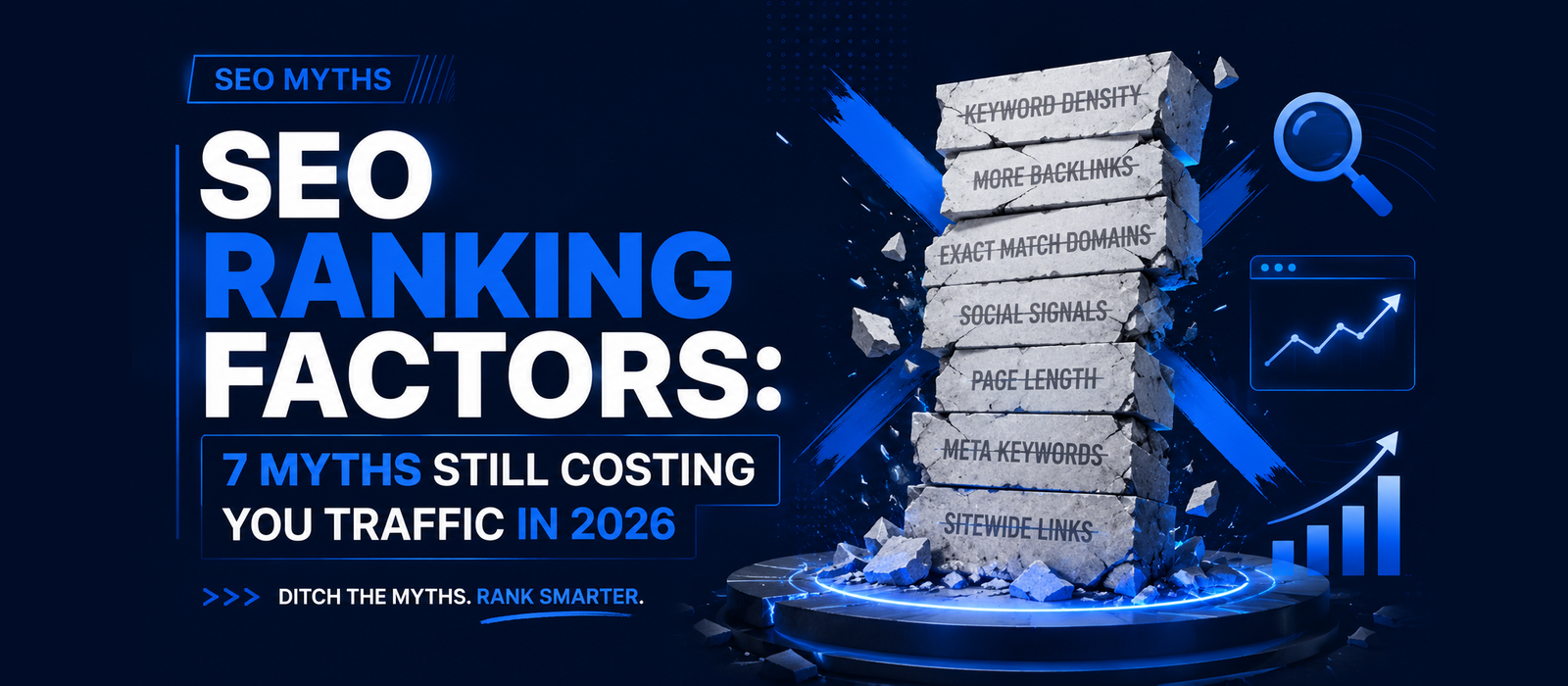
Google has confirmed only a handful of SEO ranking factors directly — backlinks, content quality, and Core Web Vitals among them — yet outdated myths like keyword density and meta-keyword tags still drive real strategy decisions. This post separates what Google has actually said from what the industry just assumes, with a data-backed fix for each myth.
Google has never published a complete list of its SEO ranking factors — and that gap gets filled with guesswork, recycled blog advice, and outright myth. Some of it was true a decade ago. Some was never true at all. If your content strategy still leans on keyword density counts or meta-keyword tags, you're optimizing for a search engine that stopped existing years ago.
Backlinks and content quality remain confirmed top-tier SEO ranking factors — Google said so directly in 2016. Keyword stuffing, meta keywords, and raw social share counts are not ranking signals. Core Web Vitals and E-E-A-T matter, but as supporting signals, not silver bullets. Fix the myths below before you touch your budget.
1. What Google Has Actually Confirmed About SEO Ranking Factors
Most "ranking factor" lists you'll find online are industry estimates, not official Google statements. That distinction matters more than most guides admit.
The One Confirmed Statement Worth Building a Strategy On
In 2016, Google's Andrey Lipattsev, then a Senior Search Quality Strategist, publicly stated that backlinks and content quality were the top two ranking factors in Google's algorithm. This is one of the few times Google has directly confirmed specific ranking signals rather than leaving the SEO industry to reverse-engineer them.
Why "200 Ranking Factors" Is an Estimate, Not a Fact
You'll see the figure "200 ranking factors" repeated across nearly every SEO blog. It traces back to industry aggregation (Backlinko and others), not an official Google count. Google has acknowledged its algorithm weighs a large number of signals, but it has never published an exact, verified figure — treat "200" as a widely cited estimate, not a confirmed statistic.
Pro Tip: When a claim about ranking factors doesn't cite a named source, assume it's industry folklore until proven otherwise. Ask "says who?" before you rebuild a page around it.
2. Myth: Keyword Density Determines Your Ranking
This is the oldest SEO myth still in circulation, and it's directly responsible for the unreadable, stuffed content that plagued the 2010s web.
Why Keyword Stuffing Backfires Today
Google's language models evaluate topical relevance and semantic coverage, not raw keyword repetition. Cramming "SEO ranking factors" into every other sentence doesn't boost relevance — it degrades readability, which hurts the user signals Google *does* weigh.
What Actually Replaced It
Comprehensive topic coverage. Backlinko's analysis of 11.8 million Google search results found that content with high topical relevance and depth — measured via Clearscope's content grading — significantly outperformed thinner content covering the same keyword. Write for the full scope of a question, not a keyword count.
Real-world example: A local plumbing site rewrote a service page from a 300-word, keyword-stuffed block to an 1,100-word guide answering the actual questions customers search for. No keyword density target was used — coverage of subtopics (pricing, timelines, licensing) was the goal.
Pro Tip: Run your target page through a topic-coverage tool (Clearscope, Surfer, or even a manual competitor gap check) instead of a keyword-density checker. Once you're covering the subtopics the top pages cover, density stops mattering.
3. Myth: Backlink Quantity Beats Backlink Quality
Backlinks remain one of the most powerful SEO ranking factors — but "more links" isn't the same as "better links."
The Data on Link Authority
Backlinko's study of 11.8 million search results found that the #1 Google result had, on average, 3.8x more backlinks than results ranking #2 through #10. That's a real, measurable correlation between link authority and top rankings — but correlation isn't the same as "buy more links."
Quality Signals That Matter More Than Volume
- Relevance of the linking domain's topic to your content
- Editorial context — is the link earned inside real content, or dropped in a footer?
- Domain trust and authority of the linking site
- Natural anchor text variation, not exact-match repetition
Pro Tip: A single link from a topically relevant, high-authority site typically outweighs dozens of low-quality directory links. Prioritize relevance over raw count.
4. Myth: Meta Keywords and Social Shares Move Rankings
Two zombie myths that refuse to die, even though both have been publicly addressed for years.
Meta Keywords Are Dead
The meta keywords tag has not been used as a Google ranking signal for well over a decade. If your CMS still has a "meta keywords" field, filling it out has no direct effect on rankings — focus that time on your meta title and meta description instead, which influence click-through rate.
Social Signals: Indirect, Not Direct
Likes, shares, and retweets are not confirmed direct SEO ranking factors. They can indirectly help — a widely shared piece of content is more likely to earn organic backlinks and brand searches, both of which *do* correlate with rankings — but the shares themselves aren't a ranking input Google has confirmed using.
Pro Tip: If your CMS still shows a "meta keywords" field, ignore it — don't waste time filling it out. Redirect that effort into tightening your meta title and description instead, which actually move click-through rate.
5. A Practical Process for Auditing Your Real Ranking Factors
Instead of chasing myths, run this process against pages that aren't performing:
- Check content depth — does the page answer the full scope of the query, not just the primary keyword?
- Audit your backlink profile — are your links topically relevant, or just numerous?
- Review Core Web Vitals — page experience is a confirmed (if lighter-weight) signal.
- Verify E-E-A-T signals — author bios, sourcing, and demonstrated expertise, especially for YMYL topics.
- Confirm technical crawlability — indexation issues silently kill otherwise strong content.
- Compare against top-ranking competitors — what do they cover that you don't?
- Re-test after 4–6 weeks — ranking changes from content updates aren't instant.
Pro Tip: Run this checklist against your 5 worst-performing pages before your best ones. Underperformers reveal which ranking-factor myth is actually costing you traffic faster than auditing pages that already work.
6. Myth vs. Reality: A Quick Comparison
| SEO Practice | Myth Status | What's Actually True |
|---|---|---|
| Keyword density targets | Myth | Topical depth and relevance matter more than repetition |
| Meta keywords tag | Myth | No ranking effect since long-deprecated by Google |
| Social share counts | Partial myth | Indirect influence only, not a confirmed direct signal |
| Backlink quantity alone | Partial myth | Quality and relevance outweigh raw volume |
| Backlink authority | Confirmed | Google has directly confirmed this as a top factor |
| Content quality | Confirmed | Confirmed by Google as a top-two ranking factor |
| Core Web Vitals | Confirmed (lighter weight) | Real signal, but not a dominant one on its own |
Micro-CTA: Not sure which myths are quietly hurting your pages? Cross Globe Marketing can run a full ranking-factor audit on your site.
Pro Tip: Bookmark this table. When a client or teammate cites a "ranking factor" you don't recognize, check it against this list before spending budget chasing it.
7. Where This Leaves Your 2026 SEO Strategy
The honest answer is uncomfortable for anyone wanting a checklist: Google has confirmed very few specific SEO ranking factors directly, and most "definitive" lists online are industry estimates dressed up as fact. The two you can build a strategy on with real confidence — backlink authority and content quality — were confirmed by Google itself in 2016 and remain consistent with more recent large-scale studies like Backlinko's 11.8-million-result analysis.
Key Takeaways:
- Backlinks and content quality are Google-confirmed top ranking factors
- Keyword density and meta keywords have no direct ranking effect
- Social shares are indirect, not confirmed direct signals
- Backlink relevance and authority beat raw backlink count
- Treat "200 ranking factors" as an industry estimate, not an official figure
If your current strategy is built on myths rather than confirmed signals, the fastest fix isn't more content — it's an audit of what's actually holding your pages back. Talk to Cross Globe Marketing about a ranking-factor audit for your site.
Pro Tip: Re-run this audit every 6–12 months. Google's confirmed signals rarely change, but the myths circulating around them do — and so does what your competitors are doing about it.
Quick Summary
SEO ranking factors most sites still get wrong: backlinks and content quality are the only factors Google has directly confirmed as top-tier signals, consistent with both Google's own 2016 statement and large-scale studies like Backlinko's 11.8-million-result analysis. Keyword density and the meta keywords tag have no direct ranking effect, social shares are an indirect signal at best, and backlink relevance/authority beats raw backlink count. The often-cited "200 ranking factors" figure is an industry estimate, not an official Google number, and should be treated as approximate.