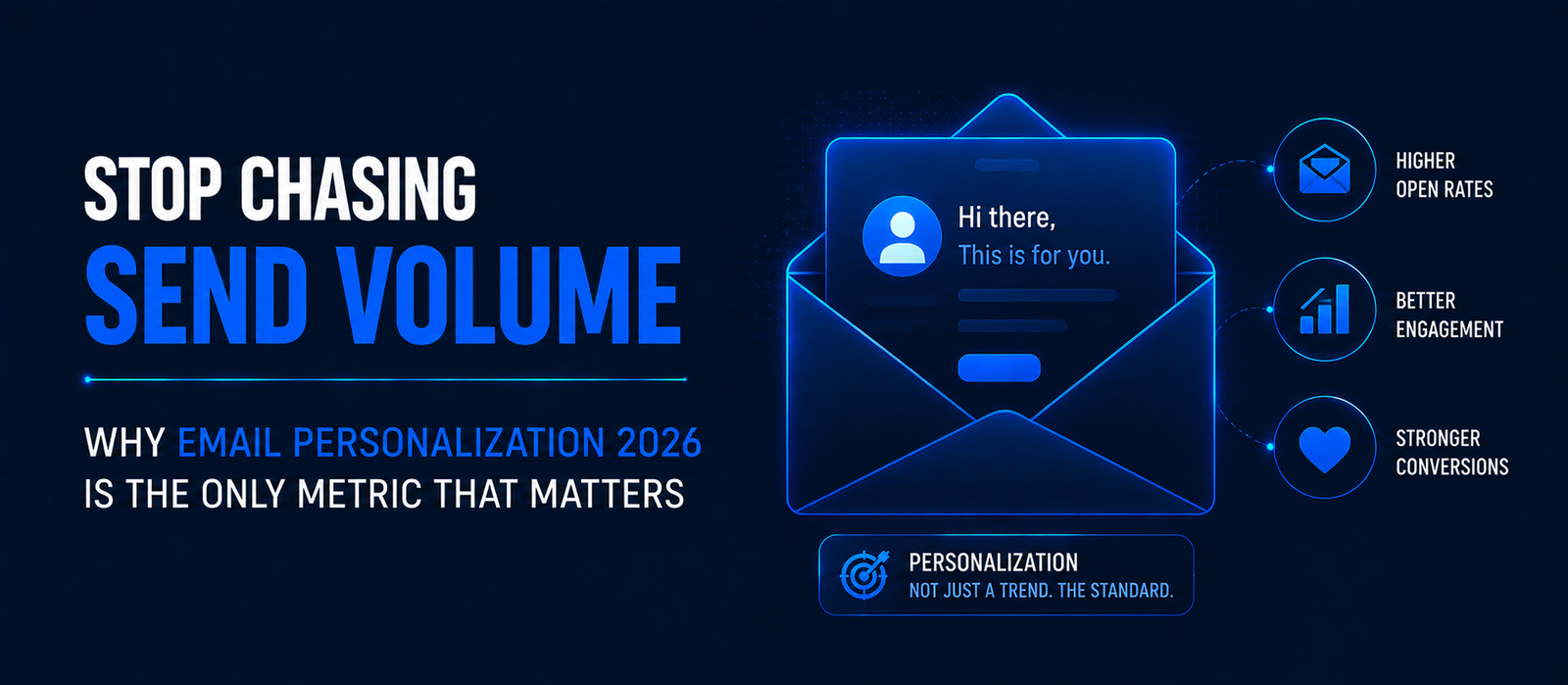
A marketer can now send 50,000 emails in an afternoon — and land in fewer real inboxes than a colleague who sent 500. That isn't a typo. It's what happens when email personalization 2026 standards collide with engagement-based spam filtering at Gmail, Yahoo, and Outlook. Volume used to be the lever that moved email revenue. In 2026, relevance is the only lever left that still works.
Blast sending is dying. Gmail and Yahoo now filter mail on engagement, not volume, so unopened blasts hurt deliverability more than they help reach. Personalized, behavior-triggered email drives up to 760% more revenue (Campaign Monitor) and up to 18x higher conversion (Epsilon). The fix: fewer, smarter sends built on real signals.
1. The Send-Volume Era Is Over: What Broke Inbox Placement in 2026
For over a decade, email marketing rewarded whoever hit "send" the most often. That math stopped working once Gmail and Yahoo formalized engagement-based filtering — treating ignored or deleted mail as a negative reputation signal instead of a neutral one. A mailbox that pushes volume without relevance now actively trains the inbox provider to hide it, which is the opposite of what the sender wanted.
Engagement-Based Filtering Rewired the Rules
Since Google and Yahoo's 2024 bulk-sender requirements took full effect, senders must keep spam complaint rates under 0.3%, and both providers weight opens, replies, and manual "not spam" actions heavily in placement decisions. Crossing that threshold — or sustaining low engagement over time — pushes mail to spam regardless of how clean your authentication setup is.
- Sender reputation now behaves like a credit score: it rises slowly and falls fast.
- Engagement signals (opens, clicks, replies, delete-without-open) outweigh raw list size.
- Authentication (SPF, DKIM, DMARC) is table stakes, not a ranking advantage on its own.
The Cost of "Batch and Blast" in Numbers
A common pattern shows up across e-commerce and SaaS accounts alike: a team doubles monthly send volume to hit a revenue target, watches short-term clicks tick up, then sees inbox placement quietly erode over the following quarter as complaint rates drift toward that 0.3% ceiling. This is happening more often as more senders lean on generative AI to produce copy faster than they can earn attention — Litmus' State of Email research found the majority of marketers now expect AI to handle up to half of their email operations by 2026, which raises volume faster than it raises relevance.
Pro Tip: Audit your spam complaint rate and unique open rate by ISP (Gmail, Yahoo, Outlook) monthly — a single provider trending toward the 0.3% complaint ceiling is enough to tank overall deliverability, even if your other metrics look fine.
2. What "Personal Relevance" Actually Means (Beyond First-Name Tags)
Personalization got reduced to inserting a first-name token into a subject line, and marketers wonder why it stopped moving the needle. Real personal relevance in 2026 means matching message, timing, and offer to what a specific subscriber has actually done — not what a segment label assumes they'll do. That shift changes both the content and the infrastructure behind every send.
Behavioral Personalization vs. Cosmetic Personalization
Cosmetic personalization (name, city, company) still ships by default in most ESPs, and it does move open rates — personalized subject lines see roughly 25% higher open rates and nearly 18% higher click-through rates than generic sends, according to AWeber benchmark data. But cosmetic tags don't fix the deeper problem: sending the same dozen campaigns a month to everyone on the list regardless of what they've actually engaged with.
The Data Stack Relevance Requires
Behavioral relevance depends on signals most lists don't currently track well:
- Purchase or conversion history, not just contact info.
- On-site browse behavior tied back to the email profile.
- Email engagement recency (last open, last click).
- Lifecycle stage (new lead, active customer, lapsed).
- Channel and frequency preference, where available.
Pro Tip: Build a single "engagement recency" field before adding anything else — it predicts inbox placement risk more reliably than any demographic attribute you're likely to have.
3. The Business Case: Relevance vs. Volume, Side by Side
Personalized, segmented, behavior-triggered campaigns generate up to 760% more revenue than one-size-fits-all blasts, according to Campaign Monitor benchmark data, and personalized emails are cited as being up to 18 times more likely to convert than generic sends in a widely referenced Epsilon study. The gap isn't cosmetic — it shows up in both revenue per send and cost per acquisition, and it compounds as volume-first senders lose inbox placement.
Revenue and Conversion Impact
| Metric | Volume-First Blast | Relevance-First Personalization |
|---|---|---|
| Revenue lift | Baseline | Up to 760% higher (Campaign Monitor) |
| Conversion rate | Baseline | Up to 18x higher (Epsilon) |
| Open rate | Baseline | ~25% higher on personalized subject lines (AWeber) |
| Spam complaint risk | Rises with volume | Falls as relevance increases |
Deliverability and Sender Reputation Impact
The table above understates the real cost of volume-first sending, because a falling sender reputation doesn't just hurt one campaign — it suppresses inbox placement for every campaign that follows, including the personalized ones. Teams that cut volume and raise relevance typically see both metrics improve at once: fewer sends, higher opens, and a recovering reputation score.
Pro Tip: Track revenue per send, not just revenue per campaign — it's the metric that exposes whether volume is actually helping or just diluting your best-performing segments.
4. How to Build a Relevance-First Email Program
Shifting from volume to relevance is an operating-model change, not a copywriting tweak. It requires rebuilding segmentation logic, cutting dead weight from the list, and re-anchoring success metrics around engagement quality instead of send count. The sequence below is the same one used to audit a client's email program before a single subject line gets rewritten.
The 5-Step Framework
- Audit sender reputation and complaint rate by ISP using Google Postmaster Tools and Yahoo Sender Hub.
- Segment by engagement recency, not just demographics or purchase category.
- Build 3-5 behavior triggers (cart abandon, browse abandon, win-back) before adding new broadcast sends.
- Cut your list, don't just grow it — suppress 90+ day non-openers instead of re-mailing them.
- Re-test send frequency per segment monthly, since relevance windows shift as behavior changes.
Tools and Signals to Prioritize
Platforms like Klaviyo and HubSpot now expose engagement-recency fields natively, and Litmus and Google Postmaster Tools provide the reputation data needed to catch deliverability drift before it shows up in revenue. The goal isn't more tooling — it's fewer, better-targeted sends built on signals the platform already has.
Pro Tip: Run steps 1 and 4 together — cleaning the list before rebuilding segmentation prevents new automations from inheriting an already-damaged sender reputation.
Summary
The pattern across every section above is the same: inbox providers stopped rewarding reach and started rewarding relevance, and the data shows the gap between the two approaches is now too large to ignore. Teams that keep optimizing for send volume in 2026 are optimizing for a metric the inbox itself no longer respects.
Key Takeaways
- Gmail and Yahoo require spam complaint rates under 0.3% for bulk senders, and engagement now drives placement more than list size (Google/Yahoo 2024 bulk-sender requirements).
- Personalized, segmented campaigns can generate up to 760% more revenue than generic blasts (Campaign Monitor).
- Personalized emails are cited as up to 18x more likely to convert than non-personalized ones (Epsilon).
- Personalized subject lines see roughly 25% higher open rates and nearly 18% higher click-through rates (AWeber).
- A majority of marketers expect AI to handle up to half of their email operations by 2026, raising the risk of AI-generated volume outpacing relevance (Litmus State of Email).
- 97% of marketers now include at least one interactive or personalized element in their emails (Litmus State of Email).
Ready to rebuild your email program around email personalization 2026 instead of send volume? Cross Globe Marketing can audit your current sender reputation and segmentation in a single session — reach out to get started.
Quick Summary
Email personalization 2026 is the shift from send-volume-driven email marketing to relevance-driven email marketing, forced by Gmail and Yahoo's engagement-based filtering and their 0.3% spam-complaint threshold for bulk senders. Personalized, behavior-triggered campaigns generate up to 760% more revenue and up to 18x higher conversion than generic blasts, while cosmetic personalization alone (name tags) lifts open rates by roughly 25%. The recommended path is a 5-step framework: audit sender reputation by ISP, segment by engagement recency, build behavior triggers, suppress non-openers, and re-test frequency monthly — prioritizing fewer, more relevant sends over raw list size.