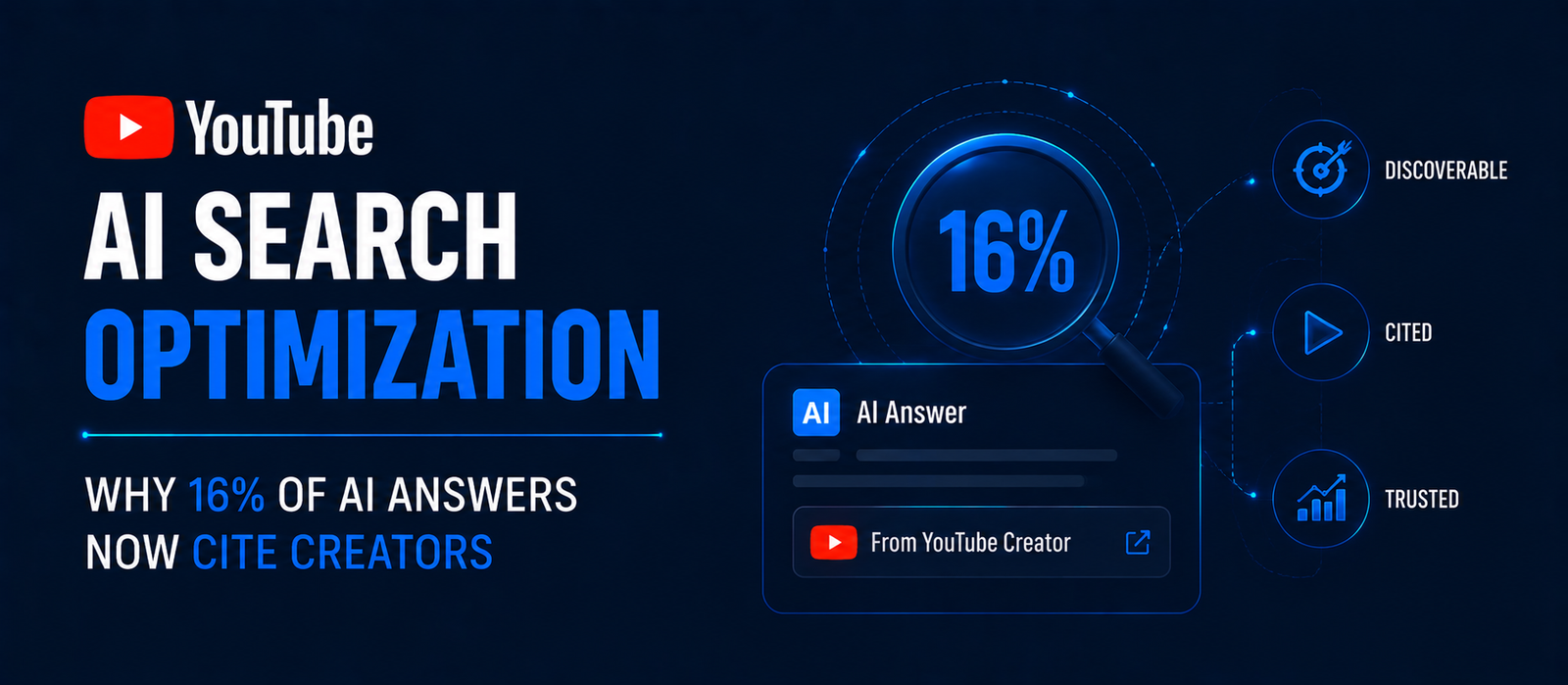
Ask ChatGPT, Perplexity, or Google's AI Overviews a question today, and there's a real chance the answer traces back to a video, not a blog post. According to a January 2026 Adweek investigation, YouTube now appears as a cited source in 16% of large language model answers — enough to overtake Reddit (10%) as the most-referenced social platform in AI-generated responses. For creators and marketers who spent a decade optimizing for Google's blue links, this is the new frontier: YouTube AI Search Optimization is becoming as important as traditional SEO, and most channels aren't structured for it yet.
YouTube now appears in 16% of AI answers, overtaking Reddit as the top-cited social platform (Adweek, 2026). Perplexity and Google AI Overviews drive most YouTube citations; ChatGPT and Gemini barely use it. Long-form, chaptered videos get cited — views and subscribers barely matter.
1. Why YouTube Suddenly Matters in AI Search
For years, AI models struggled to "read" video the way they read text, which kept YouTube out of most AI-generated answers even as the platform dominated human search behavior. That changed as transcripts, structured descriptions, and chapter markers turned videos into large, semantically dense text blocks that large language models can parse almost like a webpage.
The Reddit-to-YouTube Reversal
Bluefish's data, reported exclusively by Adweek, found YouTube cited in 16% of LLM answers over a recent six-month window, compared with 10% for Reddit — a reversal from earlier periods when Reddit dominated as the go-to social citation source. Separately, OtterlyAI's analysis of more than 100 million AI citations found YouTube accounts for 31.8% of all social-media-and-video citations, second only to Reddit's 46.4%, with the two platforms together representing 78.2% of social citations in AI search.
Why Can AI Models Suddenly Read Video Content?
Auto-generated transcripts, keyword-rich descriptions, and YouTube's native chapter system give AI crawlers something they can extract cleanly: a timestamped, text-anchored breakdown of what's in the video and where. That structural readability — not view count or channel size — is what's driving the shift, and it's why a video with a few hundred views can now outrank a viral one in AI citation terms.
As an illustrative example, a cooking channel that adds chapters like "Ingredients," "Prep," and "Bake Time" gives Google's AI Overviews a clean way to cite the exact segment a viewer needs, instead of summarizing an entire 20-minute video.
Pro Tip: Before writing a single new video script, add proper chapter timestamps to your five best-performing evergreen videos — it's the fastest way to make existing content machine-readable.
2. How Each AI Platform Actually Uses YouTube Differently
Treating "AI search" as one channel is a mistake — the six major AI platforms cite YouTube at wildly different rates, and a strategy built for one won't necessarily work on another. OtterlyAI's platform-level breakdown makes the gap explicit.
Where YouTube Citations Actually Come From
| AI Platform | Share of YouTube Citations | Behavior |
|---|---|---|
| Perplexity | 38.7% | Most YouTube-heavy platform; leans on external, link-based video sources |
| Google AI Overviews | 36.6% | Treats YouTube as a core citation layer |
| Google AI Mode | 19.6% | More selective, less video-reliant than AI Overviews |
| ChatGPT | 4.4% | Rarely surfaces YouTube as a source |
| Microsoft Copilot | 0.5% | Prioritizes LinkedIn instead |
| Gemini | 0.2% | Near-zero YouTube citation volume |
*(Source: OtterlyAI, YouTube Citation Study 2026, based on 100M+ AI citations)*
Does ChatGPT Cite YouTube at All?
Rarely. ChatGPT and Perplexity both default to Reddit as their top social source (53.6%–62.8% of social citations), with YouTube taking a smaller 9.5% share inside ChatGPT specifically but a much larger 22.7% share inside Perplexity. If your audience mostly uses ChatGPT, YouTube optimization alone won't move the needle — you'd need to pair it with Reddit and on-site authority signals.
For example, imagine two SaaS companies publishing the same comparison video: the one whose audience searches primarily on Perplexity or Google AI Overviews is far more likely to see that video cited than the one whose audience lives in ChatGPT, simply because of how each platform sources its answers.
Pro Tip: Check which AI platforms your audience actually uses (via referral data or direct surveys) before investing heavily in YouTube-specific GEO — the payoff varies enormously by platform.
3. What Makes a Video Get Cited by AI Search Engines
Not every YouTube video has equal odds of getting cited, and the deciding factors aren't what most creators assume. OtterlyAI's correlation analysis found that popularity metrics — views, likes, subscribers, channel size — show close to zero relationship with how often a cited video gets cited again.
Long-Form Beats Shorts by a Landslide
94% of AI citations point to long-form YouTube videos, while Shorts account for just 5.7%, concentrated almost entirely inside Google's AI Overviews and AI Mode. The cited-video dataset skews toward 10–20 minute videos (32.1% of the sample), suggesting AI systems favor content with enough depth to function as a genuine reference rather than a quick clip.
Do Timestamps and Chapters Really Matter?
Yes, especially on Google's surfaces. Of all timestamped YouTube citations observed, 73% appeared in Google AI Overviews and 27% in Google AI Mode — with zero timestamped citations recorded in ChatGPT, Gemini, Copilot, or Perplexity. Critically, 78% of timestamped videos were cited multiple times, often across two to five separate chapters, meaning one well-structured video can generate several distinct citations.
Picture an illustrative example: a 15-minute "how to set up email automation" tutorial with five clearly labeled chapters could earn separate AI citations for its "trigger setup," "template design," and "testing" sections — effectively multiplying one video's citation surface fourfold.
Here's the step-by-step process for structuring a video to maximize citation odds:
- Script the video around one clear, complete answer to a specific question.
- Record in the 10–20 minute range where citation density is highest.
- Add chapter timestamps starting at 00:00, with at least three timestamps in ascending order and each chapter at least 10 seconds long.
- Write a description of roughly 300+ words summarizing the video, naming key entities/tools covered, and repeating the chapter list as text.
- Include 3–5 relevant hashtags in the description.
- Publish, then update the video periodically if the topic changes quickly.
Pro Tip: Treat your video description as a mini article, not an afterthought — description length (r = 0.31) and hashtag presence (r = 0.20) were the only metadata features with a measurable link to repeat citations.
4. Building a YouTube AI Search Optimization Strategy
Turning this data into a working strategy means accepting a mindset shift: AI citation behaves like "reference selection," not popularity ranking. The best, most structured answer wins the citation — not the biggest channel.
A Mini Case Study: Reference-Style Videos Win
OtterlyAI's dataset backs this up concretely: 40.83% of cited videos had fewer than 1,000 views, and 36% had fewer than 15 likes, yet they still earned AI citations because they answered a specific query clearly. As an illustrative scenario, a small two-person agency channel with only a few dozen uploads — the median cited channel had just 41 videos — could realistically out-cite a much larger competitor simply by publishing tightly structured, chaptered explainers on questions its audience is actually asking AI engines.
What Should Creators Do This Quarter?
Prioritize channel-and-platform fit before production volume:
- If your audience skews Perplexity or Google AI Overviews, long-form chaptered video is a high-leverage investment.
- If your audience skews ChatGPT, Gemini, or Copilot, treat YouTube as a supporting signal, not a primary GEO channel — invest more in on-site content and Reddit/LinkedIn presence instead.
- Audit your five most-viewed videos this week and add proper chapters to each one before filming anything new.
Ready to see where your content actually stands with AI engines? Start by auditing one flagship video for chapter structure this week.
Pro Tip: Re-publish or update your best-performing explainer videos with "Updated for 2026" framing and refreshed chapters — recency showed a weak but real positive correlation (r ≈ 0.3) with repeat citation.
Summary
The data points to a clear conclusion: YouTube's rise in AI search isn't about virality, it's about structure. AI engines reward videos that behave like documentation — clear, chaptered, and easy to extract — over videos that simply chase views, and that reward is distributed unevenly across platforms, favoring Google's ecosystem and Perplexity far more than ChatGPT or Gemini.
Key Takeaways
- YouTube is cited in 16% of LLM answers, overtaking Reddit's 10%, per Adweek's January 2026 report citing Bluefish data.
- YouTube makes up 31.8% of all social-media AI citations, second only to Reddit's 46.4% (OtterlyAI, 2026).
- Perplexity (38.7%) and Google AI Overviews (36.6%) drive the majority of YouTube citations; ChatGPT sits at just 4.4% (OtterlyAI, 2026).
- 94% of AI citations go to long-form YouTube videos, not Shorts, which account for only 5.7% (OtterlyAI, 2026).
- Popularity metrics barely matter: view count, likes, and subscribers show near-zero correlation (r ≈ -0.03) with repeat citation (OtterlyAI, 2026).
- 78% of timestamped videos are cited across multiple chapters, multiplying one video's citation surface (OtterlyAI, 2026).
Start applying YouTube AI Search Optimization to your next upload — audit one flagship video's chapters and description today, and request a free AI-visibility audit from Cross Globe Marketing to see how your channel currently shows up across ChatGPT, Perplexity, and Google AI.
Quick Summary
YouTube AI Search Optimization is the practice of structuring YouTube videos — through chapters, timestamps, and detailed descriptions — so AI engines like ChatGPT, Perplexity, and Google AI Overviews can extract and cite them as sources. YouTube now appears in 16% of AI-generated answers, having overtaken Reddit as the top-cited social platform, though citation behavior varies sharply by platform: Perplexity and Google AI Overviews rely on YouTube heavily (38.7% and 36.6% of YouTube citations respectively), while ChatGPT (4.4%) and Gemini (0.2%) rarely do. The videos that get cited are overwhelmingly long-form (94%) and chaptered, with popularity metrics like views and subscribers showing almost no correlation to citation frequency — meaning smaller, well-structured channels can compete directly with larger ones for AI visibility.