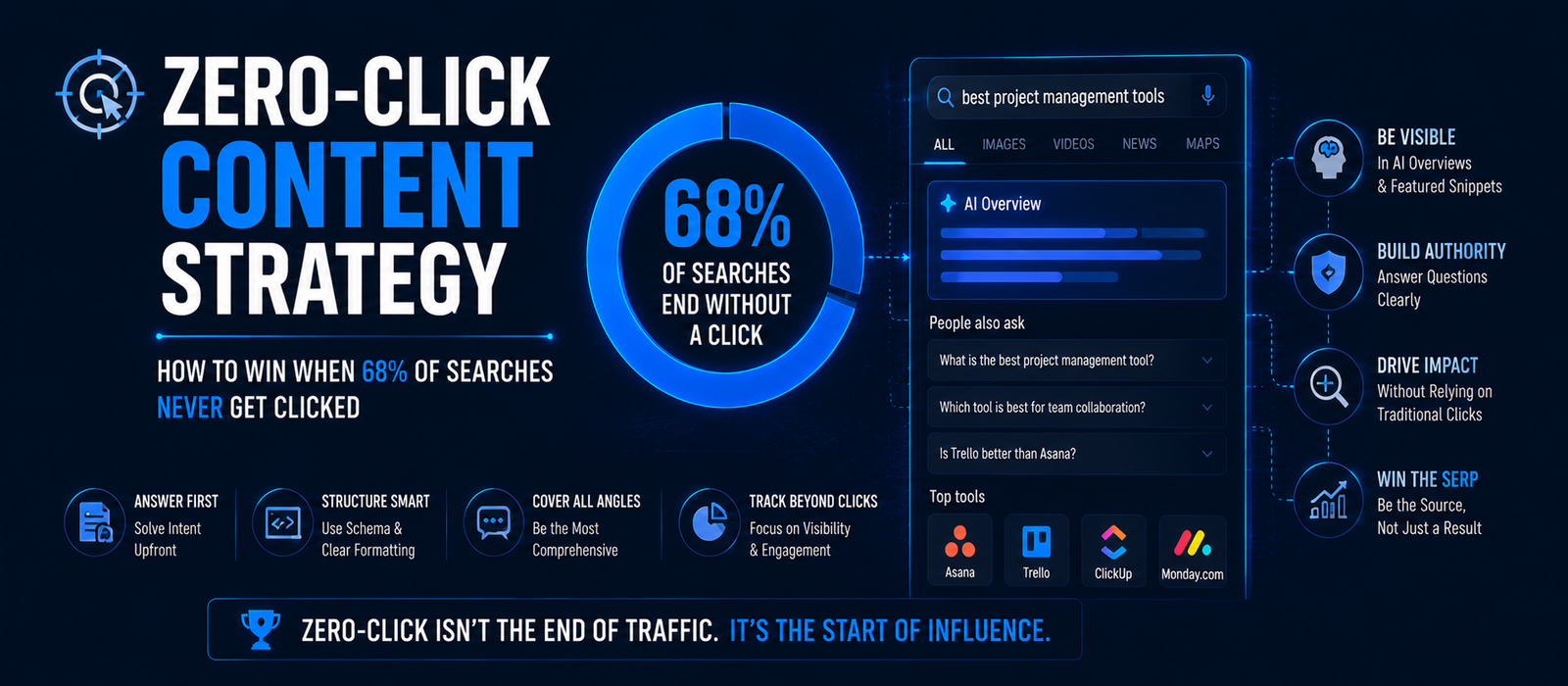
Sixty-eight out of every 100 Google searches in the US now end without a single click to any website — yours included. That's not a projection. It's what happened in the first four months of 2026, according to a SparkToro and Similarweb study covered by Search Engine Land, up from 60.45% just two years earlier. If your content strategy still measures success purely in clicks, you're optimizing for a shrinking fraction of the internet. A real zero-click content strategy treats the answer box, the AI Overview, and the featured snippet as the primary destination — not a consolation prize.
68% of US Google searches now end with zero clicks (SparkToro/Similarweb, 2026), and AI Overviews push that as high as 93% for some queries. Winning requires a zero-click content strategy built for extraction, structured data, and brand-visibility metrics — not just rankings.
1. What Zero-Click Search Actually Means for Your Business
A zero-click search happens when a user gets their answer directly on the results page — via a featured snippet, knowledge panel, AI Overview, or local pack — and never visits an external website. This isn't a fringe behavior anymore; it's becoming the default path for a majority of queries, and the gap is widening fastest for informational content, which is exactly the category most small business blogs and content marketing teams produce.
What Counts as a Zero-Click Search?
Zero-click covers several result types: AI Overviews, featured snippets, People Also Ask boxes, knowledge panels, and local packs. According to Semrush's Intent Study, 74% of informational searches ("how do I...", "what is...") end without a click, compared to just 31% of transactional searches ("buy...", "book...", "hire..."). That gap tells you exactly where zero-click risk — and opportunity — concentrates.
Why AI Overviews Are Accelerating the Trend
Google's AI Overviews carry an average zero-click rate of roughly 83%, and Google's fully conversational AI Mode pushes that to around 93%. Ahrefs' February 2026 research found AI Overviews now cut click-through for the top-ranking organic result by 58%, up sharply from a 34.5% reduction measured just eight months prior. A mid-sized SaaS company we'd cite as a working example: teams that kept publishing long, un-structured "ultimate guide" posts saw organic clicks fall even while impressions held steady — a classic zero-click signature.
Pro Tip: Check Google Search Console's impressions-vs-clicks gap by query. A widening gap on informational queries is your clearest signal that zero-click — not a ranking drop — is eating your traffic.
2. Build Content Blocks Designed to Be Extracted
Ranking #1 no longer guarantees a visitor. What guarantees visibility is being the source an AI Overview or featured snippet actually quotes. That means restructuring content so the single best answer sits in a clean, self-contained block near the top — before the storytelling, before the SEO padding, before the "in this article we'll cover."
Answer-First Formatting for AEO
Answer Engine Optimization (AEO) rewards content that states the direct answer in the first one to two sentences after a heading, in plain language, without requiring the reader to scroll. Skip throat-clearing. Skip "there are many factors to consider." Lead with the fact, the number, or the step.
A 5-Step Process to Optimize Existing Content for Extraction
- Identify your top 20 informational pages by impressions in Search Console.
- Add a direct, 40-60 word answer immediately under each H2 that matches a question.
- Convert dense paragraphs into numbered steps or short bullet lists wherever a process is described.
- Add explicit named entities (brand names, tool names, real statistics with sources).
- Re-test with Google's Rich Results tool and monitor AI Overview appearance monthly.
Pro Tip: Write the answer block as if it will be read aloud by a voice assistant with zero visual context — if it needs the surrounding paragraph to make sense, it's not extraction-ready.
3. Make Your Content Machine-Citable with Schema and Structured Data
AI engines and Google's snippet algorithms don't "read" a page the way a human does — they parse structured signals to decide what to lift and who to credit. Content without schema markup is invisible to a large share of these systems, no matter how well-written it is. This is where GEO (Generative Engine Optimization) and traditional technical SEO converge.
How Does Schema Markup Help AI Engines Cite You?
Schema markup — Article, FAQPage, HowTo, and Organization schema in particular — gives search and AI crawlers explicit, machine-readable labels for your content's structure, authorship, and entity relationships. This is one of the highest-leverage, lowest-cost investments in a zero-click content strategy because it doesn't require new content, only better labeling of what already exists.
Named-Entity and Brand Signals for GEO
Generative engines favor content tied to identifiable, consistent entities: named brands, named authors, named tools, and citable statistics. Vague, unbranded advice gets paraphrased and stripped of attribution; specific, sourced, brand-attached claims are more likely to be quoted with a citation link.
| Optimization Focus | Traditional SEO | Zero-Click Content Strategy |
|---|---|---|
| Primary goal | Rank #1 for a keyword | Get extracted/cited in the answer |
| Content shape | Long-form narrative | Answer-first blocks + narrative |
| Key asset | Backlinks | Schema markup + named entities |
| Success metric | Organic clicks | Impressions, citations, brand recall |
Pro Tip: Implement FAQPage schema on every post with a genuine FAQ section — it's one of the few schema types Google explicitly confirms can trigger rich results in search.
4. Redefine Success: Metrics That Matter in a Zero-Click World
If clicks are structurally declining across an entire category of search, measuring content success by click-through rate alone will make good content look like failing content. Teams need a parallel scorecard that captures visibility earned even when the user never leaves the results page.
What Metrics Should Replace Click-Through Rate?
Track impressions (Search Console), AI Overview appearance rate (via rank-tracking tools that now flag AIO presence), branded search volume over time, and share of voice for your core topics against competitors. A rising impression count with flat clicks isn't stagnation — it's often zero-click visibility doing its job quietly.
Where Traffic Still Comes From
Even in a zero-click-heavy landscape, clicks concentrate on transactional, comparison, and deep-technical queries where a snippet can't fully satisfy intent. Google Business Profile, branded newsletters, and communities like Reddit and niche forums increasingly carry the discovery load that organic blue links used to own alone.
Pro Tip: Set a quarterly branded-search-volume benchmark in Google Trends or Search Console — a steady rise is strong evidence your zero-click content strategy is building recognition even where it isn't driving direct clicks.
Search behavior has permanently shifted, and a zero-click content strategy built on answer-first formatting, structured data, and brand-first metrics is now a baseline requirement, not an advanced tactic, for anyone publishing content in 2026.
Summary
The math is simple even if the shift feels uncomfortable: when 68% of searches end without a click and AI Mode pushes that past 90% for some queries, content strategy has to earn visibility inside the results page, not just below it. The four moves in this guide — understanding where zero-click concentrates, formatting for extraction, wiring in schema and entities, and tracking impressions over clicks — work together as one system, not four separate tactics.
Key Takeaways
- 68.01% of US Google searches ended without a click in early 2026, up from 60.45% in 2024 (SparkToro/Similarweb via Search Engine Land).
- AI Overviews carry an average zero-click rate near 83%, and Google's AI Mode pushes that closer to 93%.
- Ahrefs' February 2026 research found AI Overviews cut top-ranking CTR by 58%, nearly double the 34.5% drop measured eight months earlier.
- Semrush's Intent Study found 74% of informational searches end zero-click versus 31% of transactional searches — informational content carries the most risk.
- FAQPage, HowTo, and Article schema remain among the clearest, lowest-cost levers for AI and snippet citation.
- Impressions, AI Overview appearance rate, and branded search volume are now necessary companions to click-through rate, not replacements for good content.
Ready to rebuild your content around visibility instead of clicks alone? Cross Globe Marketing can audit your top pages for zero-click readiness and build the AEO/GEO roadmap to match.
Quick Summary
Zero-click content strategy exists because 68.01% of US Google searches ended without a click in early 2026, up from 60.45% in 2024, and AI Mode pushes that past 90% for some query types. Winning under those conditions means earning visibility inside the results page itself, not just below it: understanding where zero-click concentrates, formatting content for extraction, wiring in schema and entities, and tracking impressions over clicks as the real success metric. These four moves work together as one system, not as separate, optional tactics.