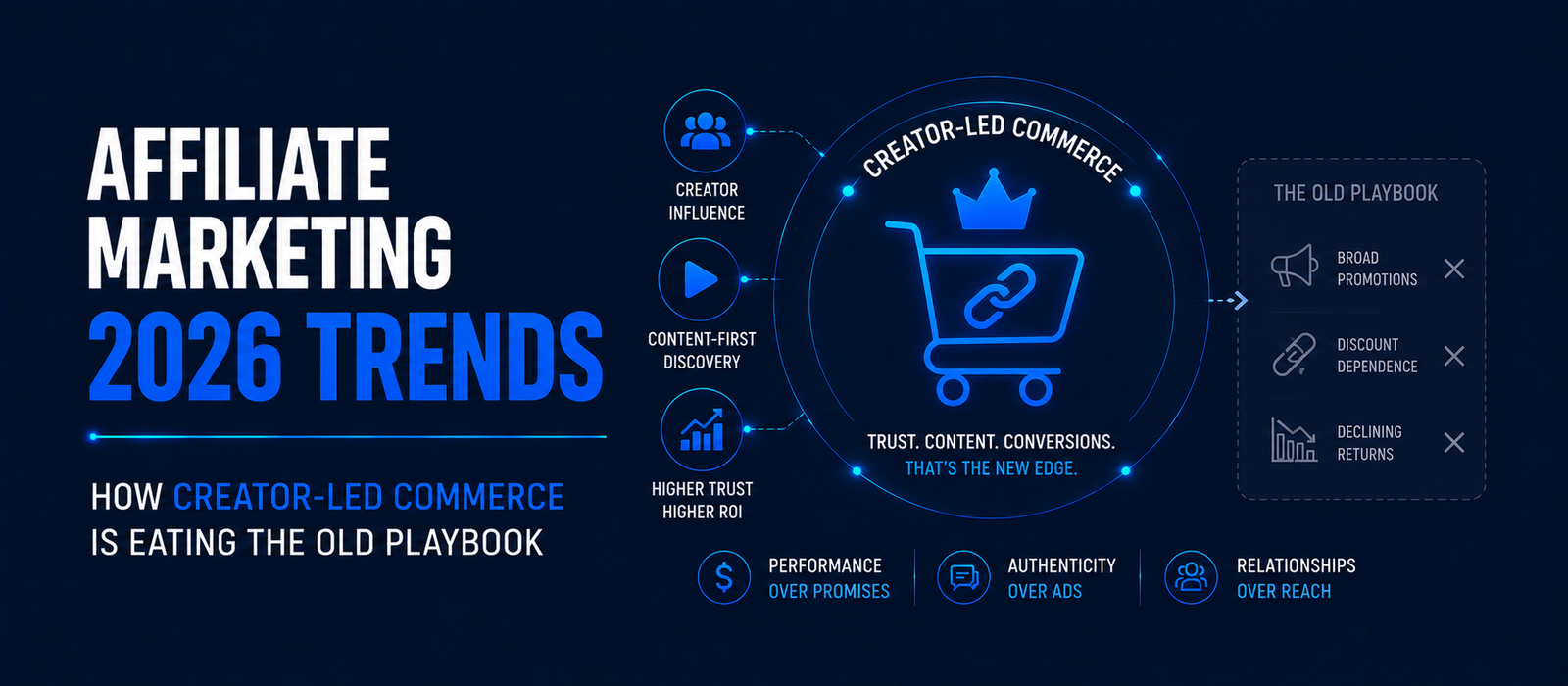
19.5%. That's the share of Awin's affiliate revenue that creators and influencers claimed in the past twelve months, up from 15.9% the year before — the fastest-growing publisher category on one of the affiliate industry's largest networks, according to eMarketer's October 2025 report. If your affiliate marketing program still routes most of its budget toward coupon sites and comparison blogs, that growth curve is a warning: the affiliate marketing 2026 trends reshaping performance marketing all point toward creators, not traditional publishers, as where the money is moving.
Creator revenue share on Awin jumped from 15.9% to 19.5% YoY. US affiliate spend hits $13.81B in 2026, but growth concentrates in creator channels. TikTok Shop's creator affiliate program now pays 100,000+ creators. Traditional coupon and content publishers are losing revenue share and AI search visibility.
1. The Data: Creator Revenue Is Outgrowing Traditional Affiliate Channels
Overall affiliate spending in the US is still growing — eMarketer projects it will reach $13.81 billion in 2026, up 11.3% from $12.42 billion in 2025, outpacing overall US retail ecommerce growth of 6.7% over the same period. But the growth isn't evenly spread across the industry: it's concentrating in creator-led commerce, the term for sales driven by individual creators and influencers acting as affiliate publishers rather than through coupon sites, cashback apps, or content blogs.
Why Creators Are Pulling Ahead
The clearest evidence comes from Awin, one of the affiliate industry's largest global networks: creator and influencer publishers grew their share of network revenue from 15.9% to 19.5% year-over-year, per eMarketer's October 2025 analysis — the single fastest-growing publisher category Awin tracks. That growth compounds with repeat exposure. Data from creator-ad platform Agentio, cited by eMarketer, shows that by a brand's eighth collaboration with the same YouTube creator, clickthrough rates reach 1.8x the rate of the first collaboration.
What Buyers Actually Need to Convert
Does one creator post drive a purchase on its own? Rarely. A joint eMarketer and impact.com survey found consumers typically need three to four creator exposures to the same brand before they buy, which is why brands running one-off creator posts instead of ongoing affiliate-style creator programs tend to underperform the network averages above.
A useful real-world signal: TikTok Shop's own data, reported by Modern Retail, shows that brands with $30 million-plus in revenue grew their TikTok Shop sales 97% year-over-year in 2025 — a segment large enough to have serious performance marketing budgets, and one that's clearly reallocating it toward creator-driven placements rather than traditional display or search affiliate slots.
Pro Tip: Before shifting budget, audit which of your current affiliate partners are individual creators versus institutional publishers (coupon sites, cashback apps, content blogs) — most affiliate dashboards don't separate this by default, so you may be underestimating how much of your existing performance already comes from creators.
2. TikTok Shop and the Creator-Affiliate Hybrid Model
TikTok Shop has become the clearest example of what creator-led commerce looks like once a platform builds affiliate infrastructure directly around creators instead of a separate publisher network. Rather than a creator linking out to a merchant's coupon-code landing page, the entire purchase — discovery, checkout, and commission — happens inside one app, collapsing the traditional affiliate funnel into a single surface.
The Scale of TikTok Shop's Creator Affiliate Program
TikTok Shop's Creator Affiliate Program has enrolled more than 100,000 creators, with roughly 54,000 of them generating $10,000 or more in annual commissions, according to research compiled by Capital One Shopping. On the seller side, the platform's US footprint expanded from about 4,450 shops in mid-2023 to an estimated 475,000 by 2026, a roughly 5,000% increase reported by Red Stag Fulfillment — growth that tracks closely with the platform's creator affiliate expansion.
Repeat Buyers, Not Just One-Off Sales
Is TikTok Shop mostly driving one-time impulse purchases? The retention data says otherwise. Red Stag Fulfillment reports a TikTok Shop repeat purchase rate of 81.3%, with buyers completing an average of 5.3 transactions per year — numbers closer to a loyalty program than a flash-sale platform, and an argument for treating creator affiliate relationships as ongoing partnerships rather than single campaigns.
LTK (formerly LIKEtoKNOW.it) and ShopMy represent the other half of this shift: platforms built specifically to formalize creator commerce and affiliate payouts outside legacy networks like CJ Affiliate or ShareASale, giving creators dashboard-level tools that used to be reserved for institutional publishers.
Pro Tip: If you're only running TikTok Shop as a one-off launch campaign, you're leaving retention value on the table — structure creator partnerships as recurring content cadences (monthly or bi-weekly) to capture the repeat-purchase pattern the platform's own data shows.
3. Why Traditional Affiliate Publishers Are Losing Ground
Not every part of the affiliate ecosystem is shrinking, but the categories that built the industry — cashback and loyalty sites, coupon aggregators, and SEO-driven content publishers — are losing relative share even as total spend grows. Two forces are driving it: budget reallocation toward creators, and a structural hit to organic search traffic from AI-powered search tools.
The Publisher Mix Is Shifting
Performance Marketing Association data from June 2025 shows cashback and loyalty platforms still capture the largest single slice of affiliate ad spend at 35%, with content publishers at 16% — but both categories are growing slower than the creator segment. Discount and coupon publishers specifically pulled in 42.4% of US affiliate revenue in H1 2025 per Awin, up from 39.7% the year prior, showing that even within "traditional" publisher types, deal-driven models are consolidating share away from general content sites.
AI Search Is Compounding the Problem for Content Publishers
Are AI chatbots actually replacing affiliate content sites? Partially, and the traffic data shows real damage: an analysis by GSQi found Wirecutter's search visibility declined more than 60% between May and August 2025. At the same time, AI-driven shopping behavior is growing fast — Sensor Tower data shows ChatGPT shopping-related queries grew faster than any other query category between December 2024 and June 2025, and a July 2025 Wildfire Systems survey found consumers already use generative AI tools for price comparison (54%), deal finding (41%), and review checking (41%). Roughly 70% of publishers surveyed by the Performance Marketing Association said they're concerned Google's search changes will directly harm their affiliate businesses.
There's a nuance worth noting: eyewear brand Zenni saw roughly 70% of its ChatGPT citations trace back to affiliate marketing content, per an October 2025 eMarketer report — meaning affiliate content itself isn't disappearing from AI answers, it's the generic comparison-blog format that's losing ground, not affiliate content as a category.
Pro Tip: Don't assume your existing SEO-driven affiliate content is safe just because it still ranks in Google — check whether it's being cited in ChatGPT, Perplexity, and AI Overviews too, since that's where the traffic risk (and the creator-content opportunity) is concentrated in 2026.
4. Affiliate Marketing 2026 Trends: Rebalancing Your Budget
The practical question for any brand running affiliate marketing in 2026 isn't whether to abandon traditional publishers — cashback and coupon sites still drive real, measurable revenue — but how much new and reallocated budget should move toward creator-led placements, and how fast. Getting this sequencing right matters more than the headline stats alone.
Creator-Led Commerce vs. Traditional Affiliate: A Quick Comparison
| Factor | Traditional Affiliate (Coupon/Cashback/Content) | Creator-Led Commerce |
|---|---|---|
| Revenue share trend (Awin, YoY) | Declining relative share | Rose 15.9% → 19.5% |
| Conversion pattern | Single-click, price-driven | Needs 3–4 exposures (eMarketer/impact.com) |
| AI search exposure | Higher risk (Wirecutter: -60%+ visibility) | Lower risk; content less commoditized |
| Best fit | Deal-seeking, bottom-funnel buyers | Discovery, trust-building, repeat buyers |
| Example platform | ShareASale, CJ Affiliate, RetailMeNot | TikTok Shop, LTK, ShopMy |
A 5-Step Plan to Rebalance Your Affiliate Program
- Segment your current affiliate report by publisher type — creator, cashback, coupon, content — since most dashboards lump these together by default.
- Set a creator-specific budget line rather than folding creator spend into a general "influencer marketing" bucket that never touches your affiliate platform.
- Move toward ongoing creator partnerships (monthly or campaign-recurring) instead of one-off posts, to reach the three-to-four exposure threshold buyers need.
- Audit AI search visibility for your existing affiliate and content pages using tools that check AI Overviews and chatbot citations, not just Google rankings.
- Keep 60–70% of budget in proven channels for the next full reporting cycle while creator allocations scale, so you're not starving a channel that still converts.
Consider a hypothetical mid-sized supplement brand running a $30,000 monthly affiliate budget: shifting 20% of that budget from a legacy coupon-site partnership into a recurring TikTok Shop creator affiliate program, while keeping the remaining cashback and content-publisher relationships intact for bottom-funnel buyers, illustrates how the rebalance works in practice rather than as an all-or-nothing switch.
Pro Tip: Track creator-driven affiliate revenue separately from your paid influencer marketing spend for at least two full quarters before combining them in reporting — the two channels have different attribution windows, and mixing them early makes it hard to prove which one is actually driving the lift.
Summary
Creator-led commerce isn't a future trend to plan for later — the revenue-share data from Awin, the enrollment numbers from TikTok Shop's creator affiliate program, and the search-visibility losses hitting traditional content publishers all point to a shift that's already underway. The brands adapting fastest aren't necessarily cutting traditional affiliate spend; they're segmenting it, tracking creators separately, and letting the data decide how much budget moves and how quickly.
Key Takeaways
- Creator and influencer revenue share on Awin rose from 15.9% to 19.5% year-over-year, the fastest-growing publisher category on the network (source: eMarketer, October 2025).
- US affiliate spend is projected to hit $13.81 billion in 2026, growing 11.3% and outpacing overall retail ecommerce growth of 6.7% (source: eMarketer).
- TikTok Shop's Creator Affiliate Program has enrolled more than 100,000 creators, with about 54,000 generating $10,000+ annually (source: Capital One Shopping).
- TikTok Shop's US seller base grew roughly 5,000%, from 4,450 shops in mid-2023 to an estimated 475,000 by 2026 (source: Red Stag Fulfillment).
- Wirecutter's search visibility dropped more than 60% between May and August 2025 as AI search reshapes traffic to traditional affiliate content (source: GSQi analysis).
- Consumers typically need three to four creator exposures to a brand before purchasing, underscoring why ongoing partnerships outperform one-off posts (source: eMarketer/impact.com survey).
Ready to see how these affiliate marketing 2026 trends should reshape your own program? Talk to Cross Globe Marketing about auditing your affiliate mix before your next budget cycle locks in.
Quick Summary
Affiliate marketing 2026 trends show creator-led commerce overtaking traditional affiliate publishers: creator and influencer revenue share on Awin climbed from 15.9% to 19.5% year-over-year even as total US affiliate spend grew to a projected $13.81 billion, while TikTok Shop's creator affiliate program expanded to more than 100,000 enrolled creators. Meanwhile, traditional coupon, cashback, and content publishers are losing relative share and, in cases like Wirecutter's more-than-60% search visibility drop, losing organic traffic to AI search tools. The practical shift for brands is not abandoning traditional affiliate channels but rebalancing budget toward ongoing, trackable creator partnerships.