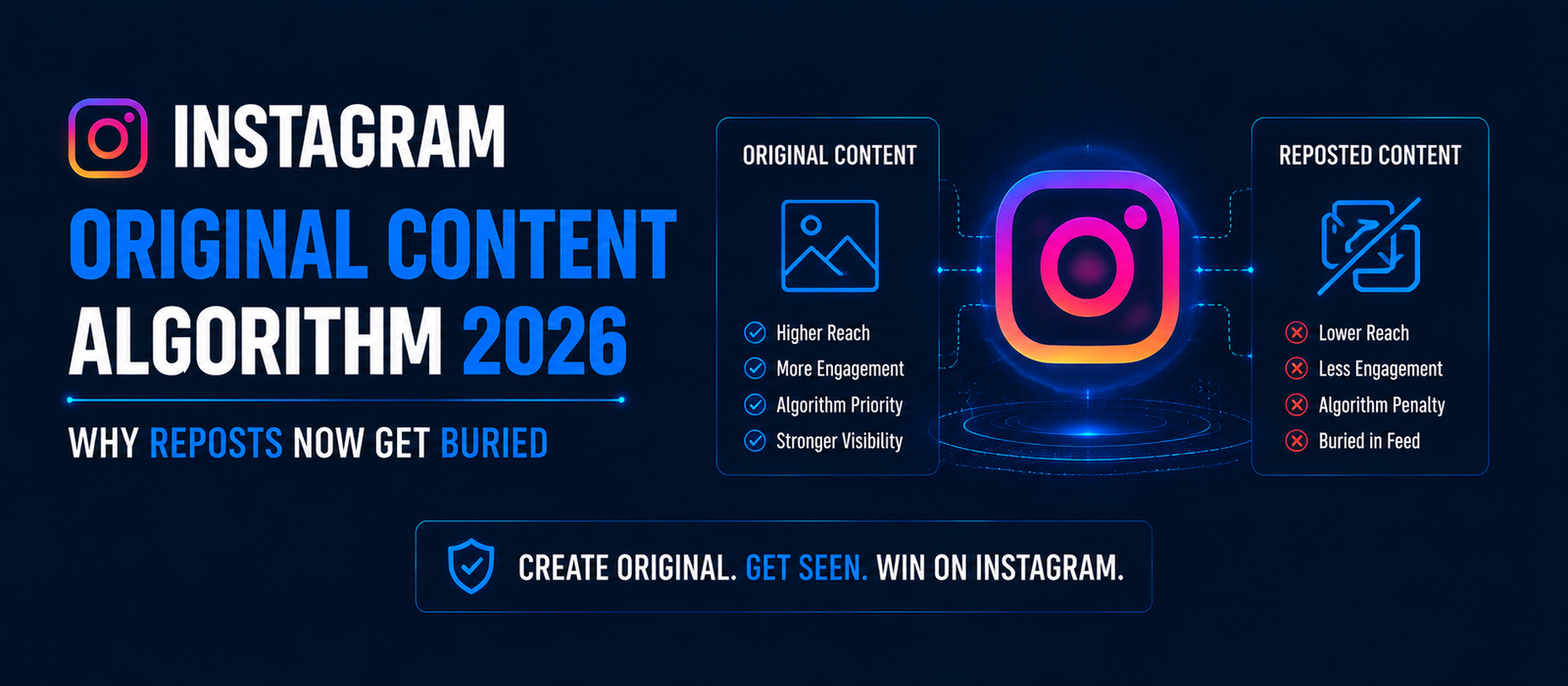
Instagram's April 2026 update cuts recommendations entirely for accounts posting 10+ reposts in 30 days. Original content now gets 40-60% more distribution, aggregators saw 60-80% reach drops, and AI fingerprinting flags unmodified content pulled from other apps.
Post the same reel that's already circulating on three other platforms and watch it die in the feed. That's the reality small business owners, creators, and growth teams are waking up to under the Instagram Original Content Algorithm 2026 update — a ranking overhaul that treats "unoriginal" the way spam filters treat phishing links.
1. What Changed: Instagram's April 2026 Originality Crackdown Explained
On April 30, 2026, Instagram rolled out its most significant recommendation-system change in years, according to PetaPixel and Tubefilter. The rule that previously applied only to Reels — no recommendations for accounts that primarily share content they didn't create or haven't meaningfully transformed — now extends platform-wide to photos and carousel posts.
Timeline of the Rollout
The policy didn't appear overnight. Instagram had been penalizing unoriginal Reels for over a year, but the April 2026 expansion closed the loophole that let aggregator accounts thrive by simply switching formats. Once photos and carousels lost their exemption, the entire repost economy on the platform shifted within weeks.
What Counts as "Original" Now
Instagram defines "original" as content either filmed specifically for the app or meaningfully edited for it — not just re-cropped or re-captioned. Reposting with visible, built-in attribution to the original creator is treated differently than a stripped, unmodified re-upload.
Does Reposting Ever Still Work?
Yes, but only within limits. Instagram's own repost tools that credit the original creator are treated as collaboration, not theft. The penalty targets volume and concealment — cross-posting occasionally with credit isn't the same violation as running an account built entirely on unattributed reposts.
Pro Tip: Audit your last 30 days of posts today. If 10 or more are reposts without meaningful edits or attribution, you're likely already excluded from Explore and non-follower Reels recommendations under the current rules.
2. The New Math of Reach: How Much Distribution You Lose (or Gain)
The numbers behind this update are stark enough to reshape content strategy for anyone running a social media presence on Instagram in 2026. This isn't a soft ranking nudge — it's a binary cutoff for high-volume repost accounts, paired with a real distribution bonus for original posters.
Comparison Table: Original vs Reposted Content Performance
| Metric | Original Content | Reposted Content (Aggregators) |
|---|---|---|
| Distribution change post-update | +40% to +60% more reach | -60% to -80% reach drop |
| Recommendation eligibility | Full access to Explore, Reels, suggested posts | Excluded after 10+ reposts in 30 days |
| Share of U.S. recommendations | ~75% of recommended posts | Minority share, shrinking |
| Detection risk | None | AI fingerprinting + watermark scan |
Sources: MediaPost, Tubefilter
Why the Algorithm Weighs Origination So Heavily
Meta's stated goal is protecting the incentive for creators to keep making new content rather than watching aggregator pages profit off reposted work. Adam Mosseri has acknowledged aggregators are "an important part of the ecosystem," but framed the update as forcing a shift toward attribution-based sharing rather than wholesale copying.
Pro Tip: If your account leans on curated or aggregated content, track your reach week-over-week starting now — a 60%+ drop is the clearest signal you've crossed the repost threshold.
3. How Instagram Detects Reposted Content (AI Fingerprinting Explained)
The enforcement mechanism matters as much as the policy itself, because it determines how much room accounts have to operate before getting flagged. Instagram isn't relying on user reports or manual review — it's running automated detection at scale.
The Detection Signals
Instagram's system uses AI visual fingerprinting to identify content that originated elsewhere, including unmodified TikTok reposts. Watermarks from other apps or third-party editing tools are a direct signal the system flags, even if the caption or account bio never mentions the source.
Can You Get Flagged by Accident?
It's possible if you're cross-posting without stripping app watermarks or adding meaningful edits. Creators who repurpose their own TikTok content onto Instagram without any platform-specific editing risk the same penalty as pure aggregator accounts, since the fingerprinting system doesn't distinguish self-repurposing from third-party theft by default.
Pro Tip: Before cross-posting anything from TikTok or YouTube, re-edit it natively in Instagram's own tools — crop, recaption, or add a platform-specific intro — to reduce fingerprint-match risk.
4. The 5-Step Process to Protect (or Rebuild) Your Reach
Whether you're a brand managing a content calendar or a solo creator, the fix isn't complicated — it's disciplined. Here's the sequence marketing teams should run through this quarter to align with the new ranking logic.
Step-by-Step Recovery Process
- Audit your last 30 days. Count how many posts are reposts without meaningful edits or attribution.
- Cut volume below the threshold. Stay under 10 unoriginal posts per rolling 30-day window if repost content is part of your mix.
- Add native edits to every cross-post. Re-crop, re-caption, or overlay platform-specific graphics before publishing.
- Use Instagram's built-in repost/attribution tools instead of manual re-uploads when sharing others' work.
- Shift budget toward original filming or editing for your highest-performing formats, since original posts now carry the distribution advantage.
What If You Run a Curation/Aggregator Account?
Pivot toward collaboration rather than aggregation. Reach out to original creators for reposting rights with visible credit, or add substantive commentary, editing, or context that meaningfully transforms the source material — Instagram's stated bar for what still qualifies as shareable.
Pro Tip: Build a simple tracking sheet logging repost count per rolling 30-day window — this single habit prevents the account from silently crossing into penalty territory.
Summary
The Instagram Original Content Algorithm 2026 update didn't just tweak a ranking weight — it drew a hard line between accounts that create and accounts that copy, and it backed that line with automated, AI-driven enforcement. For any business or creator relying on Instagram for organic reach, originality is no longer a nice-to-have differentiator; it's the entry ticket to recommendations at all.
Key Takeaways
- Accounts posting 10+ reposts in a rolling 30-day window are excluded from Explore, Reels, and suggested-post recommendations (Tubefilter, April 2026).
- Original content now sees 40-60% more distribution than reposted content post-update (Tubefilter, April 2026).
- Aggregator accounts recorded 60-80% reach drops following the rollout (Tubefilter, April 2026).
- Roughly 75% of U.S. recommendations now come from what Instagram's algorithm classifies as original posts (MediaPost, May 2026).
- Detection runs on AI visual fingerprinting, flagging unmodified reposts and third-party app watermarks automatically (PetaPixel, April 2026).
- The policy, previously limited to Reels, now covers photos and carousels platform-wide (PetaPixel, April 2026).
Ready to rebuild your Instagram reach around original content instead of guesswork? Talk to Cross Globe Marketing about auditing your content mix under the new Instagram Original Content Algorithm 2026 rules.
Quick Summary
The Instagram Original Content Algorithm 2026 update excludes accounts posting 10 or more reposts in a rolling 30-day window from Explore, Reels, and suggested-post recommendations, using AI visual fingerprinting to detect unmodified content pulled from other apps. Original content now sees 40-60% more distribution than reposted content, while aggregator accounts recorded 60-80% reach drops after the April 2026 rollout. For any business or creator relying on Instagram for organic reach, originality is no longer a differentiator — it's the entry ticket to recommendations at all.