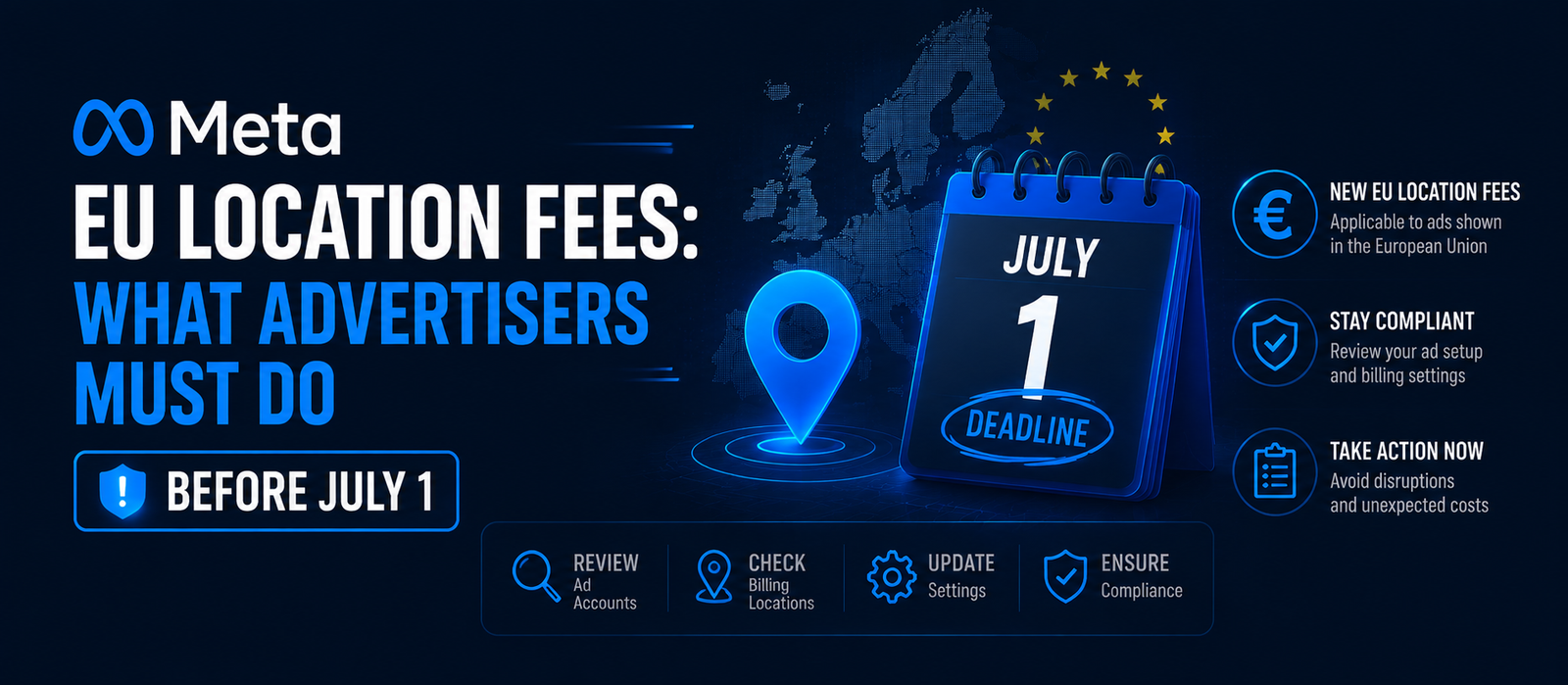
Your Meta invoice just got more expensive, and Ads Manager won't tell you why.
Starting July 1, 2026, Meta began charging a 2-5% location fee on ads delivered to audiences in six markets, and the charge does not show up anywhere in your campaign dashboard. In the same window, Google quietly rewrote the terms governing every Google Ads account for the first time since 2018. If your team manages budgets, forecasts, or client reporting for European campaigns, both changes need your attention now.
Meta now adds a 2-5% surcharge on ads delivered to the UK, France, Italy, Spain, Austria, and Turkey, billed separately from Ads Manager spend. Google rewrote its Ad Terms the same period, expanding AI automation authority and advertiser liability. Update your MER, budgets, and client reporting before quarter-end.
1. What Are Meta's EU Location Fees?
Meta EU Location Fees are pass-through charges that recover the Digital Services Taxes (DSTs) European governments impose on large tech platforms. Meta had absorbed these costs internally for years. As of July 1, 2026, it stopped.
According to Reuters' March 10, 2026 report on the announcement, Meta will charge advertisers a location fee ranging from 2% to 5% to cover digital service taxes imposed by some countries, following the same approach Google and Amazon had already adopted. The fee applies to image and video ads, plus WhatsApp click-to-message campaigns, but standard WhatsApp messaging outside of ad campaigns is excluded.
1.1 Which Countries Are Affected — and at What Rate
The fee mirrors each country's existing DST rate. Based on the confirmed rollout:
- United Kingdom — 2%
- France — 3%
- Italy — 3%
- Spain — 3%
- Austria — 5%
- Turkey — 5%
I am not fully certain these exact rates remain unchanged at the time you're reading this — several sources note Meta has stated the list of countries and rates "may change over time," and Turkey has already signaled a planned reduction to 2.5% in 2027. Verify current rates directly on Meta's Business Help Center before finalizing budgets.
1.2 Why It's Based on Delivery Location, Not Your Business Address
This is the detail that trips up most agencies. A company headquartered in New York running ads that deliver impressions to users in Spain pays the Spanish rate — not a US rate, not zero. Location fees follow the audience, not the advertiser. There is no opt-out.
Pro Tip: Check delivery country, not billing country, before quoting a client a flat management fee for European campaigns. A client based outside the EU can still trigger the full location-fee stack if their ads deliver into the UK, France, Italy, Spain, Austria, or Turkey.
Quick Summary Box: Meta location fee = 2-5% surcharge, added on top of spend (not deducted from budget), based on where the ad is delivered, effective July 1, 2026, in the UK, France, Italy, Spain, Austria, and Turkey. It does not appear in Ads Manager — only on the billing statement.
2. Meta vs. Google vs. Amazon: How the Fees Compare
Meta isn't first here — it's the third major platform to shift DST costs onto advertisers, following Google and Amazon, per Search Engine Land's June 2026 coverage of the rollout.
2.1 Side-by-Side Comparison
| Platform | Fee Structure | Visible in Reporting Dashboard? | Opt-Out Available? |
|---|---|---|---|
| Meta | 2-5%, added on top of spend, by delivery location | No — invoice/billing hub only | No |
| Google Ads | Jurisdiction-specific fees now permitted under rewritten Terms of Service | Partially, varies by market | No |
| Amazon Ads | Regional operating fees already in place in several markets | Varies | No |
2.2 A Small Case Example
Consider a US-based SaaS company spending $50,000/month on Meta campaigns targeting UK, French, and Austrian audiences in roughly equal thirds. At blended rates (2%, 3%, 5%), that's an incremental cost of roughly $1,330/month ($16,000/year) that never shows up in the campaign-level ROAS number pulled from Ads Manager — only on the invoice. Multiply that across a client portfolio and the reporting gap becomes a real client-trust problem, not just a rounding error.
Pro Tip: Google and Amazon already normalized this pattern — treat Meta's rollout as confirmation the industry direction is set, not a one-off. Build fee-line reconciliation into your reporting template now rather than per-platform later.
Pro Tip: Stop calculating Marketing Efficiency Ratio (MER) from Ads Manager spend alone for UK/EU campaigns. Pull total cost from the billing hub instead — that's the only source that includes the location fee, a shift several agencies (including Webtopia in its July 2026 client guidance) are now recommending as standard practice.
3. Google's Rewritten Ad Terms: What Changed on July 1
While Meta was rolling out location fees, Google rewrote its Google Ads Terms of Service — the first substantive rewrite since April 2018, according to Search Engine Land and ppc.land's June 2026 reporting. No advertiser action was required; the new terms applied automatically to every account.
3.1 The Core Shift: AI Authorization by Default
The previous terms described automated features — like auto-generated headlines, sitelinks, or targeting suggestions — as optional tools advertisers could choose to use. The rewritten terms remove that "optional" framing. Google now states that advertisers authorize it to use automated systems to format, select, or generate targets, ads, and destinations by default. Advertiser inputs — including anything typed into conversational AI campaign tools — may now be used across Google Ads features to improve performance.
3.2 Who's Liable When AI Gets It Wrong
This is the part worth flagging to every client: advertisers, not Google, remain fully responsible for reviewing and approving whatever automated systems generate — headlines, images, landing destinations, targeting changes. The updated terms also narrowed the liability cap to apply per advertiser account rather than across total Google spend, and introduced a new batch-arbitration process for claims involving 25 or more similar disputes.
Pro Tip: Turn on daily automated-change alerts inside Google Ads and assign someone on your team to review AI-generated assets weekly. Treat the new terms as a signal that "set and forget" campaigns now carry more, not less, oversight risk.
4. Your 5-Step Action Plan
- Audit your European spend mix. Pull the last 90 days of Meta spend by delivery country to estimate your location-fee exposure before it hits July invoices.
- Switch MER reporting to billing-hub totals for any campaign touching the UK, France, Italy, Spain, Austria, or Turkey.
- Rebuild client-facing budget forecasts with the 2-5% surcharge baked in as a separate line item, not absorbed silently into media cost.
- Review Google Ads automation settings and document which assets are AI-generated versus manually built, given the new liability terms.
- Notify finance and procurement teams now — both changes affect invoicing and contract language, not just campaign strategy.
4.1 What to Tell Clients This Quarter
Frame both changes as structural, not performance-related. A client seeing MER shift 2-5% on UK/EU spend should understand it's a platform billing change, not a sign the campaign got worse.
4.2 What Not to Do
Don't try to "absorb" the fee by quietly cutting bids in affected countries to compensate — that typically just reduces delivery and reach without actually controlling the fee, since it's calculated as a percentage of whatever you do spend.
5. Quick Q&A for Advertisers
Q: Does the Meta location fee come out of my daily budget? No — it's billed on top of your spend as a separate invoice item, so your daily budget delivers the same reach; the fee shows up afterward on the bill.
Q: Will Google's new terms let AI change my ads without telling me? Automated systems can generate or adjust assets by default now, but you remain responsible for reviewing what runs — nothing in the terms removes your ability to check or roll back changes.
Q: Are more countries likely to get location fees later? Very likely. Belgium, the Czech Republic, Latvia, Norway, Slovakia, and Slovenia have all signaled intent to introduce similar Digital Services Taxes, and platforms tend to extend fee schedules once new DSTs take effect.
Pro Tip: Build a standing watchlist of countries signaling new DST legislation. Since the fee follows delivery location automatically once a platform adopts it, the earliest warning you'll get is policy news — not a change inside Ads Manager itself.
Key Takeaways: Meta EU Location Fees add 2-5% on top of UK/EU/Turkey ad spend from July 1, 2026, invisible in Ads Manager. Google's rewritten Ad Terms make AI automation the default and put liability for AI outputs on the advertiser. Neither requires opt-in, and both change how you should report cost and manage risk this quarter.
Both changes are already live — the question now is whether your reporting, budgets, and client conversations have caught up. If you need help auditing your European ad spend or building automation-review processes that hold up under the new terms, Cross Globe Marketing can walk through your account with you.
Quick Summary
Meta EU location fees add a 2-5% surcharge on top of ad spend delivered into the UK, EU, and Turkey starting July 1, 2026, invisible inside Ads Manager and only visible on the invoice or billing hub. The rate depends on delivery location, not the advertiser's registered country — UK at 2%, France/Italy/Spain at 3%, Austria/Turkey at 5%. The same date brought Google's rewritten Ad Terms, making AI-driven automation the default while keeping advertisers liable for reviewing the outputs — neither change required opt-in, and both are already live.