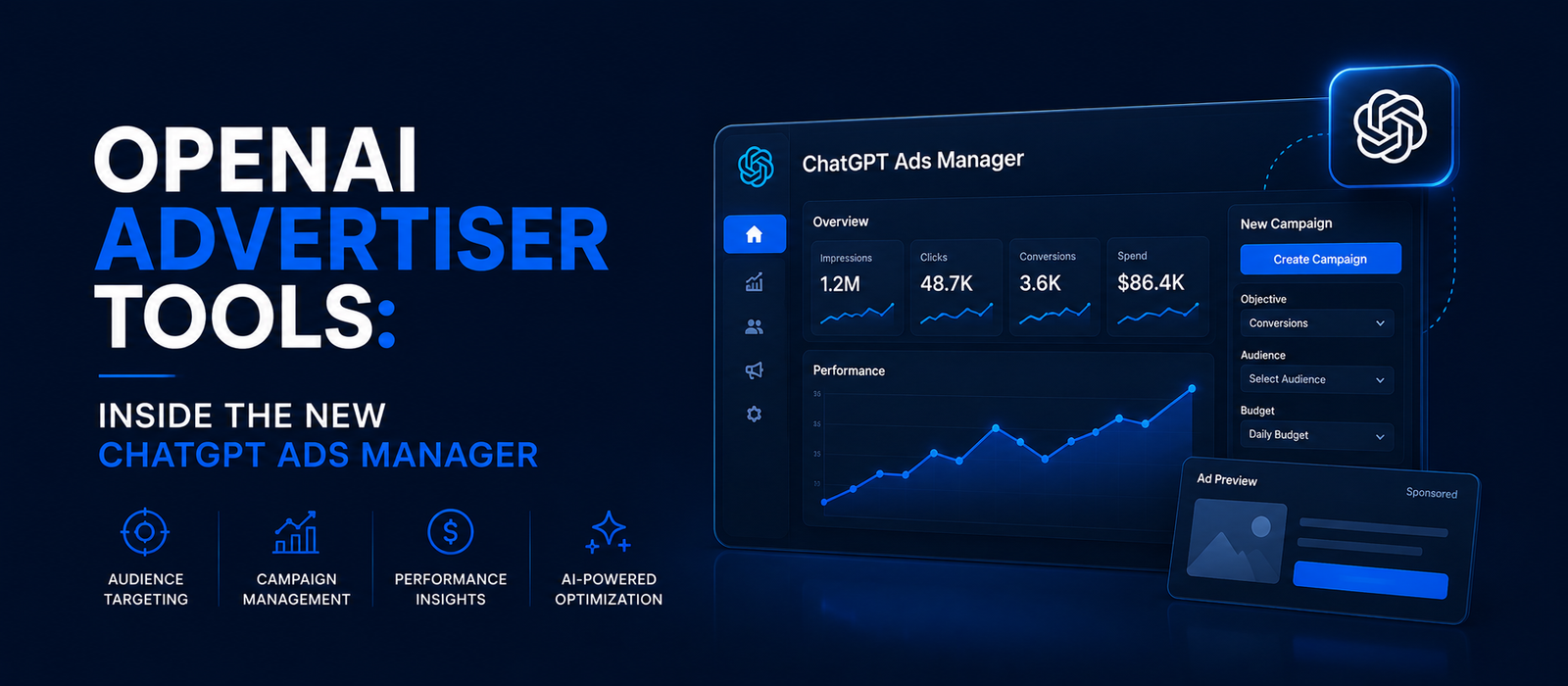
800 million people now use ChatGPT every week — and as of 2026, some of them are seeing ads between their answers. OpenAI has quietly graduated from a $200,000-minimum pilot program to a self-serve advertising platform, and the OpenAI advertiser tools behind it are built to look a lot more like Google Ads than a beta experiment.
OpenAI launched a self-serve ChatGPT Ads Manager in 2026 with CPC bidding, a Conversions API, geographic exclusions, and zero minimum spend — down from an earlier $200K beta requirement. Click-through rates remain low (1-3%) versus Google Search (~29%), but reach and first-mover positioning make it worth testing now.
If you sell anything online, the question is no longer whether OpenAI will monetize ChatGPT with ads — it already has. The question is whether the OpenAI advertiser tools are mature enough to justify a budget line yet, and how they stack up against the platforms you already run. This guide walks through exactly what's inside the toolkit, how to set up a first campaign, and where ChatGPT advertising fits against Google and Meta.
1. What Are OpenAI's New Advertiser Tools?
The OpenAI advertiser tools are the software and infrastructure that let businesses buy, target, and measure ads shown inside ChatGPT conversations. OpenAI began testing ads with logged-in adult users on the Free and Go tiers in the U.S. on February 9, 2026, before expanding to Canada, Australia, and New Zealand in March, and to the UK, Mexico, Brazil, Japan, and South Korea by August 11, 2026, according to OpenAI's own announcement. The advertiser-facing side of that rollout is the ChatGPT Ads Manager, a self-serve dashboard at ads.openai.com that entered beta on May 5, 2026.
From Invite-Only Pilot to Self-Serve Platform
Early access required a confirmed $200,000 minimum commitment, a figure OpenAI verified to Adweek during the curated beta phase. That barrier is gone. The self-serve Ads Manager eliminated the earlier $50,000 threshold entirely, meaning any business — SMB, startup, or solo brand — can now register, set a budget, and launch a campaign without a sales call.
Do You Need a Minimum Ad Spend to Get Started?
No. As of the self-serve launch, minimum spend sits at zero. You set your own daily or campaign budget inside the Ads Manager, the same way you would in a Google Ads or Meta Ads account, which is a deliberate move by OpenAI to court the long tail of advertisers rather than only enterprise brands.
Pro Tip: Register early at ads.openai.com even if you're not ready to spend — account history and approved billing tend to speed up review once you do launch a campaign.
2. Inside the ChatGPT Ads Manager: Core Features
Functionally, the Ads Manager mirrors the self-serve ad platforms marketers already know: register, upload creative, set a budget, and track performance from one dashboard. What's different is the ad unit itself — a minimal, text-plus-favicon format that appears clearly labeled "Sponsored" beneath a ChatGPT response, with no video or rich media currently supported.
Bidding, Creative, and Budget Controls
Campaigns run on a CPC (cost-per-click) model rather than the CPM impression pricing used in the earlier pilot, which reportedly ran near $60 CPM. Advertisers set pacing and creative directly in the dashboard, and a rolling 7-day average now smooths daily spend across a weekly budget range instead of front-loading delivery early in the day.
How Does OpenAI Protect User Privacy From Advertisers?
Advertisers never see individual conversations, chat history, or personal details — only aggregated performance data such as impressions and clicks, delivered through weekly reporting. OpenAI also excludes ads entirely from sensitive categories including health, mental health, and politics, and blocks ad personalization for any account identified as under 18.
Pro Tip: Because creative is limited to text and a favicon, front-load your strongest value proposition in the first few words — there's no visual to carry a weak headline.
3. How Targeting, Bidding & Measurement Actually Work
Targeting in ChatGPT Ads is conversational rather than demographic: the system matches ads to conversation topics, chat history, memories, and a user's past interactions with ads, rather than the interest and behavioral segments Meta advertisers are used to building. Measurement has matured quickly since launch, adding tools that close the gap with established platforms.
The New Conversion and Measurement Stack
OpenAI has layered in a Conversions API and pixel-based measurement to track what happens after the click — landing page views, add-to-cart, leads, sign-ups, and purchases — plus integrations with AppsFlyer and Adjust for app install and in-app event tracking. An "Automatic Advanced Matching" feature uses hashed customer data to sharpen website conversion accuracy, and a new oCPC (optimized cost-per-click) bidding mode lets campaigns favor clicks more likely to convert, while billing still happens per click rather than per conversion.
Step-by-Step: Launching Your First ChatGPT Ad Campaign
- Register a business account at ads.openai.com and complete billing verification.
- Set your campaign objective and daily or weekly budget (no minimum required).
- Write concise, benefit-led ad copy — remember, there's no image or video slot.
- Connect your Conversions API or pixel, and link AppsFlyer/Adjust if you're tracking app events.
- Apply geographic exclusions to prevent spend in countries, states, or cities outside your service area.
- Launch with CPC bidding, then test oCPC once you have enough conversion data to optimize against.
- Review weekly aggregated performance reports and adjust creative or budget pacing accordingly.
Pro Tip: Set up your Conversions API before you launch, not after — retroactive conversion data isn't backfilled, so early campaigns without it will look worse than they performed.
4. ChatGPT Ads vs. Google Ads vs. Meta Ads
No advertiser should reallocate budget on reach numbers alone, and the honest comparison right now favors patience over urgency. ChatGPT's referral click behavior looks nothing like a search engine's, so treating it as a Google Ads substitute will disappoint; treating it as an early, low-competition awareness channel is more realistic.
The Numbers, Side by Side
| Metric | ChatGPT Ads | Google Search Ads | Meta Ads |
|---|---|---|---|
| Bidding model | CPC (oCPC optimization available) | CPC / CPA | CPM / CPC |
| Minimum spend | $0 (self-serve) | $0 | $0 |
| Click-through behavior | ~1-3% of prompts lead to clicks | ~29% of queries result in clicks | Varies widely by placement |
| Ad format | Text + favicon only | Text, shopping, video | Image, video, carousel |
| Targeting basis | Conversation topic & history | Keyword intent | Demographic & behavioral |
Data on ChatGPT and Google click behavior is drawn from third-party analysis reported by ALM Corp; Meta figures vary by campaign and are not directly comparable on a single benchmark.
Where ChatGPT Ads Currently Fall Short
ChatGPT drives an estimated 0.21% of total website referral traffic compared to Google's roughly 40% share, and Google's referral volume runs approximately 190 times higher than ChatGPT's, per the same analysis. That gap reflects a young platform, not a broken one — but it means ChatGPT ads today are a supplementary test budget, not a primary channel replacement.
Pro Tip: Run ChatGPT Ads as a controlled 5-10% test slice of an existing budget for the first 60-90 days rather than diverting core search or social spend.
5. Is ChatGPT Advertising Right for Your Business?
The honest answer depends on your channel mix, product type, and appetite for early-platform risk. Businesses with a low cost-per-click tolerance, existing conversion tracking infrastructure, and a product that fits naturally into conversational recommendations (subscriptions, tools, services, meal kits, SaaS trials) are best positioned to test now, while businesses needing rich visual creative or high-volume proven ROAS should wait for more mature formats.
Who Should Test First
E-commerce brands, SaaS companies, and service businesses with clean tracking setups are the best early candidates, since the Conversions API rewards advertisers who can already measure a full funnel. Enterprise brands with dedicated performance marketing teams can absorb the learning curve fastest, but the removal of the minimum spend requirement means solo founders and small agencies can now run a real test for a few hundred dollars.
Is ChatGPT Advertising Right for Small Businesses?
Yes, with realistic expectations. The zero-minimum self-serve model was built specifically to open the platform to smaller advertisers, but the current text-only ad format and single-digit click-through rates mean small businesses should treat early campaigns as brand-awareness experiments rather than direct-response engines expected to match Google Search performance immediately.
Pro Tip: Before committing real budget, audit whether your landing pages and Conversions API setup are ready — a strong ChatGPT ad sending traffic to a slow or untracked page wastes the platform's biggest current advantage: clean, aggregated performance data.
Summary
The OpenAI advertiser tools have moved faster than most marketers expected — from a six-figure invite-only pilot to a genuinely self-serve platform with CPC bidding, conversion tracking, and geographic controls in under a year. What hasn't caught up yet is scale: click-through behavior and referral volume remain far below Google, and the ad format is still limited to text. That combination makes ChatGPT advertising a smart, low-cost test today rather than a channel to bet a media plan on tomorrow.
Key Takeaways
- OpenAI's self-serve Ads Manager launched in beta on May 5, 2026, dropping the earlier $200,000 minimum commitment confirmed to Adweek down to $0 (sources: OpenAI, Adweek via ALM Corp).
- Ads run on a CPC bidding model, with a new oCPC option to optimize toward conversions while still billing per click (source: ALM Corp campaign tools coverage).
- ChatGPT drives roughly 1-3% prompt-to-click behavior versus Google Search's ~29%, and about 0.21% of total referral traffic versus Google's ~40% (source: ALM Corp analysis).
- OpenAI reports 800 million weekly active users, with roughly 95% on the free tier where ads currently appear (source: ALM Corp, citing OpenAI figures).
- Consumer ad testing began February 9, 2026 in the U.S. and expanded to the UK, Mexico, Brazil, Japan, and South Korea by August 11, 2026 (source: OpenAI).
- Advertisers receive only aggregated performance data; ads are excluded from health, mental health, and political topics, and never shown to under-18 accounts (source: OpenAI).
Ready to test the newest ad channel in marketing before your competitors do? Register at ads.openai.com and launch a controlled ChatGPT Ads pilot this quarter.
Quick Summary
OpenAI advertiser tools center on a self-serve ChatGPT Ads Manager, launched in beta May 5, 2026, that replaced an earlier $200,000-minimum pilot with a $0-minimum, CPC-based platform featuring a Conversions API, oCPC optimization, geographic exclusions, and rolling 7-day budget pacing. Ads appear as text-plus-favicon units labeled "Sponsored" to Free and Go tier users in the U.S., UK, Canada, Australia, New Zealand, Mexico, Brazil, Japan, and South Korea, targeted by conversation topic rather than demographics. Current performance trails Google Search on click-through rate (1-3% versus ~29%) and referral volume, positioning ChatGPT advertising as an early-stage test channel rather than a proven replacement for existing search or social budgets.