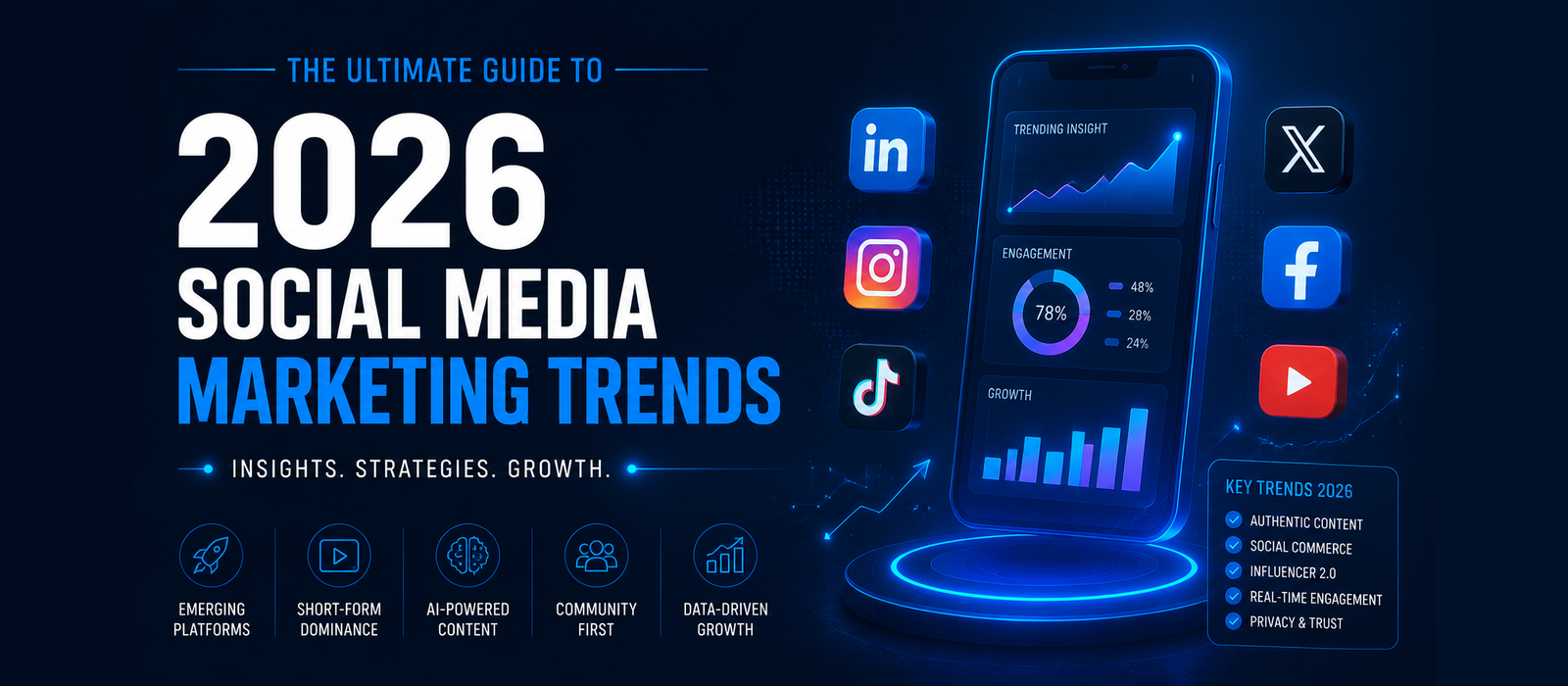
Social media has become a search engine in its own right — brand awareness is now the #1 marketer priority, AI handles production while humans handle strategy, and creator content consistently outperforms celebrity endorsements. This guide breaks down the data-backed trends reshaping social in 2026 and exactly what to do about each one.
Social media is now a search engine, not just a discovery channel. In 2026, brand awareness is the #1 marketer priority, creator content outperforms celebrity endorsements, and AI handles production while humans handle strategy. Winners build repeatable systems, not one-off viral bets.
Nearly 60% of consumers now research products on Instagram before they ever open Google, and 54.5% do the same on TikTok, according to Power Digital Marketing's 2026 State of Social Media Trends Report. If your strategy still treats social as a top-of-funnel awareness play only, you're already behind on the latest social media marketing trends shaping 2026.
This guide breaks down exactly what's changed, why it matters, and what to do about it — backed by real 2026 data, not guesses.
1. Social Search Has Replaced Traditional Discovery
The single biggest shift in the latest social media marketing trends for 2026 is that social platforms have become search engines in their own right.
Why This Is Happening
Younger audiences increasingly treat a social scroll as their default research tool instead of a text-based search bar. Platforms have leaned into this by improving in-app search, hashtag indexing, and SEO-style captions.
What It Means for Brands
- Optimize captions and video hooks like you'd optimize a meta description
- Use keyword-rich alt text and on-screen text overlays
- Treat your bio and pinned content like a landing page
Pro Tip: Write your first caption line as if it's a search snippet — front-load the keyword and the value, because that's what gets surfaced in in-app search results.
Real-World Example: A DTC skincare brand rewrote its Reels captions to lead with problem-based phrases ("oily skin routine that actually works") instead of brand taglines, and saw discovery traffic shift meaningfully toward non-follower reach within weeks — a pattern consistent with the social-search behavior Power Digital's report describes.
2. Creator Content Outperforms Celebrity Endorsement
According to Power Digital Marketing's 2026 report, 74% of shoppers say they've converted from influencer content. Meanwhile, HubSpot's 2026 Social Media Marketing Report (based on a survey of over 1,100 global marketers) found that 60% of marketers plan to increase influencer investment in 2026, with mid-tier creators (100,000–499,000 followers) delivering the strongest results.
Micro and Mid-Tier Beat Mega-Influencers
Audiences trust relatable creators more than polished celebrity ads. Smaller, niche creators typically convert better per dollar spent than mega-influencer partnerships.
B2B Isn't Exempt
HubSpot's data notes this shift isn't purely a B2C phenomenon — B2B brands are increasingly using subject-matter creators and employee advocates for the same trust-transfer effect.
Pro Tip: Before chasing follower count, ask a creator for their engagement rate and audience overlap with your target buyer — relevance beats reach in 2026.
3. AI Handles Production, Humans Handle Strategy
AI tools now speed up ideation, caption variants, targeting, and creative testing — but brand voice, ethics, and strategic judgment still require a human in the loop, per National University's 2026 trends analysis.
A Simple 4-Step AI Workflow
- Use AI to generate 5–10 hook variations for a single piece of content
- Have a human editor select and refine the top 2 based on brand voice
- A/B test both variants with a small paid boost
- Feed the winning data back into your next content brief
Pro Tip: Never publish AI-drafted copy without a human voice pass — audiences are increasingly good at spotting generic AI phrasing, and it erodes the trust creator content is built on.
4. Short-Form Video Has Matured Into a System, Not a Stunt
Short-form video remains the dominant content format at scale heading into 2026, according to Thrive Agency's 2026 statistics roundup. But the era of chasing one viral clip is over — what's working now is a repeatable content pipeline.
Comparison: Old Approach vs. 2026 Approach
| Old Approach (2023-2024) | 2026 Approach |
|---|---|
| One-off viral attempts | Repeatable weekly content system |
| Vanity metrics (views only) | Cost-per-result and conversion tracking |
| Single-platform focus | Cross-platform repurposing pipeline |
| Reactive posting | Documented creative brief + testing cadence |
Q&A: How Much Video Should a Small Business Post?
Q: Is daily posting still necessary in 2026? Consistency matters more than raw volume. A documented, repeatable cadence — even 3–4x per week — tends to outperform sporadic daily posting without a strategy behind it.
Pro Tip: Before your next shoot, write down the repeatable weekly system (hook, format, posting cadence, tracking metric) — not just the idea for one clip. A system survives past the first viral hit; a one-off doesn't.
5. Social Commerce Is No Longer Optional
Platforms have deepened in-app checkout and product-tagging features, and consumers increasingly expect to buy without leaving the app. Facebook, for example, remains a top platform for product discovery, with a notable share of consumers using it to find new products, per Sprout Social's 2026 statistics report.
Getting Started with Social Commerce
- Tag products natively in every relevant post, not just paid ads
- Keep product catalogs synced in real time to avoid checkout friction
- Use UGC and reviews directly in shoppable posts to reinforce trust
Pro Tip: Audit your product-tagging coverage monthly — untagged high-performing posts are lost commerce revenue.
Key Takeaways
- Social platforms now function as search engines — optimize accordingly
- Mid-tier creator partnerships are outperforming celebrity endorsements
- AI accelerates production; human judgment still drives strategy and trust
- Short-form video success now depends on systems, not single viral hits
- Social commerce is a core revenue channel, not an experiment
The latest social media marketing trends for 2026 all point in one direction: treat social as a full-funnel decision engine — discovery, trust, and purchase all happening inside the app. Brands that build repeatable systems around search-style content, creator trust, and native commerce will out-compete those still running a 2023 playbook.
Ready to rebuild your 2026 social strategy? Talk to Cross Globe Marketing's team for a data-backed audit of your current social presence and a roadmap built around what's actually converting right now.
Quick Summary
Social media marketing trends for 2026 point to platforms functioning as search engines in their own right, which changes how content should be optimized. Mid-tier creator partnerships are outperforming celebrity endorsements, AI is accelerating production while human judgment still drives strategy and trust, short-form video success now depends on repeatable systems rather than single viral hits, and social commerce has become a core revenue channel rather than an experiment. Brands treating social as a full-funnel engine — discovery, trust, and purchase all happening inside the app — are the ones building durable systems around it.