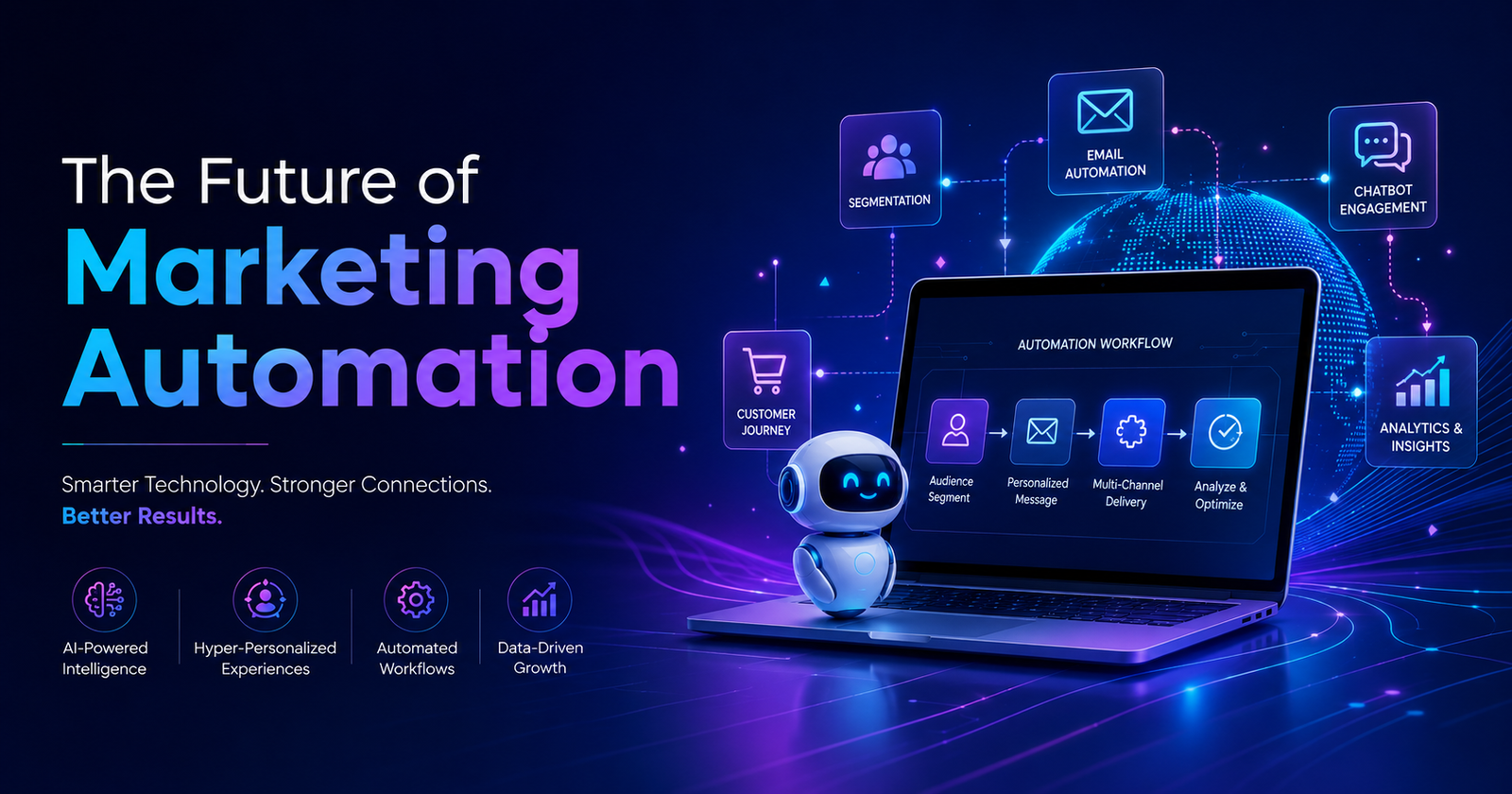
Marketing automation is evolving from rule-based sequences to AI-driven, predictive, hyper-personalized systems. Businesses that adopt these tools early will dominate. This post covers the top trends, real examples, a step-by-step adoption framework, and the tools leading the charge.
By 2027, the global marketing automation market is projected to exceed .7 billion (according to Statista, 2024 estimates — verify at statista.com for latest figures). That's not a trend. That's a tectonic shift.
If you're still manually scheduling emails, guessing the best send time, or copy-pasting reports every Monday — you're already behind. The future of marketing automation isn't just about saving time. It's about unlocking intelligence at a scale no human team can match.
Let's break it down.
1. AI-Powered Personalization at Scale
Mass marketing is dead. Consumers expect relevance — and AI delivers it.
The Shift from Segmentation to Individual Intelligence
Traditional automation groups users into buckets: "opened email last 30 days," "cart abandoner," "churned customer." Modern AI-driven automation treats every contact as a segment of one. It analyzes real-time behavior, purchase patterns, engagement history, and predictive signals to serve exactly the right message at exactly the right moment.
HubSpot's 2024 State of Marketing Report states that marketers using AI for personalization are 2.5x more likely to report strong ROI compared to those who don't (verify at hubspot.com/state-of-marketing). That number will only grow.
Real-World Example: Netflix-Level Logic for Email
Take a mid-size e-commerce apparel brand. By integrating Klaviyo's AI-powered send-time optimization and dynamic product recommendation blocks, a brand like this can increase email revenue per recipient by approximately 30–45% — without changing their content team's workload. The machine learns what works. Humans approve the creative. Automation executes at scale.
Pro Tip: Start with AI-powered subject line testing before overhauling your entire stack. Tools like Phrasee or Klaviyo's built-in AI subject line assistant give you AI wins with minimal lift.
2. Predictive Analytics and Revenue Intelligence
The best marketers don't react. They predict.
From Hindsight to Foresight
Predictive lead scoring uses machine learning to rank prospects by their likelihood to convert — factoring in firmographics, behavioral signals, engagement velocity, and historical win rates. According to Salesforce's State of Sales Report 2024 (verify at salesforce.com), organizations using AI for sales forecasting achieve approximately 28% higher win rates than those using traditional methods.
This isn't just for enterprise. Platforms like HubSpot, ActiveCampaign, and Zoho CRM now embed predictive scoring at SMB-accessible price points.
Real-World Example: SaaS Lead Prioritization
A B2B SaaS company selling project management software integrates Clearbit Reveal (now part of HubSpot) to identify anonymous website visitors, enriches them with firmographic data, then routes high-ICP accounts directly to sales — bypassing nurture sequences entirely. Result: sales team focuses only on accounts most likely to close. Marketing automation does the triage.
Pro Tip: Layer intent data (from tools like Bombora or G2 Buyer Intent) on top of your predictive score. A contact showing both high behavioral engagement AND third-party buying intent is a priority close — flag them for immediate SDR outreach.
3. Omnichannel Automation: One Brain, Every Channel
Breaking Silos Between Email, SMS, Ads, and Chat
The future of marketing automation is channel-agnostic. A single behavioral trigger — say, a user views a pricing page three times in five days — can fire:
- A retargeting ad on Meta and LinkedIn
- A personalized email from the sales rep
- A WhatsApp nudge with a case study
- A chatbot prompt on their next site visit
All coordinated. All consistent. All automated.
Tools like Braze, Iterable, and Customer.io are leading this omnichannel orchestration layer. Gartner predicts (verify at gartner.com for current reports) that by 2026, over 60% of B2C brands will operate fully unified cross-channel automation platforms.
Step-by-Step: How to Build Your First Omnichannel Automation Flow
- Map your highest-value conversion path — identify the 3–5 touchpoints that precede a purchase or sign-up.
- Choose a central automation platform — HubSpot, ActiveCampaign, or Braze depending on budget and scale.
- Define your trigger events — page views, email opens, ad clicks, form submissions.
- Build channel-specific message variants — same intent, adapted format for email vs. SMS vs. ad copy.
- Set frequency caps — avoid channel fatigue by capping total touches per contact per week.
- Test one channel at a time — add channels incrementally; measure lift before scaling.
- Review performance monthly — automation isn't set-and-forget. Optimize the flow as data accumulates.
Pro Tip: Start with just two channels — email plus retargeting ads — before adding SMS or chat. Omnichannel done half-right creates message fatigue faster than single-channel ever could. Prove the flow works, then expand.
4. The Future of Marketing Automation: What's Coming Next
Generative AI in Automation Workflows
Generative AI is being embedded directly into automation platforms. HubSpot's Content Assistant, Salesforce's Einstein GPT, and Jasper's workflow integrations now allow marketers to auto-generate email copy, ad headlines, and landing page variants — triggered dynamically by user segment and stage.
This means automation doesn't just fire messages anymore. It *writes* them, *personalizes* them, and *optimizes* them — in real time.
Autonomous Marketing Agents
The next frontier: fully autonomous AI marketing agents. Tools like Relevance AI and emerging agent frameworks allow AI to independently research prospects, draft outreach, monitor campaign performance, and reallocate budget — with minimal human input.
This isn't speculation. Early-adopter agencies and growth teams are running pilot programs today.
Pro Tip: Keep a human in the loop on anything AI-generated that touches pricing, legal claims, or outbound send volume. Autonomous agents are ready for research and first drafts — they're not ready to be unsupervised on anything customer-facing at scale.
Trend Snapshot
| Trend | What It Does | Top Tool |
|---|---|---|
| AI Personalization | 1:1 messaging at scale | Klaviyo, Braze |
| Predictive Scoring | Prioritize revenue-ready leads | HubSpot, Clearbit |
| Omnichannel Orchestration | Unified cross-channel journeys | Iterable, Customer.io |
| Generative AI in Automation | Auto-write + auto-optimize content | HubSpot Content Assistant |
| Autonomous AI Agents | Self-managing campaigns | Relevance AI |
Key Takeaways
- The future of marketing automation is AI-native, omnichannel, and predictive — not just email sequences.
- Businesses using AI-powered automation see measurably higher ROI, win rates, and conversion velocity.
- Start small: AI subject line testing, predictive lead scoring, and one omnichannel trigger flow can deliver immediate results.
- The autonomous AI agent era is arriving. Prepare your data infrastructure and team workflows now.
Ready to future-proof your marketing? Cross Globe Marketing builds automation systems that work while you sleep. Book a free strategy call with Cross Globe Marketing today →
Quick Summary
The future of marketing automation is AI-native, omnichannel, and predictive — not limited to scheduled email sequences. Businesses using AI-powered automation report measurably higher ROI, win rates, and conversion velocity than those relying on static workflows. The practical starting point is small: AI subject-line testing, predictive lead scoring, and one omnichannel trigger flow can deliver results quickly, while the underlying data infrastructure and team workflows are prepared for the autonomous agent era already arriving.