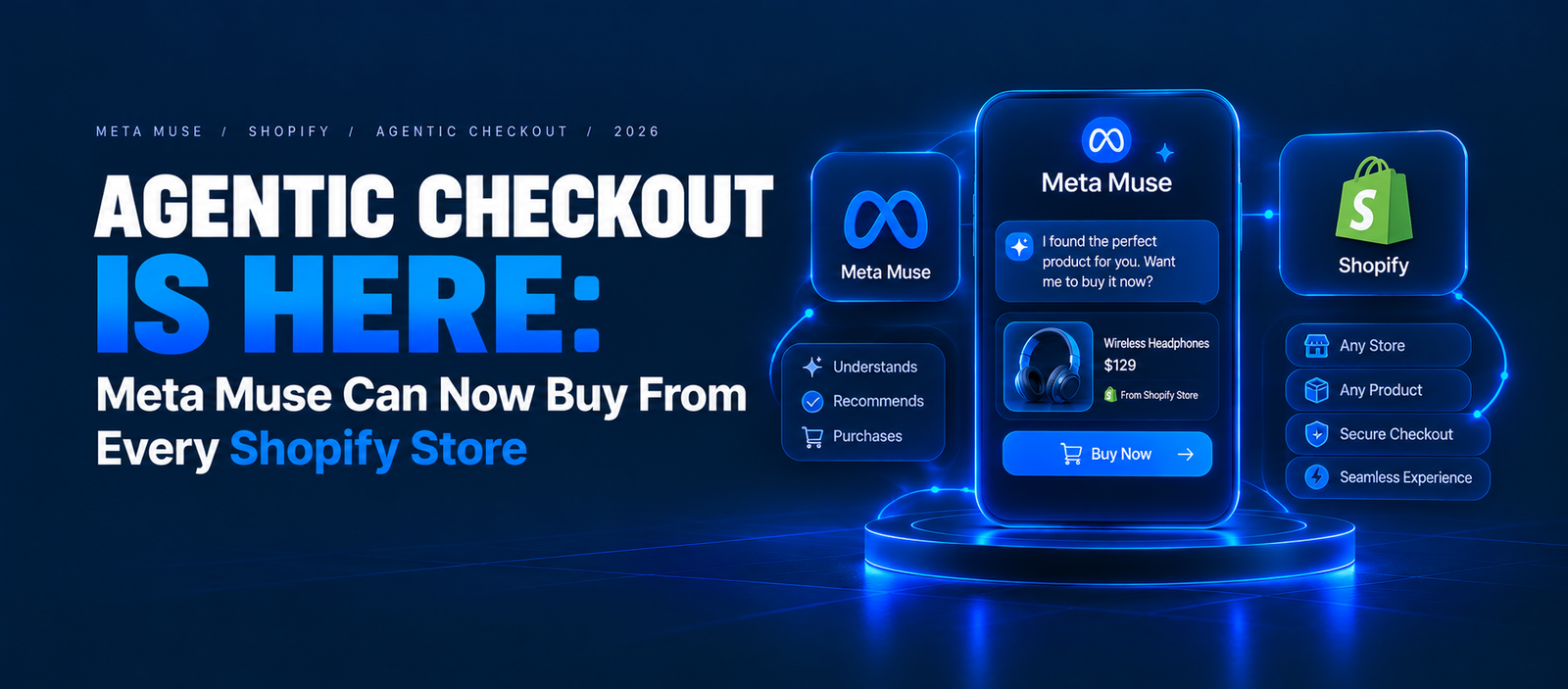
Agentic Checkout Is Here: Meta Muse Can Now Buy From Every Shopify Store
Agentic checkout just went mainstream. On September 21, 2026, Shopify and Meta announced that Muse, Meta's AI shopping agent, can complete purchases through Shop Pay on Shopify stores. Merchants stay seller of record, and direct checkout can be switched off. Here is what changed, what is still unclear, and how to prepare.
What happens when your next customer is not a person? On September 21, 2026, that question stopped being hypothetical. Shopify CEO Tobi Lütke announced a partnership to bring agentic checkout with Shop Pay to Muse, Meta's personal AI agent. Shop Pay had already passed $400 billion in lifetime accelerated gross merchandise volume, according to PYMNTS reporting on Shopify's August update. Now an AI can use that rail on a shopper's behalf.
The headline says "every Shopify store." The fine print is where the real strategy lives.
1. What Agentic Checkout Actually Means (and What Muse Does)
Agentic checkout is a purchase completed by an AI agent acting for the buyer, not by the buyer clicking through a store. The shopper gives a goal, the agent researches and selects, and the buyer approves the purchase. The Shopify and Meta deal is the clearest sign yet that this model is moving from demos to distribution.
What Is Agentic Checkout?
Think of it as a personal shopper with a payment method. Instead of searching, comparing tabs and filling forms, the user tells the agent what they need. Muse handles discovery and selection, then checks out through Shop Pay, Shopify's accelerated payment option that stores shopper email, payment and shipping details. For deeper background, read our guide to agentic commerce explained.
What Did Shopify and Meta Announce?
On September 21, Lütke said Shopify is partnering with Muse to enable agentic checkout with Shop Pay on all Shopify stores, per PYMNTS. Meta Chief AI Officer Alexandr Wang echoed the announcement, and Meta CEO Mark Zuckerberg framed it as "shoppers find more, shops sell more," as reported by Yahoo Finance.
Why Did Amazon Say No?
The contrast is the story. Amazon told Retail Insight Network that agentic third-party applications like Muse carry the same obligations as any other, and that it asked Meta to remove Amazon from the experience. PYMNTS reported Amazon's concern that an agent capturing and storing customer credentials creates privacy and security risks. Shopify chose to build an authorized rail; Amazon chose a wall.
Pro Tip: Treat this split as a channel decision. If most of your revenue runs through Shopify, agent traffic is now a channel to manage. If you sell on Amazon, expect agent access to stay restricted for now.
Next step: Not sure where your store stands? Keep reading, section 3 gives you a checklist.
2. How the Shopify–Meta Deal Works for Merchants
Muse does not need a custom integration with every store because Shopify already syndicates catalogs to AI channels. The mechanics matter more than the headline, because they decide who owns the customer, the order and the cost. Here is what the reporting says so far.
Default Settings and the Opt-Out
According to The Keyword, Shopify added Meta as a channel in Agentic Storefronts on September 8, and products are shared with Meta by default through Shopify Catalog. Direct checkout is on by default for eligible stores and is shown to customers in the US, Canada and Mexico. Merchants can switch it off under Sales channels, then Agentic; shoppers are then sent to the store's own site.
| Setting | Where the shopper pays | What the merchant controls |
|---|---|---|
| Direct checkout ON (default) | Inside Muse, via Shop Pay | Order lands in the standard Shopify Admin |
| Direct checkout OFF | On the store's own website | Full storefront and checkout experience |
Fees and Seller of Record
ExchangeWire reports the integration runs on Shopify's existing infrastructure: merchants remain the seller of record and pay their usual processing rates, with no additional fee layered on top. Compare that with ChatGPT, where The Keyword reported in January a 4% fee on Shopify merchant sales through its checkout. Fee structure, not just reach, should shape your channel math.
The Fine Print on "Every Store"
ContentGrip noted that Lütke's "all Shopify stores" statement is broader than the merchant-control guidance Shopify publishes for other AI channels. Some commentary says no setup is required, while Grazitti advises merchants to accept Shopify's Agentic Storefronts supplemental terms and complete their legal policy pages. Treat "every store" as the direction of travel, not a guarantee for your store today.
Pro Tip: Open Sales channels > Agentic > Meta in your Shopify Admin today and confirm what is actually enabled. Do not rely on headlines to know your own settings.
Next step: Want help auditing your channel settings? Talk to the Cross Globe Marketing team.
3. How to Prepare Your Store for Agentic Checkout
Agents reward clean data and frictionless checkout, and they punish gaps. Shopify's own agentic commerce guidance stresses that AI agents cannot fill gaps a merchant leaves in the catalog, according to analysis from WebPlanex. Early AI-native checkout results were also uneven; Qikify's analysis cited conversions running three times lower than traditional storefronts in some early tests, a single-source figure worth verifying.
Step-by-Step Setup Checklist
Follow this process:
- Audit your channel settings. Review Sales channels > Agentic and confirm Meta and direct checkout are set the way you want.
- Accept the terms. Review Shopify's Agentic Storefronts supplemental terms if prompted.
- Complete your legal pages. Fill in refund, shipping and privacy policies in your Shopify Admin.
- Clean your catalog. Fix titles, attributes, variants, pricing and inventory accuracy; use our Shopify SEO best practices as a baseline.
- Test the buying flow. Place test orders and check shipping, tax and discount behavior.
- Monitor orders. Agent orders land in your standard Admin, so tag and track them from day one.
What Does a Ready Store Look Like?
Consider an illustrative example, not real client data: a skincare store with vague titles like "Glow Serum" and inconsistent size variants. An agent comparing options cannot tell which bottle fits a "30 ml vitamin C serum for sensitive skin" request, so it skips the listing. Rewriting titles and attributes fixes discovery before checkout even matters. Pair that with the CRO checklist for product pages so the human fallback path converts too.
Pro Tip: Write product attributes for machines first: size, ingredients, compatibility, shipping time, return window. Clear, structured facts are what an agent can actually compare.
Next step: Download our store-readiness checklist or book an agentic commerce audit.
4. What Agentic Checkout Means for Marketers and SEOs
Agentic commerce is early, but the growth curve is steep. Shopify CFO Jeff Hoffmeister said on September 10 that agentic commerce is in its early days while expecting it to accelerate the shift of commerce online, PYMNTS reported. Marketers should treat it as a new discovery and conversion channel, not a replacement for search.
Is Agentic Commerce Big Enough to Matter?
WebPlanex, citing Shopify's reporting, states that Q1 2026 brought more than eight times the AI-referred sessions and nearly thirteen times the AI-referred orders of a year earlier. Those are growth multiples from a small base, so verify them against Shopify's primary filings before quoting them. Stellagent's analysis adds that Agentic Storefronts began a full rollout to roughly 5.6 million merchants on March 24, 2026, on an opt-out basis.
How Do You Win Visibility With AI Agents?
Agents choose from structured data, reviews, availability and price. That means product feeds, schema and brand signals become your new "ranking factors." Build a GEO strategy for AI search alongside classic SEO so your products are citable by assistants as well as findable on Google.
What Risks Should You Watch?
- Attribution: Agent orders may not look like standard referral traffic, so tag them early.
- Brand control: Agents compare you on facts, not creative; weak data loses.
- Platform conflict: Amazon's block shows access rules can change quickly.
Pro Tip: Add a "Muse / AI agent" view to your reporting now. Early baselines on orders, margins and returns will tell you whether to keep direct checkout on.
Next step: Want a plan for AI-agent traffic? Let us map your agentic commerce roadmap.
Summary
Agentic checkout turns AI from a recommendation engine into a buyer, and Shopify's Shop Pay rail gives Meta's Muse a sanctioned way to complete purchases. The opportunity is real, but so are the caveats: opt-out controls, regional limits, unclear "every store" scope and platform politics. Merchants who audit settings, clean data and track agent orders will learn faster than those who wait.
Key Takeaways
- Shopify and Meta announced Muse agentic checkout with Shop Pay on September 21, 2026 (PYMNTS, ContentGrip).
- Merchants remain seller of record and pay usual processing rates, with no additional fee reported (ExchangeWire).
- Direct checkout is on by default for eligible stores, shown in the US, Canada and Mexico, and can be turned off (The Keyword).
- Amazon asked Meta to remove it from Muse, citing obligations for agentic apps (Retail Insight Network via Yahoo Finance).
- Shop Pay passed $400 billion in lifetime accelerated GMV as of June (PYMNTS, citing Shopify).
- Shopify reportedly saw about 13x AI-referred orders year over year in Q1 2026 (WebPlanex; verify against Shopify filings).
Ready to turn agentic checkout into revenue? Contact Cross Globe Marketing for an AI-commerce readiness audit today.
Quick Summary
Agentic checkout lets an AI agent complete a purchase for the buyer, and on September 21, 2026 Shopify and Meta announced that Muse can do this through Shop Pay on Shopify stores. Merchants remain seller of record and pay usual processing rates, direct checkout is on by default for eligible stores and can be switched off, and Amazon has pushed back on Muse. Stores that audit their Agentic settings, structure product data and track agent orders are best placed to benefit.