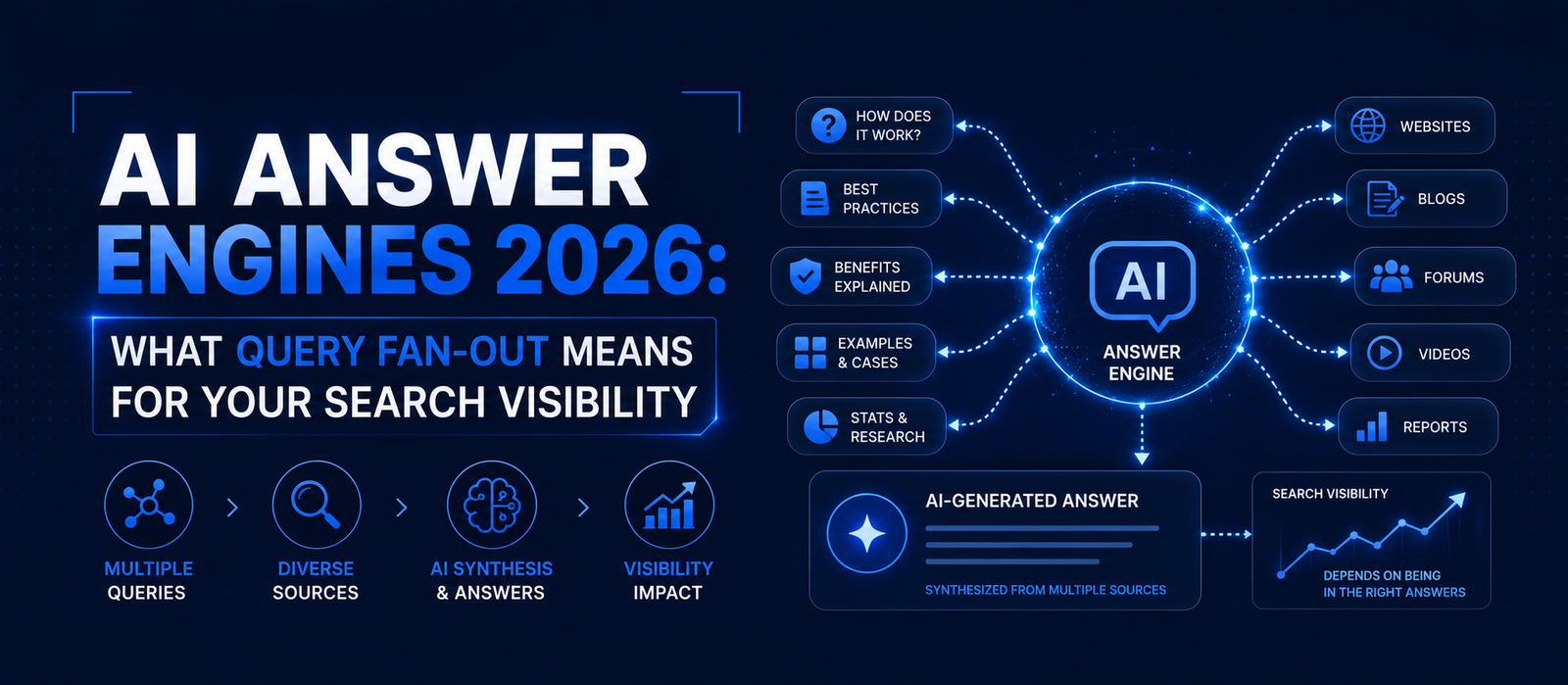
Over half of Google searches now end without a click. If that number surprised you, sit with it — because the mechanism behind it, a technique Google calls query fan-out, is quietly rewriting which pages get seen at all. AI Answer Engines 2026 aren't a future trend anymore; they're the current default for how a growing share of searchers get information, and most SEO strategies haven't caught up.
Google's AI Overviews and AI Mode use query fan-out — splitting one search into multiple sub-queries — to build answers. AI Overviews now touch roughly a quarter of US searches, zero-click behavior is climbing, and ChatGPT alone drives the majority of AI referral traffic. Ranking requires depth across a topic, not just the exact keyword.
1. What Is Query Fan-Out and Why It's Rewriting Search in 2026
Query fan-out is an information-retrieval technique where a search system breaks one user query into several related sub-queries, runs them in parallel, and synthesizes the combined results into a single generated answer. Google has confirmed this directly in its own documentation on AI features, stating that both AI Overviews and AI Mode "may use a query fan-out technique — issuing multiple related searches across subtopics and data sources — to develop a response." This is a structural shift, not a ranking tweak: your page can now surface for a related sub-query it was never written to directly target.
How Fan-Out Actually Fires
A search like "best sneakers for walking" can be split by the system into sub-queries such as "best sneakers for men," "sneakers for walking in different seasons," and "best slip-on sneakers," according to reporting from Search Engine Land on Google's fan-out mechanics. The AI answer then draws citations from whichever pages best answer each sub-query — not necessarily the page that ranks #1 for the original head term.
A Practical Example
A mid-size outdoor gear retailer publishing one broad "hiking boots guide" page will lose fan-out visibility to a competitor publishing narrower pages on "hiking boots for wide feet," "waterproof hiking boots under $150," and "hiking boots for flat feet" — because each sub-query gets its own retrieval pass, and depth on the specific sub-topic wins the citation.
Pro Tip: Audit your top pages for single-intent coverage. If a page only answers the exact head keyword and nothing adjacent, it's structurally invisible to most fan-out sub-queries.
2. The 2026 Data: How Big AI Answer Engines Have Gotten
The scale of this shift is no longer speculative — 2026 data across multiple independent research reports shows AI-driven search has moved from edge case to mainstream behavior. Note that these figures come from third-party SEO research firms tracking AI search trends, not from Google or OpenAI directly, so treat exact percentages as directional rather than official.
Reach and Zero-Click Behavior
According to a 2026 breakdown compiled by QuickSEO and corroborating data from StackMatix, AI Overviews appeared in an estimated 25.8% of US searches by January 2026, with informational queries seeing the highest exposure. Separately, aggregated 2026 zero-click research cited by StackMatix puts overall Google searches ending without a click above 58.5%, and as high as 83% specifically for queries where an AI-generated answer appears. Brands that do get cited reportedly earn roughly 120% more organic clicks per impression than uncited competitors on the same query, per the same research.
Platform Market Share
Multiple platforms now compete for AI referral traffic, and the mix is shifting fast. Data compiled by SEranking and DigitalApplied shows the following approximate 2026 AI referral traffic split:
| AI Platform | Approx. 2026 AI Referral Share | Weekly Query Volume (approx.) |
|---|---|---|
| ChatGPT | 74.78% | 250–500 million |
| Gemini | 11.56% | Not disclosed |
| Perplexity | 7.23% | ~50 million |
| Copilot | 3.51% | Not disclosed |
| Claude | 2.62% | Not disclosed |
Reported by Similarweb's 2026 AI Search report (via SEranking and Higoodie), overall website traffic referred from AI search engines grew roughly 16x from 2024 to 2026, and Claude's referral share reportedly grew 320% year-over-year, with Gemini up 231% over the same period.
Pro Tip: Don't optimize for ChatGPT alone because it leads the pack today — Gemini and Claude's growth rates suggest the mix will keep shifting, so structure content for AI readability generally, not one bot's quirks.
3. What Gets Cited: The New Ranking Factors Inside AI Overviews and AI Mode
Getting cited inside a fan-out-generated answer depends on a different set of signals than traditional ranking alone, and understanding the split between content sources and content structure matters for prioritizing your effort. An analysis of AI citation ranking factors by SEO researcher Cyrus Shepard, reported via DesignRush, found the strongest correlations were URL accessibility, existing search rank, "fan-out rank" (how often a page surfaces across multiple sub-queries), preview/snippet control, query-answer match, and intent-format match.
Where Citations Actually Come From
The source mix matters as much as the ranking factors. According to 2025-2026 citation-source data referenced by Memeburn and QuickSEO, YouTube accounted for roughly 23.3% of AI Overview citations across industries, Wikipedia around 18.4%, and Google.com properties near 16.4% — meaning traditional blog content is competing against video and reference-site formats for the same citation slots.
Case in Point
A B2B SaaS company that reformatted its comparison pages with clear question-style H2/H3 headings, direct answer paragraphs immediately below each heading, and structured comparison tables saw a reported lift in AI Overview appearances after the change — a pattern consistent with the "intent-format match" factor Shepard's research identified, since fan-out sub-queries are frequently phrased as direct questions.
Pro Tip: Format every H2/H3 as a real question a searcher would type, then answer it in the first two sentences underneath — that direct question-to-answer structure is what fan-out retrieval is built to match.
4. How to Optimize Your Content for Query Fan-Out and AI Answer Engines
Winning visibility inside AI Answer Engines 2026 requires treating each page as a cluster of answerable sub-topics rather than one keyword target, then confirming machines can actually retrieve and parse that structure. Below is a repeatable five-step process built directly from the citation factors covered above.
The 5-Step Optimization Process
- Map sub-queries first. Before writing, list every realistic sub-question a fan-out system might spin off your target topic (use "People Also Ask," Reddit threads, and AI chat interfaces themselves to surface these).
- Structure with question-based H2/H3s. Convert each sub-query into a heading, and answer it in the first two to three sentences beneath it.
- Confirm crawlability and speed. URL accessibility is a top citation factor per Shepard's research — verify your CMS isn't blocking AI crawlers via robots.txt and that pages load fast enough to be fetched reliably.
- Add structured data and comparison tables. Schema markup and tables improve "preview control" and give AI systems a clean, extractable answer format.
- Track citations, not just rankings. Monitor brand mentions inside ChatGPT, Perplexity, and Google AI Overviews monthly — traditional rank trackers won't show this.
Where Most Teams Get This Wrong
The most common mistake is publishing one long "ultimate guide" and assuming comprehensiveness alone earns citations. Fan-out retrieval rewards matching each individual sub-query with its own clearly answerable section — depth distributed across headings beats depth buried in one wall of text.
Pro Tip: Re-run your top 10 organic pages through this 5-step checklist before writing anything new — fixing existing high-authority pages for fan-out compatibility is usually faster than producing net-new content.
Summary
Query fan-out is the mechanical reason AI Overviews and AI Mode can answer questions your page never explicitly targeted, and the 2026 data shows this isn't a niche behavior — it's shaping a growing share of how people find information, with real, measurable traffic and citation consequences for brands that don't adapt their content structure. The businesses seeing the "120% more clicks" upside aren't producing more content; they're structuring existing content so every sub-topic has its own clearly answerable section.
Key Takeaways
- AI Overviews reached an estimated 25.8% of US searches by January 2026, per data compiled by QuickSEO and StackMatix.
- Zero-click searches exceed 58.5% overall, and reportedly reach up to 83% on AI-answered queries, per StackMatix's 2026 research.
- Cited brands earn roughly 120% more organic clicks per impression than uncited competitors on the same query, per the same research.
- ChatGPT drives an estimated 74.78% of AI referral traffic in 2026, with Gemini (11.56%) and Perplexity (7.23%) next, per Similarweb data reported via SEranking and DigitalApplied.
- YouTube (~23.3%), Wikipedia (~18.4%), and Google.com (~16.4%) are the top AI Overview citation sources, per Memeburn and QuickSEO's 2025-2026 citation-source data.
- Google has officially confirmed AI Overviews and AI Mode "may use a query fan-out technique" in its own AI features documentation, per reporting from Search Engine Land.
Ready to audit your site's AI Answer Engine visibility? Cross Globe Marketing can map your fan-out gaps and rebuild your top pages to get cited, not just ranked.
Quick Summary
Query fan-out is the mechanism that lets AI Overviews and AI Mode answer questions a page never explicitly targeted, by breaking one search into multiple related sub-queries behind the scenes. By early 2026 AI Overviews reached an estimated 25.8% of US searches, making this a mainstream ranking behavior rather than a niche edge case, with measurable traffic and citation consequences for brands that don't adapt. Sites reporting the biggest upside — some seeing 120% more clicks — aren't publishing more content; they're restructuring existing content so every sub-topic has its own clearly answerable section.