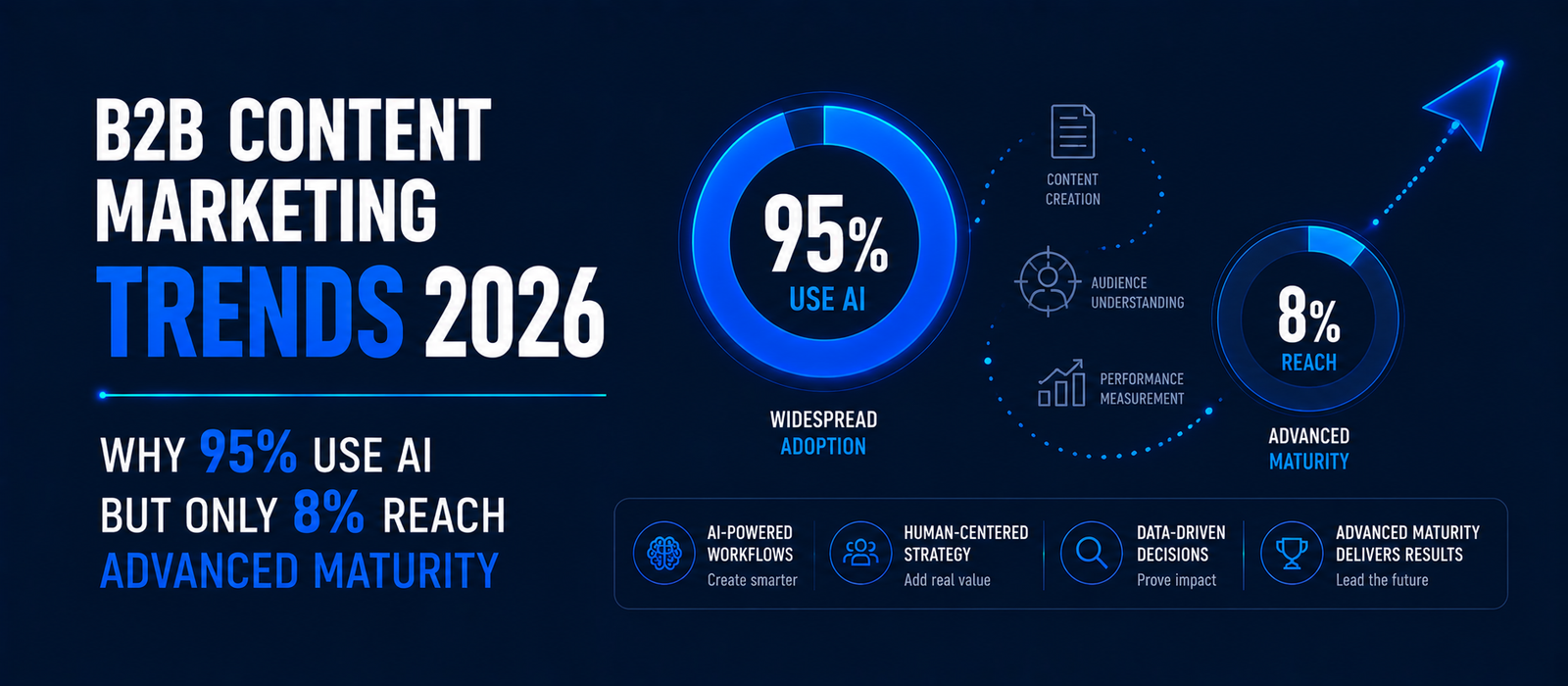
95%. That's the share of B2B marketers who say their organization now uses AI-powered applications somewhere in its content operation, according to Content Marketing Institute (CMI) and MarketingProfs' 2026 B2B research. Now the number that should worry every CMO reading this: only 8% rate their organization's AI implementation as "advanced" or "leading." Everyone adopted the tool. Almost nobody mastered it. That gap — not the tools themselves — is the defining story in B2B content marketing trends 2026, and it's reshaping which teams get more budget next year and which get questioned.
95% of B2B marketers use AI (CMI/MarketingProfs, 2026), but only 8% reach "advanced" or "leading" maturity, and just 39% see better content performance from it. The gap comes down to process, training, and scope — not the tools. Here's the data and a framework to close it.
1. The AI Paradox: What 95% Adoption vs. 8% Maturity Actually Means
B2B content marketing trends 2026 research makes one thing clear: adoption has plateaued at near-universal, but capability hasn't caught up. CMI and MarketingProfs surveyed 1,015 B2B marketers between June 24 and August 14, 2025, and mapped respondents against a five-stage AI maturity model — a useful lens for understanding why "everyone uses AI" and "AI is working" are two completely different claims.
The Five Stages of AI Maturity, and Where Everyone Actually Sits
The CMI framework splits organizations into exploratory, developing, established, advanced, and leading stages. The 2026 distribution: 20% exploratory, 48% developing, 24% established, 5% advanced, and 3% leading — meaning nearly 70% of B2B marketers are still in the first two stages, testing tools and getting mixed results, while only 8% combined have reached the top two.
| AI Maturity Stage | Share of B2B Marketers | What It Looks Like |
|---|---|---|
| Exploratory | 20% | Early testing, no defined workflow or governance |
| Developing | 48% | Basic implementation, mixed and inconsistent outcomes |
| Established | 24% | Consistent use with some measurable results |
| Advanced | 5% | Optimized workflows with strong, repeatable ROI |
| Leading | 3% | Industry-leading implementation, exceptional outcomes |
What Does "AI Maturity" Actually Mean for a Content Team?
Maturity isn't about how many AI tools show up in the tech stack — it's about whether a team has the process, governance, and judgment to turn AI output into content that performs. Picture two hypothetical B2B SaaS companies: one gives every writer an AI drafting tool with no editorial guardrails and calls that "AI adoption," while the other builds a scoped workflow — a defined brief, a human review step, and a way to measure whether the output actually converts. Both would answer "yes" to a survey asking if they use AI. Only one is anywhere near "advanced."
Pro Tip: Don't measure your AI progress by how many tools you've rolled out. Measure it by whether you can point to a documented workflow, a review step, and a metric that tells you the output is actually working.
2. Why So Few B2B Marketers Reach Advanced AI Maturity
The maturity gap isn't a mystery — CMI's research and follow-on analysis point to the same handful of structural causes repeating across the 92% of organizations stuck below "advanced." It's less that AI doesn't work and more that most teams are applying it without the scaffolding advanced teams have already built.
Performance Isn't Following Adoption
Using AI and getting better content out of it turn out to be weakly connected: CMI's 2026 research found only 39% of B2B marketers observe better content performance as a result of using AI. That's a roughly 56-point gap between the 95% who've adopted it and the 39% who can point to a real performance lift — which means for most organizations, AI is currently a cost added to the workflow, not yet a return on it.
Is This a New Problem Caused by Generative AI?
Not entirely. The underlying issue — organizations rolling out a capability faster than they build the process to use it well — predates the generative AI wave. What's new is the scale of the gap: with 95% adoption, there's now a much larger population of marketers running unscoped AI workflows than there ever was with earlier martech waves, which is part of why the maturity numbers look so lopsided in 2026.
Budget Is Chasing Tools, Not the Skills to Use Them
CMI's research also found 45% of B2B marketers are increasing investment in AI-powered marketing tools for the year ahead — the single largest planned budget increase in the survey — while only 9% plan to increase investment in human resources, including the salaries, training, and development that would actually build AI judgment on the team. Teams are buying more capability than they're building the skill to operate — the same budget-versus-skill mismatch shows up across leadership more broadly; see our breakdown of why most CMOs still fall short on agentic AI despite near-universal adoption.
Pro Tip: Before approving another AI tool purchase, ask what percentage of this year's AI budget went to training the people who use it. If the answer is close to zero, more tools won't move you toward "advanced."
3. The Real Cost: Effectiveness, Challenges, and Where Budgets Are Actually Going
The AI maturity gap doesn't exist in isolation — it's playing out against a backdrop where B2B content marketing overall is only modestly effective, and the same resource constraints that limit AI maturity are limiting everything else. Understanding both at once explains why "just add AI" hasn't been the fix most teams hoped for.
Content Effectiveness Still Tops Out at "Somewhat"
CMI's 2026 research found 59% of B2B marketers rate their content marketing as at least "somewhat effective" — split between just 12% who call it highly effective and 47% who call it only somewhat effective. That's a meaningful share of programs, AI-assisted or not, delivering results nobody would call strong, which is the exact condition under which adding an unscoped AI workflow tends to compound existing problems rather than fix them.
The Same Three Challenges Keep Showing Up
Asked what's holding content marketing back, B2B marketers named creating content that prompts a desired action like conversion (40%), resource constraints — time, people, and budget (39%), and measuring content effectiveness (33%) as their top three challenges. Notice that none of these three is "we don't have enough AI tools" — they're strategy, staffing, and measurement problems, which is exactly what a tool alone can't solve.
Where the Content Marketing Budget Is Actually Going
- 45% of B2B marketers are increasing spend on AI-powered marketing tools.
- 33% are increasing spend on events and experiential marketing.
- 32% are increasing spend on owned media.
- Only 9% are increasing spend on human resources — salaries, training, and development.
Pro Tip: If your top three reported challenges are strategy, staffing, and measurement, spend your next budget cycle fixing those directly rather than routing more of it through an AI tool and hoping the tool absorbs the gap.
4. Closing the Gap: A Framework for Moving From Adoption to Maturity
Reaching the "advanced" 8% doesn't require ripping out this year's AI tools and starting over — CMI's own data suggests the fix is closer to process discipline than technology. The organizations already at "established" or above didn't get there by using more AI; they got there by scoping it, governing it, and measuring it like any other content workflow.
A 5-Step Process to Build AI Maturity in B2B Content Marketing
- Audit which AI use cases are actually scoped — list every place AI touches your content pipeline and flag which ones have a defined brief, a human review step, and a success metric versus which are open-ended "just draft something" prompts.
- Fund training before the next tool purchase — with only 9% of marketers increasing human-resource investment, this is the fastest way to move ahead of most of the field rather than staying stuck at "developing."
- Attach a measurable outcome to every AI-assisted workflow — since only 39% currently observe better performance from AI, tying each use case to a specific metric (conversion rate, time-to-publish, engagement) turns a vague "we use AI" into evidence you can act on.
- Fix your top three named challenges first — content that drives action, resourcing, and measurement are the barriers B2B marketers actually report, so a maturity push that skips them and only adds AI tooling is solving the wrong problem.
- Re-benchmark against the five-stage model quarterly — moving from exploratory or developing toward established and advanced is incremental, and tracking it quarterly against CMI's stages keeps the goal concrete instead of aspirational.
What Would an "Established" Team's Workflow Look Like?
An organization at the "established" stage — the 24% CMI found doing consistent AI implementation with measurable results — typically has a documented brief format AI drafts against, a named person accountable for reviewing output before publish, and a dashboard tracking whether AI-assisted content converts at parity with (or better than) fully human-drafted content. None of that requires a bigger AI budget; it requires deciding those three things exist and enforcing them.
Pro Tip: Pick one single content workflow — not your whole content operation — and take it from "developing" to "established" this quarter. Proving the model on one workflow makes it far easier to fund expanding it to the rest of the team.
Summary
The story underneath B2B content marketing trends 2026 isn't that AI failed — it's that adoption sprinted ahead of the process, training, and measurement needed to turn AI use into AI results, leaving 92% of B2B marketers somewhere below "advanced" even as 95% have the tools in hand. Closing that gap is less about buying the next AI platform and more about doing the unglamorous work CMI's data points to: scoping workflows, funding people alongside tools, and measuring outcomes instead of usage.
Key Takeaways
- 95% of B2B marketers say their organization uses AI-powered applications (source: Content Marketing Institute & MarketingProfs, 2026 B2B research, n=1,015).
- Only 8% combined rate their AI implementation as "advanced" (5%) or "leading" (3%) (source: CMI & MarketingProfs, 2026).
- Just 39% of B2B marketers observe better content performance as a result of using AI (source: CMI & MarketingProfs, 2026).
- 59% rate their overall content marketing as at least "somewhat effective," with only 12% calling it highly effective (source: CMI & MarketingProfs, 2026).
- Top challenges are creating action-driving content (40%), resource constraints (39%), and measuring effectiveness (33%) (source: CMI & MarketingProfs, 2026).
- 45% are increasing AI tool spend for the year ahead, but only 9% are increasing investment in the people who use those tools (source: CMI & MarketingProfs, 2026).
If your team is part of the 95% using AI but unsure whether you're anywhere near the 8% seeing real results from it, talk to Cross Globe Marketing's marketing consultation team about a B2B content and AI-maturity audit before you plan next year's budget. For a broader look at where B2B AI adoption is heading industry-wide, see HubSpot's State of AI Marketing Trends 2026 breakdown.
Quick Summary
B2B content marketing trends 2026 show a wide gap between AI adoption and AI maturity: 95% of B2B marketers now use AI-powered applications, but only 8% combined reach the "advanced" or "leading" stages of implementation, and just 39% report measurably better content performance from using it (Content Marketing Institute & MarketingProfs, 2026). The gap traces back to process and investment rather than the technology itself — 45% of marketers are increasing AI tool spending while only 9% are increasing investment in the training and staffing needed to use those tools well, even as the top reported challenges remain creating action-driving content, resource constraints, and measuring effectiveness rather than a shortage of AI tools.