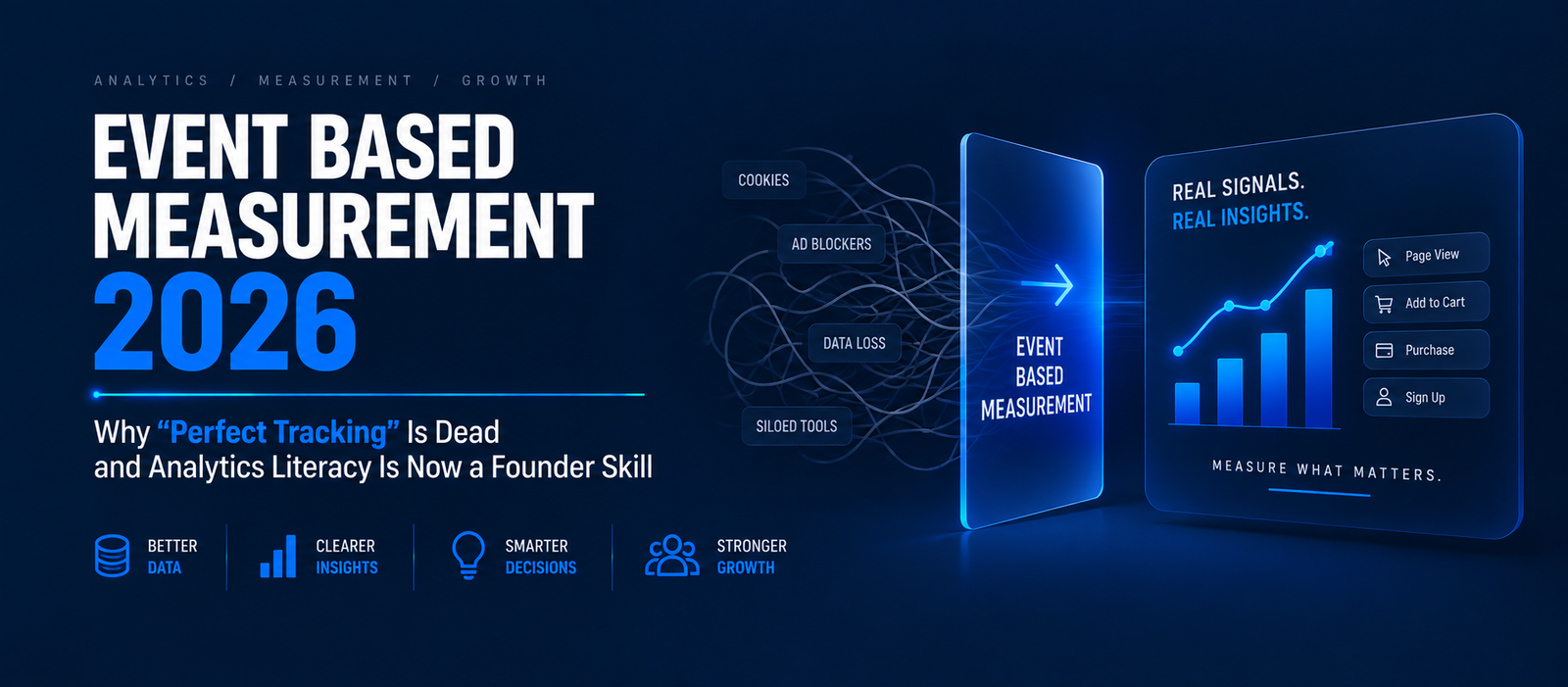
Event Based Measurement 2026: Why "Perfect Tracking" Is Dead and Analytics Literacy Is Now a Founder Skill
Only 29% of marketers say they're extremely confident their attribution data is accurate. Sit with that for a second — nearly three out of every four people making budget decisions from a dashboard don't fully trust the numbers on it. That's not a niche complaint from an underfunded startup; it's the industry median in 2026.
Cookie deprecation and consent law ended "perfect" session-based tracking for good. Event based measurement 2026 — first-party, consent-aware, server-side — is the replacement, but it only works if the person reading the dashboard understands what it can and can't prove. That makes analytics literacy a founder skill now, not a specialist's job.
For a decade, marketers ran on an assumption: track everything, stitch it together with third-party cookies, and trust the funnel. That assumption is gone, and nothing has fully replaced the false comfort it provided. What's replaced it is event based measurement — and the businesses winning with it aren't the ones with the biggest martech budget, they're the ones where the founder or CMO can actually read the data correctly.
1. Why "Perfect Tracking" Died in 2026
"Perfect tracking" was never really perfect — it was a convenient illusion built on third-party cookies, cross-device stitching, and assumptions about identity that browsers and regulators have spent years dismantling. What changed in 2026 is that the illusion finally became too expensive to maintain, forcing even small teams to confront how much of their historical funnel data was inference rather than fact.
What "Perfect Tracking" Actually Promised (And Why It Was Always a Myth)
Session-based analytics tools promised a clean, continuous view of a user's journey: first touch, every channel in between, and the final conversion, all connected by a persistent cookie ID. In reality, that chain broke constantly — ad blockers, Safari's Intelligent Tracking Prevention, multi-device behavior, and app-to-web handoffs all created silent gaps that dashboards simply filled in with modeled guesses, presented with the same confidence as hard data.
The 2026 Data Points That Confirm It's Over
According to Deloitte's March 2025 global marketer survey, only 15% of marketers felt fully ready for a cookieless measurement world — and that readiness gap has now collided with reality. Separate research on attribution accuracy found cookie deprecation has driven a 20% to 35% decline in attribution accuracy across B2B organizations, with cross-domain tracking setups losing as much as 60% accuracy in affected cases. On the other side of the shift, IAB's State of Data research found 71% of brands, agencies, and publishers are now growing their first-party datasets — nearly double the 41% reported just two years earlier — which tells you where the industry has actually landed. A mid-sized ecommerce brand we reviewed had spent three years optimizing toward a last-click model that, once audited, turned out to be crediting retargeting ads for sales that would have happened anyway; once cookie-based tracking degraded further, that inflated retargeting "win rate" simply had nowhere left to hide.
Pro Tip: Don't wait for your existing dashboard to visibly break before questioning it — if your attribution model hasn't been audited against a first-party data source in the last 12 months, assume it's already drifting.
2. Event Based Measurement 2026: The Architecture Replacing Session Tracking
Event based measurement doesn't track a "session" tied to a cookie at all — it logs discrete, consented actions (a signup, a purchase, an add-to-cart, a scroll-depth milestone) as first-party events, typically sent server-side directly from a business's own systems rather than relying on a browser to relay them. That architectural shift is what makes the data more durable against ad blockers, browser restrictions, and privacy regulation, though it comes with real trade-offs founders need to understand.
How Event-Based Measurement Works in Practice
Instead of a third-party cookie following a user across the web, an event-based setup — think GA4's event model, server-side Google Tag Manager, or Meta's Conversions API — captures the action directly from the website or app backend and pairs it with consent state and first-party identifiers (a logged-in user ID, a hashed email) rather than a cross-site tracking ID. According to Improvado's 2026 marketing analytics research, 81% of organizations have now adopted privacy-first measurement strategies, and 88% are projected to rely primarily on first-party data by 2027 — meaning this isn't an edge-case setup anymore, it's becoming the default. A B2B SaaS client migrated its trial-signup tracking from a client-side pixel to a server-side event fired at account creation; signup counts didn't change much, but attributed revenue from paid channels dropped 18% once ad-blocked and consent-declined sessions stopped being silently modeled as conversions — a more honest number, even though it stung.
Session-Based vs. Event-Based Tracking: A Side-by-Side Comparison
| Factor | Session-Based Tracking | Event-Based Measurement |
|---|---|---|
| Data source | Third-party cookie, browser-relayed | First-party event, often server-side |
| Survives ad blockers/ITP | No — degrades significantly | Yes — largely unaffected |
| Consent handling | Often bolted on after the fact | Built in at the event level |
| What it measures | Modeled "sessions" and inferred paths | Discrete, verified actions |
| Cross-device accuracy | Weak, relies on probabilistic matching | Strong, if identity is first-party |
Founders evaluating a new analytics setup should ask their vendor or agency directly whether a recommended server-side tracking setup guide has actually been implemented for the account, rather than assuming a GA4 property alone counts as "event-based."
Pro Tip: Ask any analytics vendor one question before signing: "Which of these events are captured server-side, and which still rely on the browser?" If they can't answer specifically, the setup isn't as consent-resilient as advertised.
3. Why Analytics Literacy Is Now a Founder-Level Skill, Not Just an Analyst's Job
Event-based data is more accurate, but it's also less forgiving — it won't quietly smooth over gaps with modeled estimates the way session-based tools did, which means whoever reads the dashboard needs to understand what a given number actually represents. In small and mid-sized companies, that person is increasingly the founder, not a dedicated analyst nobody has hired yet.
The Skills Gap by the Numbers
DataCamp and YouGov's 2026 State of Data & AI Literacy survey of 500+ enterprise leaders found 60% of organizations report a data skills gap, even though 88% of leaders say basic data literacy is essential to their day-to-day work — and 74% say they'd pay a higher salary specifically for it. The gap looks even sharper at the top: The CMO Club's survey of 401 global CMOs found 78% identify data science as a critical skills gap and 68% cite analytics specifically, with 31% having already outsourced their insights function entirely rather than build the muscle in-house. This mirrors the CMO trust gap in marketing analytics that shows up across leadership levels — the tools got more precise while the confidence to interpret them didn't keep pace.
What Founders Specifically Need to Understand About Event Data
A founder doesn't need to write SQL, but they do need three things: the difference between correlation and causation in an event dashboard, why a spike in one event (like "add to cart") doesn't guarantee a spike in revenue, and how consent rates affect what percentage of real activity is even visible in the data. A solo founder we spoke with had paused a high-performing ad set because GA4 showed a drop in "purchase" events — only to discover the drop coincided with a consent banner update that had quietly reduced tracked events by 22% while actual orders, confirmed in the payment processor, hadn't moved at all.
Pro Tip: Before reacting to any sudden change in an event metric, cross-check it against a source outside your analytics tool — your payment processor, CRM, or order system — since consent and tracking changes can move the dashboard without moving the business.
4. Building an Event-Based Measurement Stack You Can Actually Trust
Building the right stack matters less than building one the whole team, founder included, actually understands and checks regularly — a technically flawless setup nobody can interpret correctly produces the same bad decisions as a broken one. The goal is a small number of trusted event sources paired with a habit of validating what they show.
6-Step Process to Set Up Trustworthy Event-Based Measurement
- Audit every existing tracking source and flag anything relying purely on third-party cookies or client-side pixels without a server-side or first-party backup.
- Define your core events first — signup, purchase, key activation action — before adding secondary events, so the dashboard isn't cluttered with noise nobody reads correctly.
- Implement server-side tagging (server-side GTM, Conversions API, or platform-native equivalents) for every event tied to a budget decision.
- Connect consent state to every event so drops in tracked activity can be separated from drops in real business activity.
- Pair event data with a causal check — a lightweight marketing mix modeling vs incrementality testing comparison — before crediting any single channel with a result event data alone can't prove.
- Review the dashboard with the founder or decision-maker monthly, not just the analyst, so literacy builds alongside the data itself.
Common Mistakes When Founders Migrate to Event-Based Measurement
The most common failure isn't technical — it's treating event-based measurement as a one-time project rather than an ongoing practice, then reverting to gut feel the moment a number looks confusing. Google and BCG's research on first-party data found businesses using first-party data in campaigns saw a 2.9x increase in revenue lift compared to those relying on other data sources, but that lift assumes the first-party data strategy playbook behind it is actually followed, not just implemented once and forgotten. Separately, research on attribution and measurement gaps found 78% of marketing leaders believe meaningful budget is being wasted specifically because of inadequate measurement — a number that won't move for a founder who builds better infrastructure but never learns to read what it's telling them.
Pro Tip: Budget time, not just money, for measurement — a monthly 30-minute "read the dashboard together" habit between the founder and whoever owns marketing catches more bad decisions than any single tool upgrade.
Summary
The thread running through cookie deprecation, event-based architecture, the skills gap, and stack design is the same one: event based measurement 2026 replaced a system that was comfortable but quietly wrong with one that's accurate but demands more from the people using it. Businesses that treat this as purely a technical migration will end up with better data and the same bad decisions as before, while the ones that pair the new architecture with real analytics literacy at the founder level will be the ones who can actually trust their next budget call.
Key Takeaways
- Only 29% of marketers report being extremely confident in their attribution data's accuracy, and 78% of marketing leaders believe budget is being wasted due to inadequate measurement (source: attribution accuracy and trust research, 2026 compilation).
- Cookie deprecation has driven a 20-35% decline in attribution accuracy across B2B organizations, with cross-domain tracking losing up to 60% accuracy in affected setups (source: marketing attribution accuracy research, 2026).
- Only 15% of marketers felt fully ready for a cookieless measurement world as of March 2025 (source: Deloitte global marketer survey).
- 71% of brands, agencies, and publishers are now growing their first-party datasets, nearly double the 41% reported two years earlier (source: IAB, State of Data).
- 60% of organizations report a data skills gap even though 88% of leaders call data literacy essential, and 74% would pay a salary premium for it (source: DataCamp and YouGov, 2026 State of Data & AI Literacy survey, 500+ enterprise leaders).
- Businesses using first-party data saw a 2.9x revenue lift compared to those relying on other data sources (source: Google and BCG research on the business impact of first-party data).
If your dashboards look busier than ever but you still can't say with confidence what's actually driving results, talk to Cross Globe Marketing about building an event-based measurement stack — and the literacy to read it — before your next budget cycle.
Related services and guides
- Conversion tracking and attribution — Set up measurement you can trust.
- Performance reporting — Clear reporting on what drives results.
- Data tracking and analytics — Our analytics and tracking service line.
Quick Summary
Event based measurement 2026 is the first-party, server-side, consent-aware replacement for session-based tracking, which broke down as third-party cookies faded and only 15% of marketers felt ready for a cookieless world (Deloitte). It captures discrete, verified actions instead of modeled sessions, which is why 71% of brands are now growing first-party datasets and 81% have adopted privacy-first measurement strategies. The remaining gap isn't technical — it's that 60% of organizations report a data skills gap even as 88% call data literacy essential, meaning the accuracy of event-based systems only pays off when founders and decision-makers can actually interpret what the data does and doesn't prove.