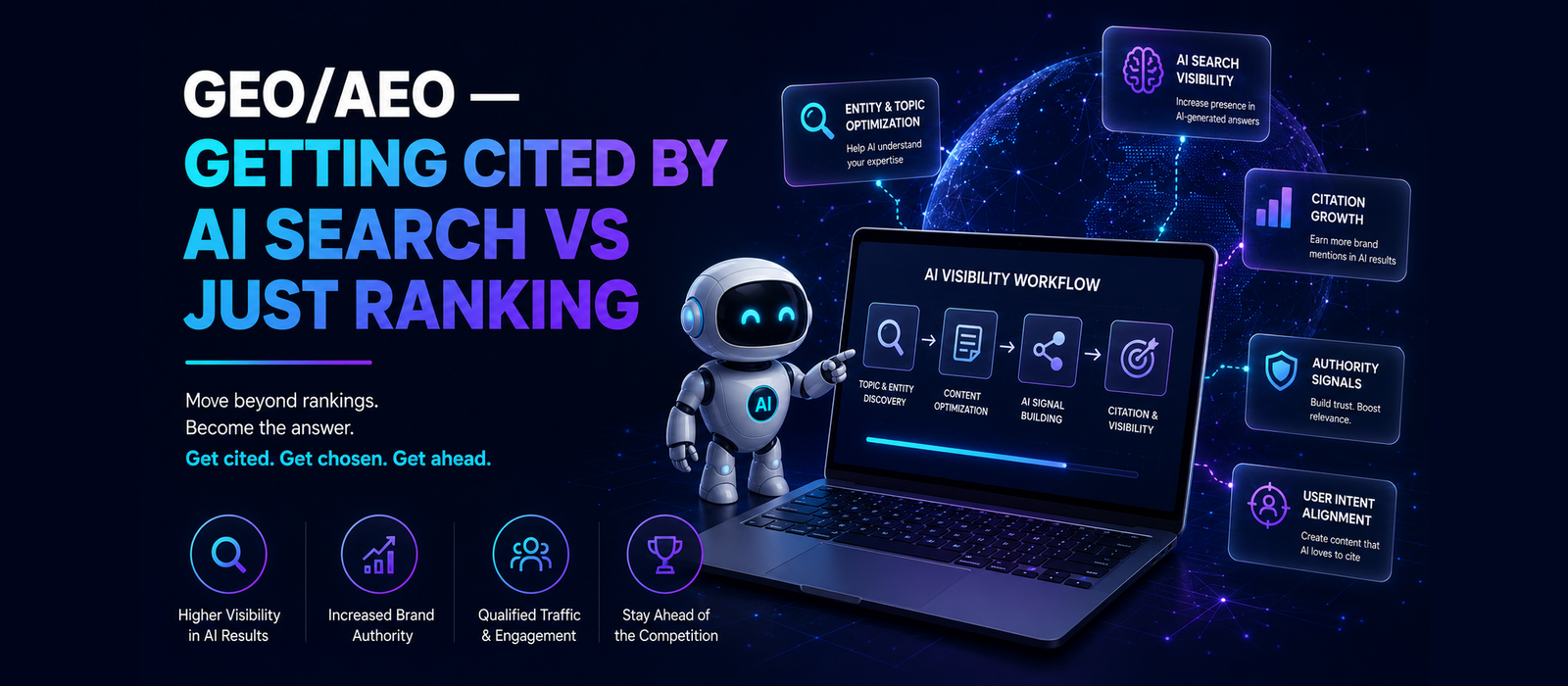
Ranking #1 doesn't guarantee visibility anymore. As AI answer engines like ChatGPT, Perplexity, and Google's AI Overviews rewrite how people search, brands need a new discipline: getting cited inside the answer itself, not just ranked below it.
A large and growing share of Google searches now end without a single click (figures vary by source and change quickly — verify current numbers before quoting them). The searcher gets an answer directly in the results page or from an AI assistant, and moves on. If your content isn't the source of that answer, you've effectively lost the visitor — even if your page technically ranks #1.
This is the shift behind two fast-growing disciplines: Generative Engine Optimization (GEO) and Answer Engine Optimization (AEO). Here's what they actually mean, how they differ from traditional SEO, and the concrete steps that move the needle in 2026.
1. The Search Landscape Has Already Changed
From Ranked Links to Generated Answers
Traditional SEO optimizes for a position on a results page. GEO and AEO optimize for something different: being the source an AI model chooses to quote, summarize, or recommend when it generates an answer. Our SEO team breaks this down further in a full site audit — but the short version is that "ranking" and "being cited" are now two separate goals, and most sites are only optimizing for one of them.
Why This Matters More for Some Industries Than Others
Informational and comparison-driven queries — "best," "how to," "vs" — are where AI-generated answers show up most aggressively. Service businesses, SaaS products, and anything with a considered purchase decision are especially exposed, because that's exactly where buyers are now asking AI assistants for a shortlist before they ever visit a website.
Pro Tip: Search your own brand's core questions directly in ChatGPT, Perplexity, and Google's AI Overview. If a competitor gets cited and you don't, that's your GEO gap — and it's usually fixable within a few content updates.
2. GEO vs. AEO vs. Traditional SEO — What's Actually Different
These three disciplines overlap heavily, but they optimize for different outcomes:
| Discipline | Optimizes For | Primary Signal |
|---|---|---|
| Traditional SEO | Ranking position on the results page | Backlinks, technical health, keyword relevance |
| AEO | Being the direct answer to a specific question | Clear, self-contained answers; structured data |
| GEO | Being cited or summarized inside AI-generated responses | Authority, clarity, and citability of individual content chunks |
In practice, none of these replace the others. A page still needs solid technical SEO to be crawled and trusted in the first place — GEO and AEO build on top of that foundation, they don't substitute for it.
Pro Tip: Don't treat GEO as a replacement project. If your technical SEO foundation is weak — slow pages, blocked crawlers, thin content — fix that first. AI answer engines still lean on the same crawlable, well-structured pages traditional search does.
3. How to Actually Get Cited by AI Search Engines
This is where most of the actionable work happens. A few principles consistently show up across GEO guidance from search and content teams:
- Answer the question in the first sentence. AI systems reward content that validates the query immediately, not three paragraphs into a preamble.
- Write in self-contained sections. AI models frequently pull individual chunks of a page rather than the whole thing — each H2/H3 section should make sense read in isolation.
- Use real, checkable data. Vague claims get skipped. Specific, sourced figures get quoted — but only cite a source if you can actually verify it's accurate and current.
- Structure for machines, not just readers. Clear headings, FAQ sections, and schema markup (FAQPage, Article, HowTo) all make it easier for an AI system to parse and trust your content.
- Build topical depth, not just single pages. AI systems weigh authority across a whole topic cluster — a structured content strategy matters more here than any single blog post.
Pro Tip: Pick your 3 most-asked customer questions and rewrite the opening sentence of each relevant page to directly answer them before anything else. That single change usually moves the citation needle faster than any schema update.
4. What This Means Going Into the Rest of 2026
The practical reality: SEO and GEO are converging, not splitting into separate jobs. The sites winning right now are the ones treating "get ranked" and "get cited" as the same project, built on the same technical foundation, measured with two different sets of questions.
If you're only tracking keyword rankings and ignoring whether your brand shows up when someone asks ChatGPT or Perplexity the same question, you're measuring half the picture. See how this plays out in our latest marketing automation deep-dive.
Pro Tip: Add "Do we get cited when someone asks ChatGPT about [core topic]?" to your monthly reporting alongside keyword rankings. If nobody's tracking it, nobody will notice when it slips.
Key Takeaways
- Zero-click search means ranking #1 no longer guarantees visibility — being cited inside AI answers is the new goal.
- GEO and AEO build on traditional SEO; they don't replace the technical fundamentals.
- Content that answers questions immediately, in self-contained sections, with checkable data, gets cited more often.
- Manually testing your own brand's questions in ChatGPT and Perplexity is the fastest way to spot your citation gaps.
Want to know if your brand is actually visible in AI search? Get a free SEO audit from Cross Globe Marketing — we now check AI-citation visibility alongside traditional rankings.
Quick Summary
GEO (Generative Engine Optimization) and AEO (Answer Engine Optimization) are the practices of getting a brand cited inside AI-generated answers on ChatGPT, Perplexity, and Google's AI Overviews — not just ranked in traditional blue links. They build on existing SEO fundamentals rather than replacing them: content still needs technical crawlability and authority, but it also needs to answer questions immediately, in self-contained, checkable sections that an AI system can quote directly. The fastest way to spot a citation gap is to manually ask ChatGPT and Perplexity your own brand's core questions and see whether you're the source they cite.