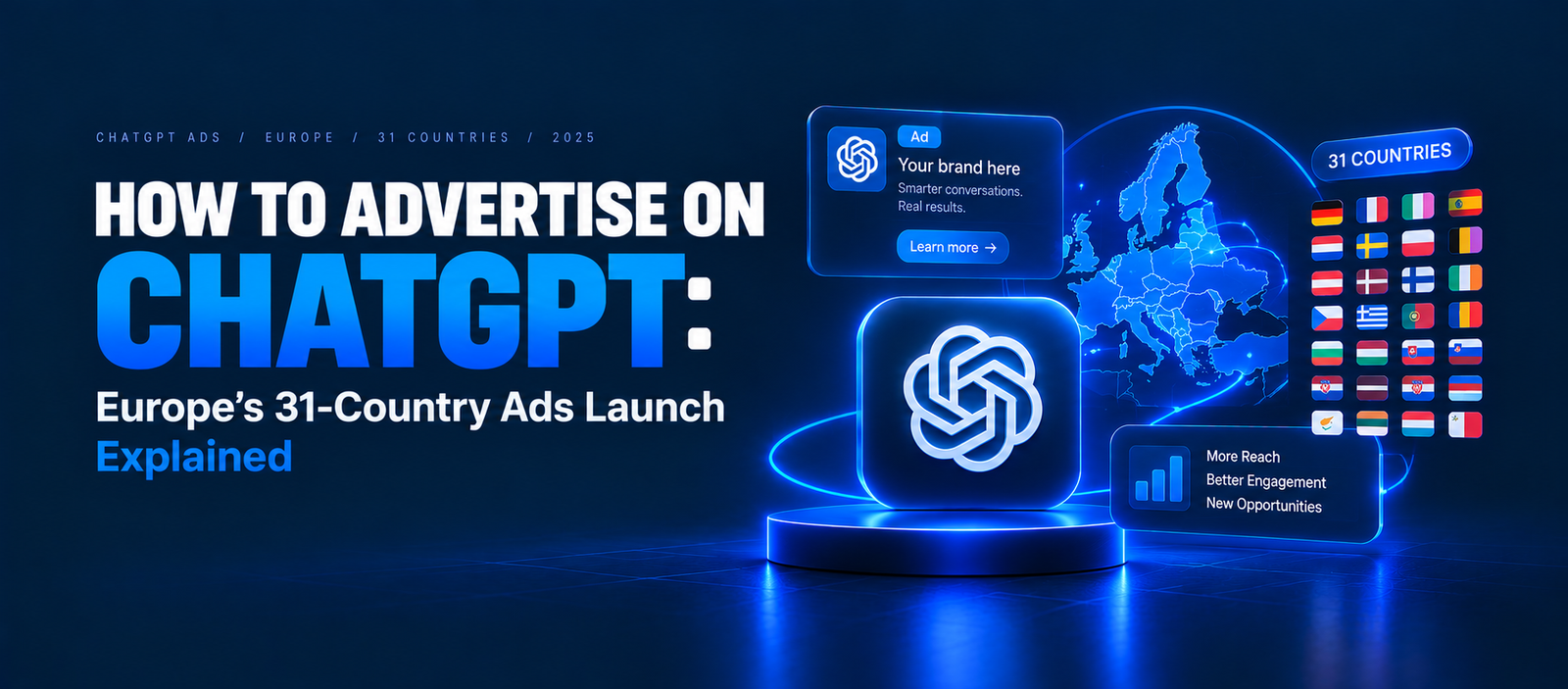
How to Advertise on ChatGPT: Europe's 31-Country Ads Launch Explained
OpenAI began showing ChatGPT Ads in 31 European countries on 24 August 2026, with self-serve Ads Manager opening on 31 August. Ads reach only Free and Go users, sit below answers and never change them. Here is how to advertise on ChatGPT: rules, placements, costs and a six-step launch plan.
Tens of thousands of marketers have already advertised on ChatGPT, according to OpenAI. Europe just joined the auction. If you are asking how to advertise on ChatGPT, the door is open: ads went live across 31 European markets in late August 2026, and self-service buying followed days later. This guide covers the rules, placements, costs and a launch plan, so you test smart instead of burning budget.
1. What Just Launched: ChatGPT Ads Across 31 European Countries
OpenAI announced on 18 August 2026 that ChatGPT Ads would expand to 31 European markets, its largest rollout since a US pilot began in February. The appeal is simple: people explain goals in full sentences inside ChatGPT, so an ad can meet them mid-decision. Paid placement is only half of AI visibility, though; earning organic mentions is the other half, covered in our generative engine optimization guide.
When Did ChatGPT Ads Launch in Europe?
Ads began appearing on 24 August 2026, according to Euronews, lifting the total to 40 markets worldwide. At first, advertisers had to buy through OpenAI's Ads Solutions team, agency partners or technology partners. On 31 August, OpenAI confirmed that self-service access through Ads Manager is available across all 31 European markets.
Which Countries and Users Are Covered?
OpenAI names Germany, France, Spain, Italy, Sweden, Norway, Denmark, the Netherlands and Austria among the 31. Confirm the full list in OpenAI's help center before planning country-level budgets. Only people on the Free and Go plans see ads; Plus, Pro and Enterprise subscribers stay ad-free.
*Illustrative example (hypothetical):* A Lyon-based project-management SaaS notices prospects asking ChatGPT to compare tools. Instead of guessing keywords, it plans a test campaign aimed at that "compare and decide" moment.
Next step: Create your account at ads.openai.com before you design a single creative.
Pro Tip: Register your Ads Manager account early. Verification takes time, and key account settings reportedly cannot be changed afterwards.
2. The Rules: Placements, Policies and Privacy
Before you spend, understand the guardrails. OpenAI says ads are clearly labeled, separate from ChatGPT's answers, and never influence what the model says. Those principles shape where ads run, what you can promote and how targeting works in Europe.
Where Do ChatGPT Ads Appear?
A ChatGPT ad appears as a labeled sponsored card below the answer, not inside it. Trade reports describe the card as a brand name, headline, description, image and landing page link. Ads must also be clearly distinguishable from the ChatGPT experience, so imitation of ChatGPT's look or voice is a fast route to rejection.
What Can't You Advertise?
OpenAI's ad policies are strict. Key restrictions at the time of writing:
- Gambling, alcohol and drugs, dating or sexual content, and political ads are disallowed at launch.
- Financial services and health services outside the US are generally prohibited.
- Ads for individual job listings or housing rentals and sales are prohibited.
- Exaggerated results, false endorsements and deception are banned in every category.
Policies have changed several times already, so check current rules inside Ads Manager.
How Does Privacy Change Targeting in Europe?
OpenAI says it keeps conversations private from advertisers and never sells customer data, and users control ad personalization. Digiday reportedly found that the EU launch does not use chat history or personal profiles, relying on conversation topic, approximate location, device, language and time of day instead. Treat this as reported, not guaranteed, and verify current targeting options in your account.
*Illustrative example (hypothetical):* A Berlin online store selling running shoes wants to appear when someone asks which shoes suit marathon training, not when they type a brand keyword.
Next step: Audit your offer against the prohibited list before you build creative.
Pro Tip: Submit one real ad for review early. Category eligibility is decided at the advertiser and ad level, so approval is your true answer.
3. How to Advertise on ChatGPT: Six Steps to Your First Campaign
Setting up is closer to Meta or Google Ads than to publishing a post, with a few unusual twists. Here is the shortest path from zero to a live test, followed by the creative and measurement details that decide whether the test teaches you anything. If you already run paid media, your performance marketing strategy will transfer, but your keyword habits will not.
The Step-by-Step Launch Process
- Sign up and verify. Register at ads.openai.com and complete business verification. Reportedly, country, currency and timezone lock after creation, and the payment card should match the verified company and country.
- Install measurement. Add the OpenAI Pixel and, ideally, the Conversions API. OpenAI also supports third-party measurement integrations.
- Check eligibility. Match your category against OpenAI's ad policies.
- Describe the situation, not keywords. Targeting reportedly runs on contextual signals, so describe who is solving what problem and why your product fits.
- Build creative. Use a clean square image, a short headline and a tight description. Early limits reportedly sit around 50 characters for headlines and 100 for descriptions, and may change.
- Launch small. Choose CPC, CPM or conversion optimization, tag your URL with UTM parameters and start with a capped test budget.
Creative, Landing Pages and Measurement
The image displays small, so design it like an app icon: one clear subject, no text. After the click, message match matters, which is why a tested conversion rate optimization checklist belongs in your launch plan. Reportedly, the default attribution window is seven days after a click and one day after a view; confirm yours in Ads Manager.
Next step: Brief your developer on Pixel and Conversions API setup this week.
Pro Tip: Add UTM parameters from day one. Without them, paid ChatGPT traffic blends into organic ChatGPT referrals in analytics.
4. Costs, Bidding and How to Test Smart
Money is where hype meets reality. OpenAI has widened buying options quickly, yet it publishes no official performance benchmarks, so every number you read online should be treated as a starting hypothesis, not a promise.
What Do ChatGPT Ads Cost?
OpenAI says the platform now supports CPM and CPC bidding plus conversion optimization, alongside geo-targeting and custom audiences. A trade report says the February US pilot reportedly required a USD 200,000 minimum spend, while today there are no minimum commitments. Another analysis put CPMs roughly between USD 25 and 60; treat that as anecdotal and verify with your own data.
ChatGPT Ads vs Google Search Ads
| Factor | ChatGPT Ads | Google Search Ads |
|---|---|---|
| Trigger | Conversation context | Typed keywords |
| Placement | Labeled card below the answer | Search results page |
| Query visibility | Reportedly no triggering-conversation report | Search terms report available |
| Buying options | CPC, CPM, conversion optimization | CPC, CPM, automated bidding |
| Maturity | Launched Feb 2026, no official benchmarks | Mature, extensive benchmarks |
Keep working campaigns untouched and review your Google Ads campaign structure before moving any budget.
How Should You Test the Channel?
Run ChatGPT Ads from a separate test budget with success criteria set upfront. One agency reasoned that a test shorter than a few months proves little, and click-through rates reportedly trail paid search because users often keep chatting instead of clicking. Judge on conversions and learning, not clicks.
Next step: Set a test budget you can afford to lose, plus a review date.
Pro Tip: Group one intent per ad group. Mixing research, comparison and purchase conversations makes results unreadable.
Summary
ChatGPT Ads turn conversations into a paid channel at the moment buyers compare options, and Europe now has full access. The opportunity is real but young: rules are strict, benchmarks are thin and several details are still reported rather than confirmed. Smart advertisers prepare account, measurement and creative now, then learn cheaply.
Key Takeaways
- OpenAI announced the 31-market European expansion on 18 August 2026 and confirmed self-service Ads Manager access on 31 August (OpenAI).
- Ads reach only Free and Go users; Plus, Pro and Enterprise stay ad-free (OpenAI).
- Ads show as labeled cards below answers and do not influence responses (OpenAI).
- Financial and health services outside the US are generally prohibited under OpenAI's ad policies (OpenAI Ad Policies).
- Tens of thousands of marketers have advertised on ChatGPT, and bidding now includes CPC, CPM and conversion optimization (OpenAI).
- The EU launch reportedly relies on contextual signals rather than personal profiles (Digiday, via MAIRA).
Ready to learn how to advertise on ChatGPT with a smart, low-risk test? Talk to Cross Globe Marketing today and launch your first campaign.
Related services and guides
- ChatGPT ads — Advertising inside ChatGPT.
Quick Summary
How to advertise on ChatGPT in Europe starts with a self-serve OpenAI Ads Manager account, available across 31 European markets since 31 August 2026. Ads appear as labeled sponsored cards below answers for Free and Go users only, and they do not influence ChatGPT's responses. Advertisers choose CPC, CPM or conversion optimization, must respect strict category policies, and should run a capped test budget with Pixel and Conversions API measurement.