Best Email Send Time 2026: What 14 Billion Emails Reveal About Send-Time and Design "Rules"
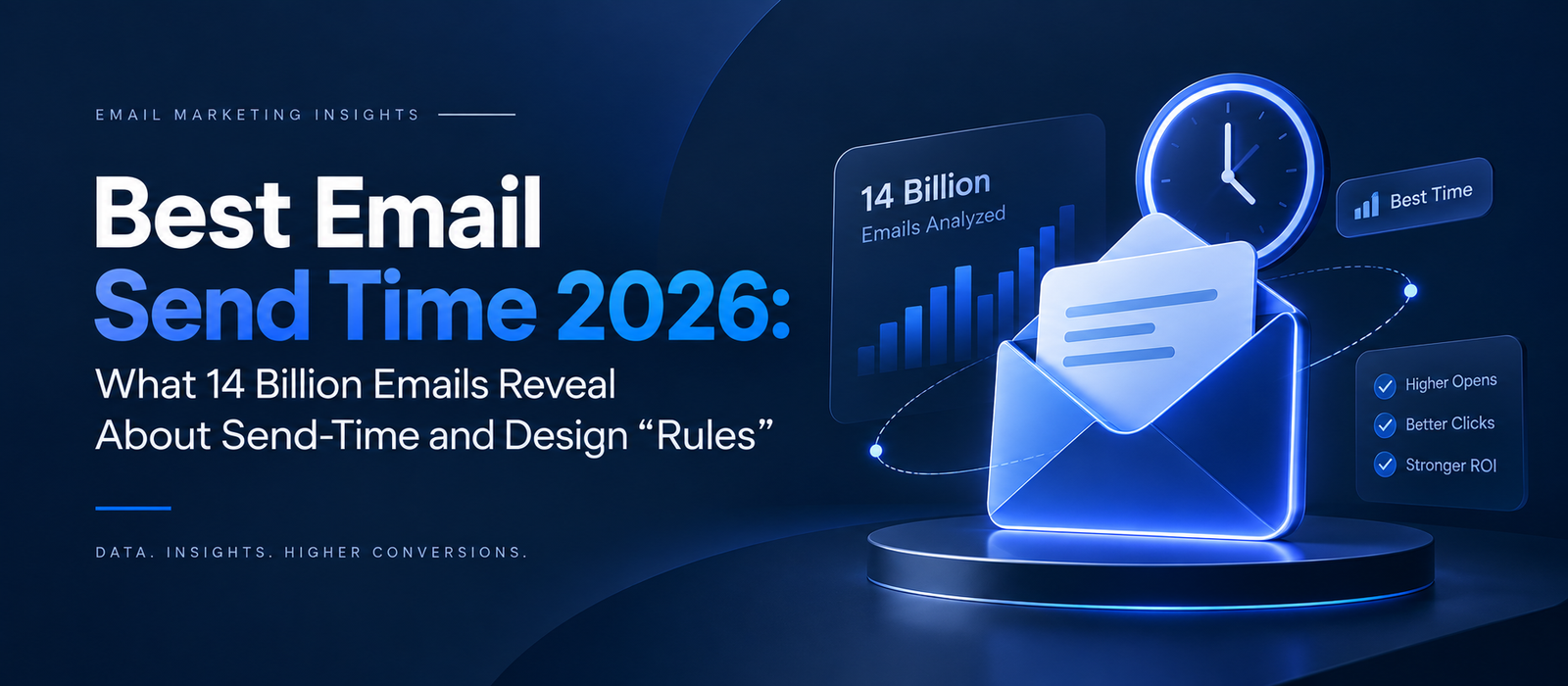
Flodesk analyzed 14 billion emails across 3 million campaigns and found the best email send time 2026 is 5–8 a.m. ET (21% higher opens), image-heavy emails now beat text-only ones, and several classic subject-line "rules" barely matter. Segmentation still delivers the biggest single lift.
14 billion emails. 3 million campaigns. One inconvenient truth: most of what your team believes about email timing and design is either outdated or was never true. Flodesk's 2026 Email Marketing Trends Report just put the industry's favorite "best practices" under a microscope, and a lot of them didn't survive contact with the data. If you've been agonizing over the "perfect" send time or stripping every image out of your newsletter because someone once said minimalism converts better, the best email send time 2026 data below is going to change how you plan your next campaign.
This isn't a hunch dressed up as a stat. It's the actual behavior of real subscribers, at scale, across a full 18-month window — and it's bold enough to challenge assumptions Cross Globe Marketing has tested with clients too.
1. Inside the Study: What 14 Billion Emails Actually Prove
Most "best time to send email" advice circulating online traces back to surveys of marketers' opinions, not subscriber behavior — which is exactly the gap Flodesk's 2026 report was built to close. The company pulled send, open, and click data from January 2025 through July 2026 across its own platform, giving it a dataset large enough to smooth out the noise that skews smaller studies.
The Scale Nobody's Ignoring
A sample of 14 billion emails sent through 3 million campaigns is large enough to treat as ground truth rather than a trend to eyeball, according to Flodesk's 2026 Email Marketing Trends Report. That scale matters because email behavior varies wildly by list size, industry, and even time zone distribution — a study of a few thousand sends can easily overweight one quirky audience. At 14 billion data points, those quirks average out.
Why Aggregate Data Beats Anecdotal "Best Practices"
Does a study this large actually apply to a small business list? Largely yes, because the report is measuring subscriber behavior patterns — when people check inboxes, what visual format holds attention — that don't fundamentally change based on list size, even though your specific numbers will vary. A boutique e-commerce brand with 2,000 subscribers and an enterprise SaaS company with 200,000 are both sending into the same human inbox habits this data captures.
Pro Tip: Treat this report as a starting hypothesis, not gospel — send at 6 a.m. ET to a small segment first and compare it against your current schedule before rolling the change out to your full list.
2. The Best Email Send Time 2026 Data: Why Early Mornings Win
Here's the headline finding: the best email send time 2026 window is 5–8 a.m. ET, and it isn't a marginal edge — Flodesk's data shows a 21% jump in opens compared to sends outside that window. That single stat should be reason enough to test a schedule change this month, but the report goes further into which hour performs best and which triggers beat any fixed schedule entirely.
The Send-Time Numbers, Hour by Hour
| Send Window | Performance vs. Other Times | Notes |
|---|---|---|
| 5–8 a.m. ET | +21% higher opens | Strongest overall window |
| 5 a.m. ET specifically | Top-performing single hour | Best hour in the dataset |
| Midnight | Weakest performance | Avoid scheduling here |
| Day of week | <1 percentage point variation | Largely irrelevant — except Saturday |
| Saturday | Lowest-performing day | Worst day to send, regardless of hour |
Automated Triggers Beat Any Scheduled Send
If timing matters this much, does automation still work? It works better than manual scheduling in almost every case, because Flodesk's data shows behavior-triggered emails ignore the clock problem entirely by firing at the moment of highest subscriber intent. Post-purchase follow-ups pulled roughly 2.7x the platform's average open rate, and freebie-delivery emails — the automated send after someone claims a lead magnet — landed around 2.5x average. Re-engagement campaigns, sent to cold subscribers on a schedule rather than triggered by a fresh action, came in as the lowest-performing category in the entire dataset. A skincare brand sending a "thanks for your order" email the instant a purchase completes, rather than batching it into tomorrow's 9 a.m. send, is a simple example of how much intent-based timing can outperform even the best fixed schedule — the same shift toward triggered, intent-based systems is showing up across AI marketing automation for small business more broadly, not just email.
Pro Tip: Before you rebuild your entire send calendar around 5–8 a.m. ET, audit which of your emails could be automation-triggered instead — a well-timed trigger beats a perfectly timed newsletter.
3. The Design Rule Flodesk Debunked: Images Beat Minimalist Text
For years, "keep it simple, keep it text-heavy" has been repeated as an email design rule, on the theory that plain-text emails feel more personal and dodge spam filters. Flodesk's 2026 data says that advice is now working against senders: image-heavy emails are winning, and by a wide margin.
The Numbers Behind the Reversal
Emails where images fill at least a third of the layout saw 45% higher opens and 37% more clicks than text-heavy alternatives, per Flodesk's 2026 report — and text-only campaigns landed 34% below the platform average on opens. That's not a small stylistic preference; it's a meaningful performance gap that should change how much time your team spends on visual design versus copy alone.
A Real-World Example: The Newsletter Redesign Test
Consider a mid-sized online boutique that spent a year sending stripped-down, text-only weekly updates on the assumption that it read as more authentic. Based on Flodesk's findings, simply reintroducing a hero image and two or three supporting product shots per send — without changing the copy at all — is the kind of change that aligns with the 45%-higher-opens pattern the report documents. The lesson isn't "always maximize images" — it's that the industry's swing toward minimalist, text-only email over the past few years overcorrected past what subscribers actually respond to.
Pro Tip: Don't go from zero images to a graphics-heavy layout overnight. Add one strong hero image first, measure the open-rate change on a test segment, then decide how far to push it.
4. Subject Lines and Segmentation: Which Rules Still Hold Up
Not everything old is wrong — some subject-line advice checks out, some barely matters, and one lever still dwarfs everything else in this report. Sorting out which is which keeps you from spending effort "optimizing" a rule that was never actually costing you opens.
What the Subject Line Data Actually Shows
Do words like "free" or "buy now" really hurt deliverability, like everyone says? Mostly not — Flodesk's data found only seven specific phrases measurably reduce opens (by 5–20%): "work from home," "make money," "limited time," "guaranteed," "hurry," "don't miss out," and "act now." Beyond that narrow list, the report found subject lines of 12 words or more saw 6% lower opens, subject lines over 90 characters saw 4% lower opens, subject lines without numbers saw up to 14% higher opens, and — perhaps the most counterintuitive result — two emojis placed at the start of a subject line produced up to an 11% lift. None of this matters if the email never reaches the inbox in the first place, which is why correct SPF, DKIM, and DMARC setup still comes before any subject-line optimization.
Segmentation Is Still the Biggest Lever in the Room
Compare any of the above to what happens when you simply target the right audience: segmented sends produced roughly 3.6x higher opens and 3.3x higher clicks than blasting a full, unsegmented list, according to Flodesk's report. For context on where "average" sits industry-wide, Mailchimp's benchmark data (last refreshed in December 2023, so treat it as a directional baseline rather than a current figure) puts the average open rate across all senders at 35.63% and average click rate at 2.62% — numbers that make a 3.6x segmented lift look enormous by comparison. This lines up with what we've seen writing about email personalization over send volume: relevance to the individual subscriber outperforms almost every other lever you can pull.
A 3-Step Process to Apply This Data to Your Next Send
- Move your next campaign's send time into the 5–8 a.m. ET window and compare open rates against your last three sends at your usual time.
- Add at least one hero image to a historically text-only email and track opens and clicks against the text-only version.
- Split your list into two segments based on any behavior you already track — purchase history, engagement level, signup source — and send the same content to both, then compare performance.
Pro Tip: Run all three tests in the same month using a small holdout group, so you're not stacking multiple variables into one result you can't actually attribute.
Summary
The throughline across Flodesk's 14-billion-email study is that subscriber behavior has quietly shifted while a lot of "best practice" advice stayed frozen in place — the best email send time 2026 is earlier and narrower than most calendars assume, plain-text minimalism is now underperforming rather than converting better, and only a handful of the subject-line taboos senders still avoid actually cost them opens. None of these findings replace testing on your own list, but they give you a far better starting hypothesis than guesswork or outdated advice ever did.
Key Takeaways
- 5–8 a.m. ET produces 21% higher opens than other send windows, with 5 a.m. as the single strongest hour (source: Flodesk 2026 Email Marketing Trends Report, 14 billion emails, 3 million campaigns).
- Day of week barely matters (under 1 percentage point of variation), except Saturday, which underperforms every other day (source: Flodesk 2026 Email Marketing Trends Report).
- Image-heavy emails see 45% higher opens and 37% more clicks than text-heavy ones, while text-only campaigns run 34% below average (source: Flodesk 2026 Email Marketing Trends Report).
- Post-purchase automated emails hit roughly 2.7x average open rates, and freebie-delivery emails hit roughly 2.5x average (source: Flodesk 2026 Email Marketing Trends Report).
- Only seven specific subject-line phrases measurably reduce opens, while two emojis at the start of a subject line can lift opens by up to 11% (source: Flodesk 2026 Email Marketing Trends Report).
- Segmented sends produce roughly 3.6x higher opens and 3.3x higher clicks than unsegmented blasts, dwarfing the industry-wide average open rate of 35.63% (source: Flodesk 2026 Email Marketing Trends Report; Mailchimp Email Marketing Benchmarks, data last updated December 2023).
If your current send schedule and design template haven't been tested against this data yet, Cross Globe Marketing can help you run the send-time, design, and segmentation tests above on your own list before your next campaign goes out.
Related services and guides
- Email A/B testing and optimization — Test timing, subject lines and content with a clear method.
- Email campaign strategy and copywriting — Campaign planning and copy for your list.
- Email marketing services — Strategy, flows and deliverability for brands that rely on email.
Quick Summary
The best email send time 2026 is 5–8 a.m. ET, according to Flodesk's analysis of 14 billion emails across 3 million campaigns, which found this window drives 21% higher opens than other times, with 5 a.m. as the single best hour and Saturday as the weakest day. The same study found image-heavy emails now outperform text-only ones by 45% on opens and 37% on clicks, only seven specific subject-line phrases measurably hurt performance, and segmented sends produce roughly 3.6x higher opens than unsegmented blasts — making segmentation, not send time or design alone, the single biggest lever in the dataset.