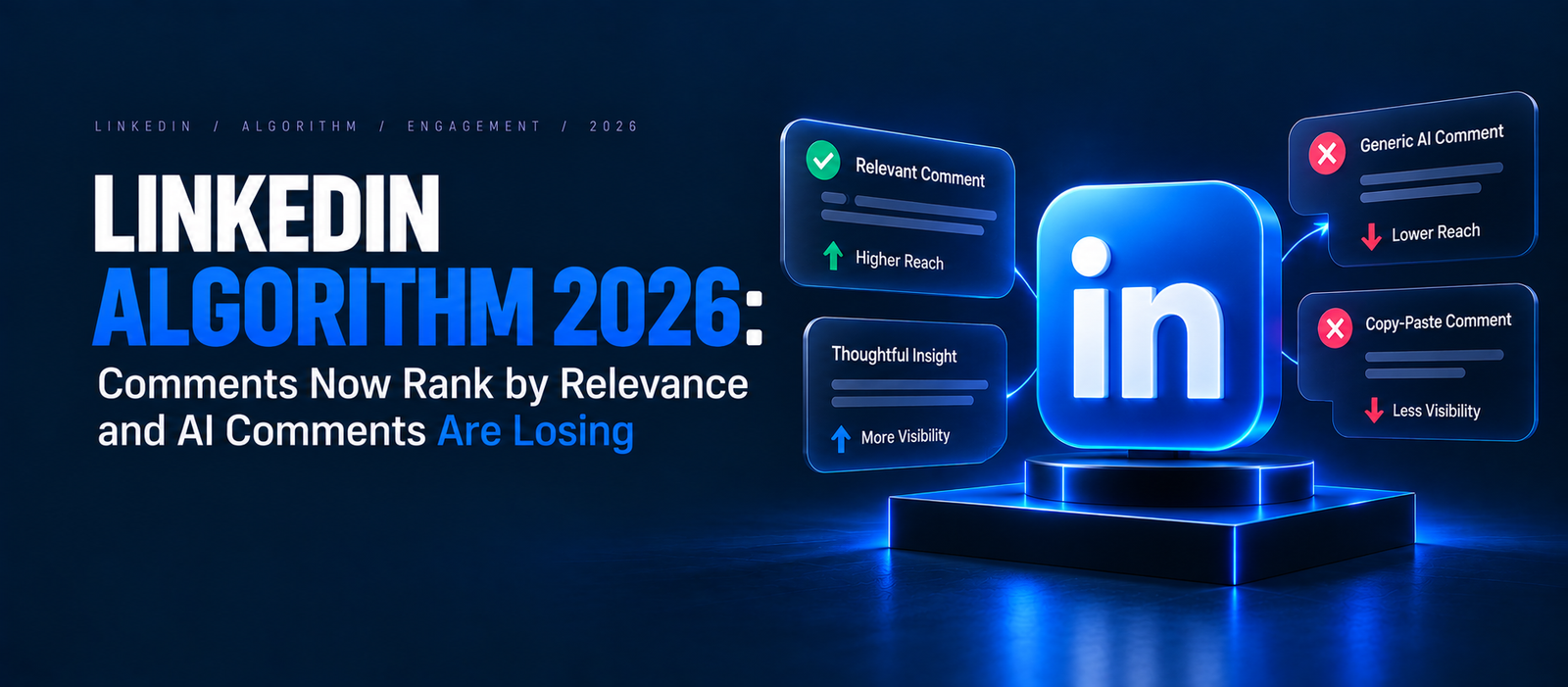
LinkedIn Algorithm 2026: Comments Now Rank by Relevance and AI Comments Are Losing
The LinkedIn algorithm 2026 ranks comments by relevance to each viewer, not by timing. Automated comments get pulled from "Most Relevant," can be limited to the commenter's network, and repeat offenders risk restrictions. About 30% of comments from April–June 2026 were fully AI-generated (Pangram Labs). Specific, expert, human comments now win.
Nearly one in three LinkedIn comments posted between April and June 2026 was written entirely by a machine. That's the finding from a Pangram Labs analysis of 57,000 public posts, reported by Social Media Today in August 2026. LinkedIn has responded, and the linkedin algorithm 2026 now handles comments very differently.
The "comment first with 'Great insight!'" playbook no longer works. Comment threads are now sorted by relevance to each viewer, and LinkedIn is actively demoting automated comments and engagement pods. If your LinkedIn strategy leans on comment volume, some of that activity has likely stopped counting.
Below: what changed, why, and exactly how to adapt.
1. What Changed: The LinkedIn Algorithm 2026 Now Ranks Comments by Relevance
The biggest shift is simple to state. Comments used to appear in close to one fixed order for every reader, which heavily rewarded speed. Now LinkedIn orders each thread individually for each viewer, so two people opening the same post can see different comments at the top.
Which Signals Decide Comment Ranking?
According to Social Media Today's August 9, 2026 report, LinkedIn uses signals "including professional interests, connections and engagement activity." LinkedIn has not published a complete list or how the signals are weighted, so treat any "exact formula" you see online with caution.
What this means in practice:
- Professional interests: a comment about SaaS pricing ranks higher for people who follow SaaS topics.
- Connections: comments from people in a viewer's network are more likely to surface.
- Engagement activity: comments that start replies and real discussion carry more weight.
Why Did LinkedIn Make This Change?
Comments have become one of LinkedIn's most valuable areas. LinkedIn reported an 18% year-over-year increase in time spent in post comments and a 10% rise in overall content consumption in its Q2 2026 figures. When a section grows that fast, spam follows it. Chronological sorting let low-effort "first!" comments take the top spot. Relevance ranking removes that advantage.
Example (illustrative): Two founders comment on a viral post about B2B pricing. One writes "So true 🔥" eight seconds after it goes live. The other posts 20 minutes later with a three-line breakdown of how they tested annual versus monthly pricing. Under relevance ranking, pricing-focused viewers are far more likely to see the second comment first. Speed no longer beats substance.
Pro Tip: Stop racing to comment first. Comment where you have real expertise, because relevance ranking favors comments that match what the viewer cares about.
Want your team's LinkedIn activity built around relevance instead of volume? Cross Globe Marketing can audit it.
2. The Crackdown: How LinkedIn Is Treating AI Comments and Engagement Pods
Relevance ranking is only half the update. LinkedIn is also going after the inauthentic engagement that inflated comment sections for years. This is an ongoing, official campaign, not a quiet tweak.
What LinkedIn Has Said Officially
In February 2026, Gyanda Sachdeva, LinkedIn's VP of Product Management, outlined the measures against automated comments, as reported by Social Media Today. Comments posted "through a third party auto-script or a browser plugin without any human oversight or review" can be:
- Removed from the "Most Relevant" section of the comment thread
- Restricted in reach so they mostly show only to the commenter's direct connections
- Grounds for account restrictions for users who "continuously post automated comments"
SocialDay reported in September 2026 that LinkedIn now blocks hundreds of thousands of automated comment attempts every day as part of the wider crackdown on engagement pods.
Why Engagement Pods Are a Liability Now
An engagement pod is a group that agrees to like and comment on each other's posts, often through third-party tools, to fake early traction. They worked when LinkedIn mostly counted engagement volume. Under the 2026 approach, coordinated, templated comments are exactly the kind of pattern LinkedIn is looking for.
Here's the comparison:
| Factor | Engagement Pods / AI Auto-Comments | Genuine Expert Comments |
|---|---|---|
| Visibility in "Most Relevant" | Can be removed | Eligible and favored |
| Reach | Can be limited to direct connections | Can reach the wider audience |
| Account risk | Restrictions for repeat automation | None |
| Lead quality | Low, mostly other pod members | High, real decision-makers |
| Long-term brand equity | Weakens trust | Builds authority |
Example (illustrative): A SaaS founder's posts were getting 60+ comments each from a 40-member pod. After the crackdown, the same posts show a handful of comments in "Most Relevant," and inbound demo requests stayed flat. The pod had been inflating the numbers, not the pipeline.
Pro Tip: Leave any engagement pod you belong to, and remove comment-automation browser plugins from every account on your team. The possible restrictions cost far more than the fake numbers are worth.
Not sure if your current LinkedIn tools put your accounts at risk? Talk to our team for a quick compliance check.
3. The AI Comment Problem: Why "Machine-Made" Engagement Stopped Paying Off
AI writing tools made it almost free to post dozens of comments a day. That volume is now working against the people using it. When a big share of comments is machine-made, both readers and ranking systems learn to discount generic replies.
How Big Is the Problem?
The Pangram Labs data reported by Social Media Today is the clearest benchmark:
- About 30% of LinkedIn comments from April–June 2026 were fully AI-generated
- About 41% of long-form LinkedIn posts in the same window were flagged as fully AI-generated, per SocialDay's coverage of the same analysis
- The sample covered 57,000 public posts
One caveat: the reports do not publish Pangram's detection methodology or error rates, so read these as strong directional signals, not exact counts.
Can AI Still Help Without Hurting You?
Yes, if a human stays in charge. LinkedIn's wording targets comments posted "without any human oversight or review." Using AI to research a topic, check a stat or tighten your own draft is very different from a plugin that posts on your behalf. We explored this "AI paradox" in our piece on B2B content marketing trends in 2026, and the lesson carries over: AI speeds you up, but your judgment is what gets rewarded.
Example (illustrative): A marketing manager uses AI to summarize a 20-page industry report, then writes her own comment on a CMO's post with one specific number from it and a question back to the author. That's human-reviewed and adds real value, which is exactly what relevance ranking is designed to surface.
Pro Tip: Use a simple rule: if you wouldn't say a comment out loud to the author at a conference, don't post it, no matter who or what drafted it.
Need a LinkedIn content system that uses AI responsibly? Cross Globe Marketing builds them for B2B teams.
4. How to Win Comment Visibility in the LinkedIn Algorithm 2026: A Step-by-Step Playbook
Here's the practical side. Organic reach on LinkedIn has already tightened. SocialPilot, citing Richard van der Blom's 2025 Algorithm Insights Report of over 1.8 million posts, reports views down about 47% and engagement down about 39%. Every comment you post needs to earn its place.
The 6-Step Relevance-First Comment System
- Pick 15–25 target accounts. Choose creators and buyers in your niche whose audiences match your ideal customers.
- Comment only where you have real expertise. Relevance ranking rewards matching topics, so stay in your lane.
- Add one concrete element to every comment. A number, a short personal result, a contrarian point or a useful resource.
- End with a real question. Replies are an engagement signal, and questions start conversations.
- Reply to every thoughtful comment on your own posts. Treat your comment section as part of the content.
- Review monthly. Track profile views, connection requests from your ideal customers and inbound DMs, not raw comment counts.
What a High-Relevance Comment Looks Like
Weak: "Great post, totally agree! 👏"
Strong: "We saw the same thing. Moving our demo CTA from the footer to comment replies roughly doubled demo requests in 60 days (our own internal data). Did you test gated versus ungated assets too?"
The strong version is specific, shows experience and invites a reply. That's the pattern to repeat. For brands, this ties into a bigger shift toward authentic brand campaigns that put honesty ahead of polish. Creators should also watch the creator burnout trends that make automation tempting in the first place.
Example (illustrative): A Jaipur-based e-commerce founder commits to five thoughtful comments a day on posts from D2C and logistics leaders. Within a quarter, the comments themselves start bringing in profile visits and partnership DMs, because relevance ranking keeps showing them to logistics-minded viewers.
Pro Tip: Keep a "comment swipe file" of your own real stats, case results and opinions. It lets you write specific, high-relevance comments in two minutes without handing the job to a bot.
Want this playbook set up for your founder or leadership team? Book a LinkedIn strategy session with Cross Globe Marketing.
Summary
LinkedIn made two linked moves in 2026. It stopped rewarding speed in comment threads, and it started penalizing fake scale. Relevance ranking decides who sees your comment, and the crackdown on automation decides whether your comment is shown at all. Together they move LinkedIn from a volume game toward an expertise game, which favors people who actually know their field. Platforms like TikTok are moving in a similar direction on AI content labeling and transparency, so this looks like a wider industry trend rather than a one-off.
Key Takeaways
- LinkedIn now ranks comments by relevance to each viewer, using professional interests, connections and engagement activity (Social Media Today, August 2026).
- About 30% of LinkedIn comments from April–June 2026 were fully AI-generated, based on 57,000 public posts (Pangram Labs via Social Media Today).
- Automated comments can be removed from "Most Relevant," limited to direct connections, and lead to account restrictions (LinkedIn VP Gyanda Sachdeva, February 2026).
- LinkedIn blocks hundreds of thousands of automated comment attempts daily (SocialDay, September 2026).
- Time spent in post comments rose 18% year over year (LinkedIn Q2 2026).
- LinkedIn views fell about 47% in van der Blom's 1.8-million-post analysis (via SocialPilot), so each comment has to count.
Ready to make the linkedin algorithm 2026 work for your brand instead of against it? Partner with Cross Globe Marketing to build a LinkedIn presence driven by real expertise.
Related services and guides
- LinkedIn and B2B social marketing — Build B2B reach on LinkedIn.
- Employee advocacy and personal branding — Turn team profiles into a brand channel.
- Social media marketing services — Our full social media service line.
Quick Summary
The LinkedIn algorithm 2026 ranks comments by relevance to each viewer, using signals like professional interests, connections and engagement activity, so posting first no longer wins. LinkedIn is also cracking down on automated comments and engagement pods: comments posted by auto-scripts or plugins without human review can be removed from "Most Relevant," limited to direct connections, and lead to account restrictions for repeat offenders. With Pangram Labs finding about 30% of April–June 2026 comments fully AI-generated, specific, expert, human-written comments are now the most reliable way to earn visibility on LinkedIn.