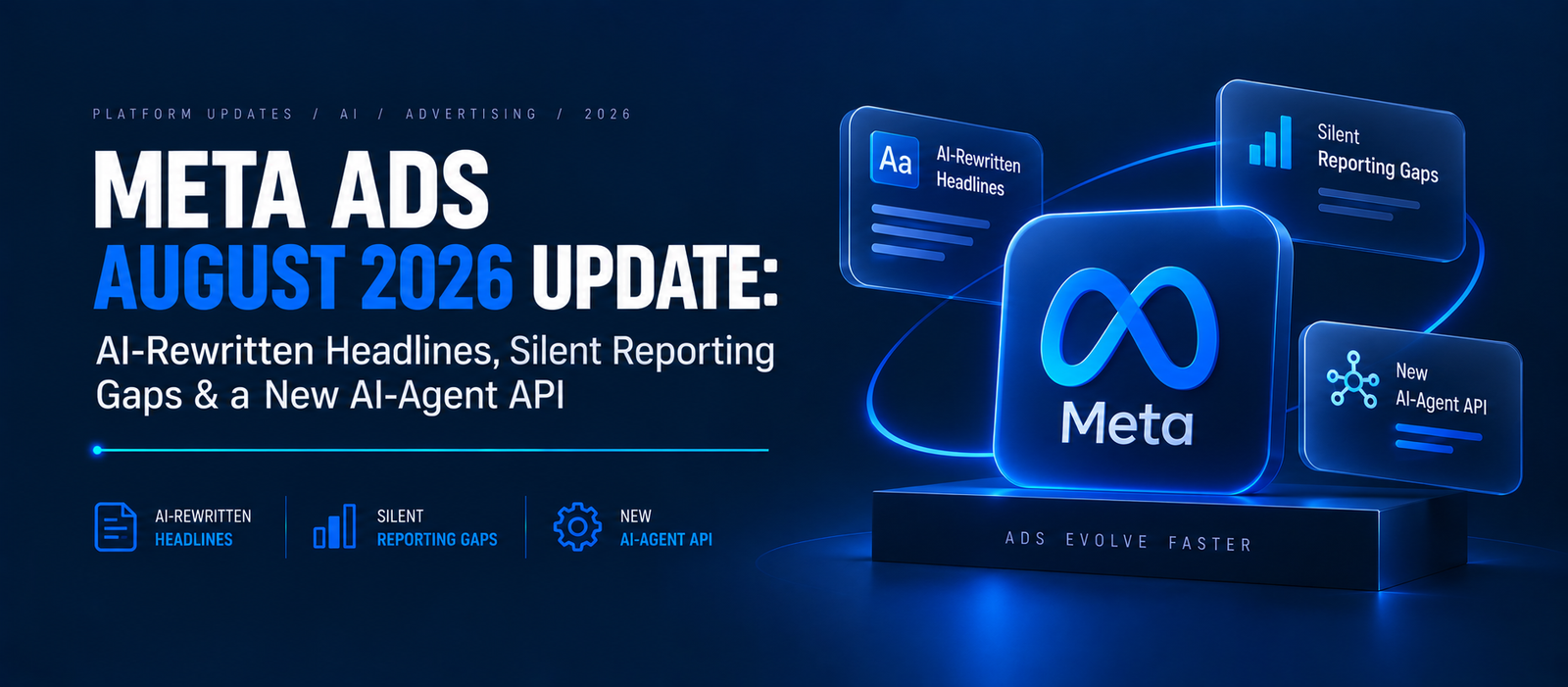
Meta Ads August 2026 Update: AI-Rewritten Headlines, Silent Reporting Gaps & a New AI-Agent API
Your Meta Ads dashboard might be lying to you right now — and not because performance actually collapsed. Sometime in August, hourly, device, and frequency data quietly went blank for a large share of advertisers, with no warning banner and no error code. That's just one piece of the Meta Ads August 2026 update, a cluster of changes that also let Advantage+ rewrite the text baked into your ad images and opened Meta's ad platform to AI agents for the first time through an official API.
The Meta Ads August 2026 update includes three changes: Advantage+ now auto-rewrites headline text inside uploaded ad images (from July 27), three Ads Manager breakdowns went silently empty for non-opted accounts (from August 6), and Meta launched an official Ads MCP Server for AI-agent access (from July 16). Marketing API v26.0 also shipped July 29.
If you manage a Meta Ads account and your numbers looked strange in the first half of August, this isn't a coincidence, and it isn't necessarily your targeting or creative. It's a platform-level shift, and the fixes are straightforward once you know where to look.
1. AI-Rewritten Headlines: Advantage+ Now Edits Your Ad Images
Starting around July 27, 2026, Meta's Advantage+ creative tools began doing something new: rewriting the actual text embedded inside uploaded ad images, not just generating separate headline fields. The system reads the text baked into your creative, generates up to eight rewritten variants, and pre-selects one to run by default — while trying to preserve the original font, color scheme, and layout.
For agencies running dozens of client accounts, this is a meaningful shift from prior AI creative tools, which mostly touched copy fields, not the pixels of the image itself. A small e-commerce brand running a promotional banner with "20% OFF TODAY ONLY" baked into the graphic could see Meta silently swap that in-image text for an AI-generated alternative, without anyone on the team approving the new wording first.
How the Rewrite Feature Actually Works
The tool ingests the uploaded image, identifies the embedded text, and regenerates it while attempting to keep the surrounding banner, colors, and layout intact. It ships with eight variants and one enabled automatically — meaning opting out is something advertisers have to actively do, not something they're asked about upfront.
Do You Have to Let Meta Rewrite Your Ad Text?
No. Advertisers can disable the rewrite on a per-creative basis, or set account-level guardrails through the Branding section in Ads Manager, which controls logo placement, approved fonts and colors, brand tone, and a list of restricted words the AI shouldn't generate. This is the same panel worth checking if you're building out brand consistency guardrails for AI creative tools, since it now governs more than just AI-written captions.
Pro Tip: Audit your Branding section restricted-words list this week — if it's empty, Meta's default variants have nothing stopping them from generating claims your legal or compliance team hasn't approved.
2. Silent Reporting Gaps: Why Your Device, Hourly & Frequency Data Vanished
On August 6, 2026, three reporting breakdowns in Ads Manager — impression device, hourly stats, and frequency value — stopped returning data for any account that hadn't opted into a new setting under Additional Breakdowns. The catch is that the API still returns a technically successful response: an HTTP 200 status with an empty data array, rather than an error. To a dashboard or a client report pulling that data automatically, it looks exactly like performance evaporated overnight.
Picture a performance marketer prepping a Monday client report who pulls hourly dayparting data to justify a bid-schedule change, only to find every hour showing zero. Without knowing about this change, the natural (and wrong) conclusion is that the campaign broke — when the real issue is a reporting toggle, not a delivery problem.
Where to Find the Fix
The opt-in toggle lives under the Additional Breakdowns section inside Ads Manager reporting. Enabling it restores device, hourly, and frequency data, though Meta's own backfill for historical data takes roughly one day to populate after you flip the setting.
Is This Only an Ads Manager Problem, or Does It Hit the API Too?
Both. Advertisers pulling breakdown data through the Marketing API see the identical empty-array behavior on unopted accounts, which means any automated Meta Ads reporting dashboards built on the API need the same setting checked at the account level, not just the UI.
Here's the fastest way to confirm and fix this on any account you manage:
- Open Ads Manager and navigate to the Reporting or Breakdowns section.
- Check whether device, hourly, or frequency breakdowns are showing blank or zeroed rows across all campaigns simultaneously — a strong signal this is the platform issue, not an actual delivery problem.
- Go to Additional Breakdowns in your account reporting settings.
- Enable the new opt-in toggle for the affected breakdown types.
- Wait approximately 24 hours for historical data to backfill.
- Re-pull any client or internal reports generated during the gap window and flag them as provisional until confirmed.
- Document the change date so future dips in these specific metrics aren't mistaken for the same bug recurring.
Pro Tip: Before telling a client their campaign "tanked" based on hourly or device data pulled in early August, re-check that account's Additional Breakdowns setting first — it will save an uncomfortable conversation.
3. Meta's New AI-Agent API: What the Official Ads MCP Server Means
On July 16, 2026, Meta released an official Model Context Protocol (MCP) server for advertising, hosted at mcp.facebook.com/ads. This is Meta's first sanctioned way for AI agents — including tools like Claude — to read and write directly into ad accounts: pulling reporting data such as spend, ROAS, and breakdowns, creating and editing campaigns, pausing underperforming ad sets, and managing product catalogs, all through a standardized protocol rather than custom API integrations each vendor builds separately.
For an agency managing many client accounts, this is the difference between a developer team building and maintaining custom connectors to the Marketing API and simply pointing an approved AI agent at a first-party server Meta itself maintains. Access isn't open to everyone by default — agencies managing client accounts need Advanced Access, and the integration has to pass Meta's App Review process before it can touch live campaigns.
MCP Server vs. the Traditional Marketing API
| Traditional Marketing API | Meta Ads MCP Server | |
|---|---|---|
| Access model | Direct developer integration, custom-built | Standardized protocol, agent-facing |
| Primary user | Developers and internal tools | AI agents (e.g., Claude, other MCP clients) |
| Setup requirement | API app + permissions review | Advanced Access + App Review |
| Core functions | Full API surface, code-level | Reporting, campaign CRUD, catalog management |
| Maintenance burden | On the integrating team | Largely on Meta |
What Should Agencies Do With Agent-Level Access?
Treat it like any other permissioned account access: request Advanced Access only for the accounts that need it, scope agent permissions narrowly, and review what actions an AI agent actually took in an account the same way you'd audit a junior team member's changes, at least until the workflow has a track record. This connects directly to how teams are rethinking AI agent workflows for campaign management more broadly, not just on Meta.
Pro Tip: Start Advanced Access requests for your top 3-5 client accounts now — App Review timelines aren't instant, and agencies that wait until they need agent access urgently will be stuck behind manual workflows longer than necessary.
4. Marketing API v26.0 and the Bigger Picture: Prices, Revenue, and What to Watch Next
Underneath the headline features, Meta also shipped Marketing API v26.0 on July 29, 2026, which added mandatory Advantage+ audience flags for special-category ad sets, removed two ad placements, and deprecated delivery-estimate fields developers previously relied on for forecasting. Marketing API v24.0 is scheduled to sunset on October 6, 2026, which puts a real deadline on any integration still running against older API versions.
These platform changes are landing against a backdrop of real financial pressure and growth. Per Meta's Q2 2026 earnings, cited in AdMake AI's changelog coverage, ad revenue reached $59.4 billion, up 27% year-over-year, while the average price per ad rose 12% year-over-year — even as an independent tracker, Superads, measured average Facebook CPM down 12.7% year-over-year for July, a divergence AdMake AI attributes to Meta's blended average reflecting high-performing placements while overall impression volume grows fastest in lower-monetizing inventory.
Why Advertisers Should Care About Adoption Numbers
The same reporting notes roughly nine million small businesses now use at least one Meta AI advertising tool, and a newer ranking system Meta rolled into delivery produced a reported 8.3% lift in clicks and 15.7% lift in conversions in early testing. Those numbers matter less as a claim to trust blindly and more as a signal: Meta is pushing AI-driven creative, ranking, and now agent access harder and faster than in prior years, which means the pace of change advertisers need to track is accelerating, not slowing down — and it's a good moment for teams comparing ad platform budgets across Meta, Google, and newer AI-native channels to revisit those splits with current pricing data.
Is All of This Actually Good News for Advertisers?
Mixed. AI-rewritten headlines and a new agent API expand what's possible without extra headcount, but the silent reporting gap is a reminder that platform changes now ship fast enough to break workflows before most advertisers even hear about them. The Meta Ads August 2026 update is best treated as a checklist, not a headline to skim past.
Pro Tip: Calendar a recurring monthly 15-minute "Meta changelog check" for whoever owns your ad accounts — most of August's disruption was avoidable simply by knowing the changes existed before a client asked about them.
Summary
The Meta Ads August 2026 update wasn't one change — it was three moving simultaneously, each requiring a different response. AI-rewritten headlines shift creative control partly into Meta's hands unless guardrails are set. The silent reporting gap shows how a routine settings change can look like a performance crisis if nobody knows to check Additional Breakdowns. And the new Ads MCP Server marks Meta formally opening its ad platform to AI agents, with real access controls and a real review process behind it.
Key Takeaways
- Advantage+ began auto-rewriting in-image ad headline text around July 27, 2026, generating eight variants with one pre-selected by default (source: AdMake AI, Vistalaro Meta Ads coverage).
- Three Ads Manager breakdowns — device, hourly, frequency — returned silently empty data for non-opted accounts starting August 6, 2026, with roughly a one-day backfill after opting in (source: AdMake AI, Vistalaro).
- Meta's official Ads MCP Server launched July 16, 2026 at mcp.facebook.com/ads, giving approved AI agents reporting, campaign management, and catalog access (source: AdMake AI).
- Marketing API v26.0 shipped July 29, 2026 with mandatory Advantage+ audience flags and delivery-estimate deprecation; v24.0 sunsets October 6, 2026 (source: AdMake AI).
- Meta's Q2 2026 ad revenue reached $59.4 billion, up 27% year-over-year, with average price per ad up 12% year-over-year (source: Meta Q2 2026 earnings, via AdMake AI).
- An independent tracker (Superads) measured July Facebook CPM down 12.7% year-over-year, a divergence from Meta's own average-price figures worth watching next quarter (source: AdMake AI).
If your account touches any of these three changes — and most active advertisers' do — audit your Branding guardrails, your Additional Breakdowns setting, and your API version this week before they surface as a client question you weren't ready for.
Related services and guides
- Meta and Instagram ads management — If Advantage+ rewrites or reporting gaps are hitting your accounts, our team sets up the guardrails and reporting checks.
- Conversion tracking and attribution — Silent breakdown changes are easier to catch when tracking and reporting are audited regularly.
- Budget allocation and bid strategy — Plan spend across Meta and other channels with a clear bid strategy.
- Managing ads with ChatGPT, Claude and ad-platform MCP connectors — Our related guide on AI-agent access to ad accounts.
- Meta EU location fees, July 2026 — Another recent Meta cost change worth tracking.
Quick Summary
The Meta Ads August 2026 update combines three platform-level changes: Advantage+ now automatically rewrites text embedded in uploaded ad images (from July 27, 2026, with eight variants generated per creative), three Ads Manager reporting breakdowns — device, hourly, and frequency — went silently empty for accounts not opted into a new setting starting August 6, 2026, and Meta launched an official Ads MCP Server on July 16, 2026 giving approved AI agents direct access to campaign reporting and management. Marketing API v26.0 followed on July 29, 2026, alongside a Q2 2026 earnings backdrop showing $59.4 billion in ad revenue, up 27% year-over-year. Advertisers should check their Branding restricted-words list, Additional Breakdowns toggle, and API version to avoid being caught off guard by any of the three changes.