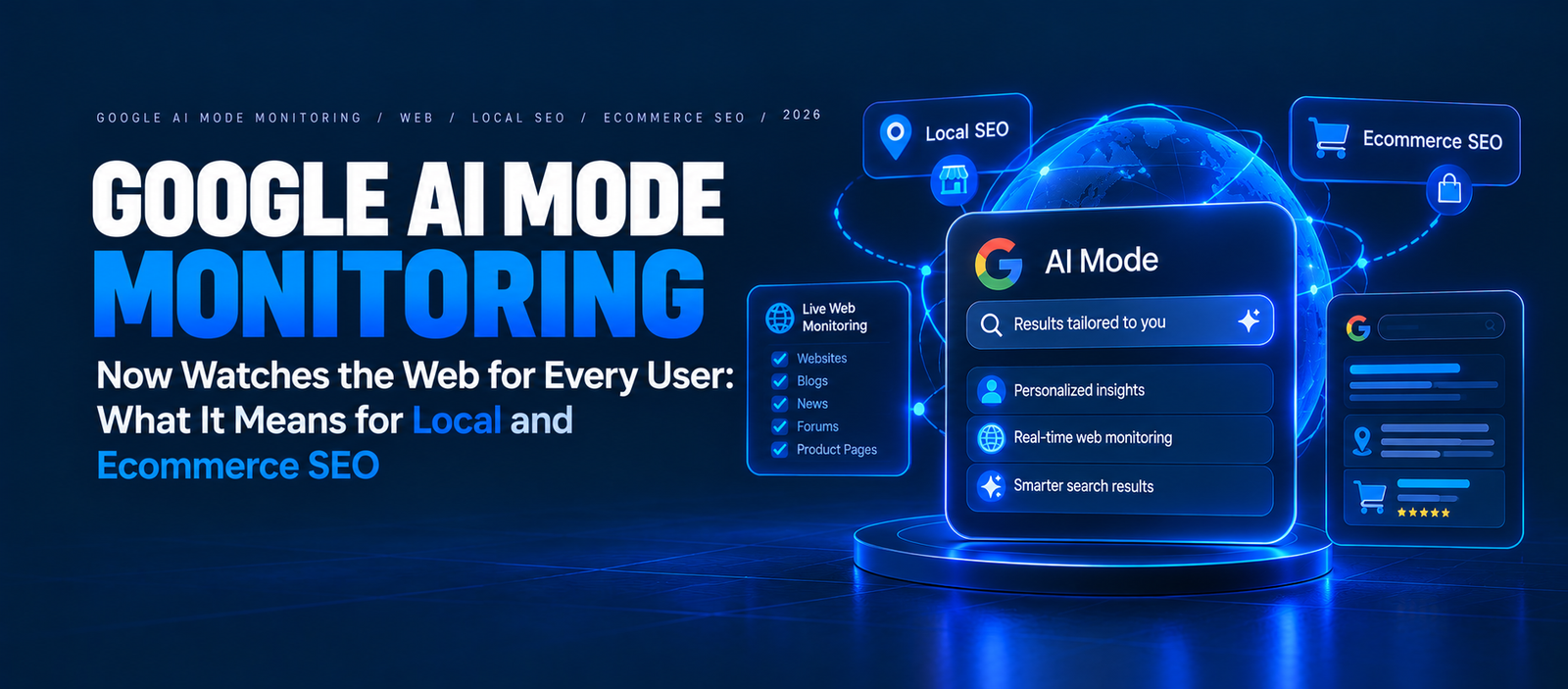
Google AI Mode Monitoring Now Watches the Web for Every User: What It Means for Local and Ecommerce SEO
Google AI Mode monitoring is rolling out free to all users globally, announced September 28, 2026. Searchers can now ask Google to watch for restocks, price drops and local openings, then get alerted. For local and ecommerce brands, fresh, accurate, structured data now decides who appears in those alerts.
What happens to your SEO when customers stop searching and start waiting to be told? That is the shift behind Google AI Mode monitoring, which Google began rolling out to every user worldwide on September 28, 2026. Instead of typing the same query each week, a shopper can now ask AI Mode to watch the web and report back when something changes. Google says AI Mode has passed 1 billion monthly active users (Alphabet Q2 2026 earnings), so this is not a niche experiment. This guide explains what changed, what it means for local and ecommerce visibility, and how to prepare.
1. What Is Google AI Mode Monitoring and What Changed?
Google AI Mode monitoring turns search from a one-time question into a standing request. A user describes what they care about, and Google keeps checking for updates on their behalf. The capability existed before, but only paying subscribers could use it.
How Does Google AI Mode Monitoring Work?
Users tell AI Mode what to track, and Search keeps checking in the background. According to Robby Stein, VP of Product for Google Search, "Search will continuously check across changing info on the web like sites, forums and social posts, our real-time data sources, and Shopping Graph of 60B+ products." Search Engine Roundtable reports that alerts arrive through the Google app, and that Search can also suggest monitoring tasks while you search.
From Paid Perk to Global Default
- May 2026: Google unveils information agents at Google I/O 2026.
- June 12, 2026: Rollout begins for Google AI Ultra subscribers, triggered by phrases like "keep me updated on" or "alert me when" (9to5Google).
- September 28, 2026: Stein confirms the feature is rolling out "to everyone globally."
Real-world example: In Google's own demo, a user asked AI Mode to flag weekend pop-ups, and it set up monitoring for flea markets, stoop sales and block parties in Austin (Search Engine Journal).
This launch is part of a wider move toward autonomous web agents that act for users without a fresh query each time. Want to know whether your pages are ready for them? Start with the workflow in Section 4.
Pro Tip: Open the Google app, ask AI Mode to "alert me when" something changes in your own category, and note which sources it cites. That list is your real competitor set.
2. What Google AI Mode Monitoring Means for Local SEO
Local search has always rewarded relevance, distance and prominence. Monitoring adds a new pressure: timeliness. Google named new restaurants, nearby pop-ups and local holiday activities as headline use cases, which puts local businesses at the center of this launch.
Why Does Fresh Local Information Matter More Now?
Because an alert is triggered by change. A static listing gives a monitoring task nothing new to report. Consumers already lean on AI for local decisions: BrightLocal's Local Consumer Review Survey 2026 found that use of generative AI tools for local recommendations jumped from 6% to 45% in one year. Trust is not automatic, though. BrightLocal's July 2026 search behavior study found that only 18% of consumers who used AI felt ready to contact the recommended business, and 43% of AI-initiated searches returned to Google to verify.
Which Local Signals Should You Keep Current?
Google has not published a full list of the local sources its monitor reads. Based on Stein's description of sites, forums and social posts, these are the sensible priorities:
- Google Business Profile hours, attributes, posts and photos
- Dedicated event and menu pages with clear dates and locations
- Social posts announcing launches, pop-ups and seasonal offers
- Reviews, since 97% of consumers read them for local businesses (BrightLocal 2026)
Illustrative example: A Jaipur bakery planning a Diwali pop-up publishes an event page with the date, address and Event schema, then mirrors it in a Google Business Profile post and on Instagram. A user monitoring "new food pop-ups near me" now has three consistent, dated signals pointing to the same business.
One warning: never manufacture fake "new opening" posts or reviews to trigger alerts. That is the kind of manipulation Google's spam policies target, as covered in our guide to the Google September 2026 spam update. Need a second pair of eyes on your local signals? Ask our team for a review.
Pro Tip: Put a visible "last updated" date on event, menu and offer pages. Clear dates help both people and machines judge what is new.
3. What Google AI Mode Monitoring Means for Ecommerce SEO
For retailers, monitoring turns two moments into triggers: a price drop and a restock. Google named both in its announcement, and the rollout lands just ahead of peak season. The store whose data is accurate at the moment of change is the store that can be surfaced.
Price Drops and Restocks Become Search Triggers
Adobe forecasts US online holiday spending of $275.1 billion from November 1 to December 31, 2026, up 6.7% year over year, and expects AI-driven traffic to retail sites to grow 130%. Search Engine Watch, citing Adobe data, reports that AI-referred visitors converted 40% better than non-AI traffic during Prime Day. Monitoring opens one more path into that high-intent traffic.
Why Is Product Feed Accuracy Now Critical?
Because the monitor reads Google's Shopping Graph. Google says it holds more than 60 billion product listings, with 2 billion updated every hour (PPC Land). If your Merchant Center feed shows an old price or the wrong stock status, you either miss the alert or show shoppers misleading information.
| Factor | Traditional Search | AI Mode Monitoring |
|---|---|---|
| User action | Types a query each time | Sets one standing request |
| Trigger | The search itself | A change: price, stock, new listing |
| What wins | Relevance and authority | Relevance plus fresh, accurate data |
| Key asset | Optimized landing page | Live feed, schema and dated content |
| Measurement | Clicks and rankings | Limited; Google has shared no referral data |
Real-world example: When information agents first launched, the sample request was an alert whenever favorite athletes announce sneaker collaborations or signature releases (9to5Google). A sneaker retailer with accurate launch pages and live inventory is the natural destination for that alert.
Google indexes the mobile version of your pages, so also review mobile-first indexing and the AI search gap to confirm prices and stock render correctly on mobile. Selling online this season? Audit your feed before November.
Pro Tip: Match your on-page price, your Product schema and your Merchant Center feed exactly. Price mismatches can get products disapproved in Merchant Center right when an alert would have fired.
4. How to Optimize for AI Mode Monitoring: A 6-Step Process
No one outside Google knows exactly how monitoring selects its sources, so be wary of anyone selling a secret formula. What you can control is how fresh, consistent and machine-readable your information is. The process below focuses on those controllable inputs.
The Step-by-Step Workflow
- Audit your change-prone data. List every price, stock status, opening hour, event and offer that changes during the year.
- Automate your feeds. Turn on automatic item updates in Merchant Center so price and availability stay in sync with your site.
- Add structured data. Use Product, Offer, Event and LocalBusiness schema with accurate dates, prices and availability.
- Publish change announcements. Create dated pages or posts for restocks, launches, pop-ups and seasonal hours.
- Mirror updates across channels. Repeat the same facts on your Google Business Profile and social accounts.
- Test and log. Set up your own monitoring tasks in AI Mode each month and record which brands get surfaced.
How Do You Measure Monitoring Traffic?
For now, you mostly cannot. Search Engine Journal notes that local businesses and retailers cannot yet tell from Google's posts how often monitoring updates will surface their sites or send them visits. Google CEO Sundar Pichai did say on the Q2 2026 earnings call that Google is "sending billions of clicks to websites every week through AI features in Search." Until Google shares more, track AI Mode impressions in the Search Console generative AI report and watch for referral spikes that line up with your price drops or announcements.
Illustrative example: An electronics store logs every price change in a simple sheet, then compares those dates against Search Console impressions and analytics sessions. After a few cycles, it can see whether changes coincide with visibility lifts.
Ready to put this in place before peak season? Start with step one this week.
Pro Tip: Treat every restock and price change as a publishing event. Update the page, the feed and the schema within the same hour.
Summary
Search is moving from questions users ask to changes Google reports. That shift rewards businesses whose information is current, consistent and structured, and it leaves stale listings with nothing for a monitoring task to say. Local and ecommerce brands that tighten their data now will be the ones surfaced when alerts fire during the busiest weeks of the year.
Key Takeaways
- Google began rolling out AI Mode info monitoring to all users globally on September 28, 2026 (Robby Stein, Google, via Search Engine Journal).
- AI Mode has surpassed 1 billion monthly active users (Alphabet Q2 2026 earnings).
- Use of generative AI tools for local recommendations rose from 6% to 45% in one year (BrightLocal Local Consumer Review Survey 2026).
- Only 18% of consumers who used AI felt ready to contact the recommended business (BrightLocal, July 2026).
- Google's Shopping Graph holds 60 billion+ product listings, with 2 billion updated every hour (Google figures via PPC Land).
- AI-driven traffic to retail sites is forecast to grow 130% this holiday season (Adobe 2026 holiday forecast).
Want your business ready for Google AI Mode monitoring before peak season? Talk to Cross Globe Marketing today for a local and ecommerce AI visibility audit.
Quick Summary
Google AI Mode monitoring lets any user ask Google to keep checking the web and alert them when something changes, and it began rolling out globally on September 28, 2026 after launching for paid subscribers. It draws on sites, forums, social posts, real-time data sources and the Shopping Graph of 60 billion+ products. For local businesses, that means keeping Google Business Profile, event pages and social posts current, while ecommerce stores need exact agreement between on-page prices, Product schema and Merchant Center feeds. Google has not shared referral data for monitoring, so track AI Mode impressions in Search Console and log your own tests.