Search Console Generative AI Report: How to Measure AI Search Visibility in 2026
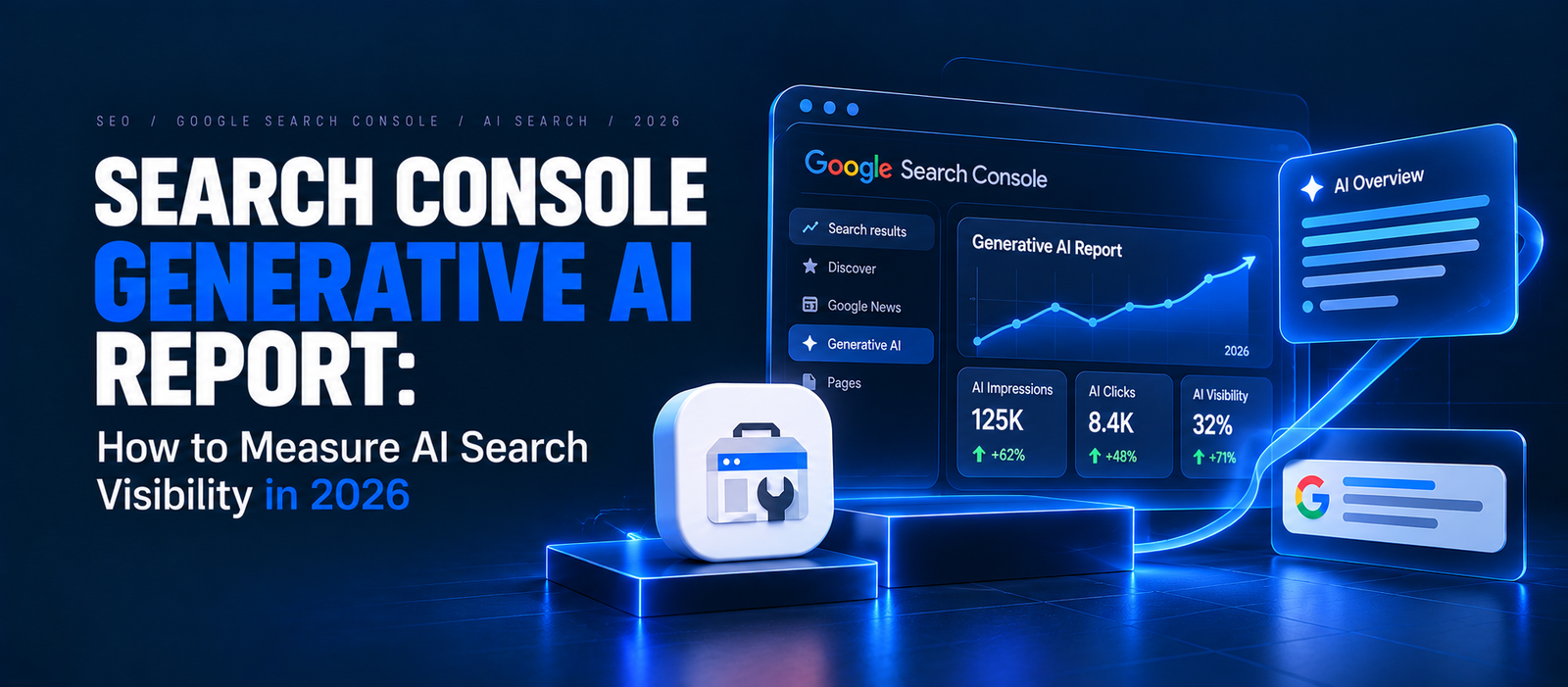
Google's Search Console generative AI report now shows impressions from AI Overviews, AI Mode, and Discover AI features, but no clicks or queries. The IAB's new 4 P's framework (Presence, Prominence, Portrayal, Persuasion) fills the gap for off-Google AI engines. Use both. Track trends, not snapshots.
Only 16% of brands systematically track AI visibility today, according to the IAB's August 2026 report "Measuring Visibility in the AI Era." Meanwhile, the same report notes Google AI Overviews reach over 2.5 billion monthly users and appear on almost half of searches. That is a massive blind spot.
The search console generative ai report is Google's first attempt to close it. And the IAB AI visibility framework is the industry's first attempt to standardize everything Google won't show you. Here is how to use both, what each one misses, and how to turn them into one measurement system.
1. What the Search Console Generative AI Report Actually Shows
Google announced its Search generative AI performance reports on June 3, 2026, starting with UK sites. Per Search Engine Land and Search Engine Journal, Google confirmed on August 31, 2026 that the insights had rolled out to all websites worldwide. For the first time, site owners get first-party Google data on AI surface exposure instead of guessing from third-party trackers.
What Metrics and Dimensions Are Included?
The report is impressions-only. You can slice data by:
- Pages — which URLs Google surfaced in AI features
- Countries — where AI exposure happens
- Devices — available for the Search report
- Dates — trend lines over time
It covers three surfaces: AI Overviews, AI Mode, and generative AI features in Discover. According to Neil Patel's breakdown, data starts from May 18, 2026, with no historical backfill.
What Is Missing From the Report?
This is where marketers must stay sharp. As of publication, there is no click data, no CTR, no average position, and no query-level breakdown. Also, per Search Engine Journal, sites without enough AI impressions may not see the report at all. So you know *that* Google cited you, but not *for what* or *whether anyone clicked*.
Real-world example: A SaaS blog sees its "pricing comparison" guide spike in AI impressions while organic clicks on the same URL fall. Without query data, the team cannot confirm the cause, but the pattern flags that page as an AI-exposed asset worth protecting and refreshing.
Want the full picture on why tracking breaks? Read our guide on event-based measurement in 2026.
Pro Tip: Export AI impressions per page every month and pair them with organic clicks for the same URLs. Pages high in both are your "dual-channel winners." Update those first.
2. The New Generative AI Opt-Out Control: Should You Use It?
Alongside the reports, Google shipped a Search generative AI control, a property-level toggle in Search Console settings. It removes your links and content from AI Overviews, AI Mode, and AI Overviews in Discover. This is a big strategic decision, not a checkbox.
What Happens If You Opt Out?
Google stated that "sites that opt out will not receive traffic or impressions from our generative AI features," per Search Engine Land. Google also says the setting is not used as a ranking signal elsewhere in Search. Per Search Engine Journal, it does not govern AI model training, which is handled separately by Google-Extended.
Who Should Consider It?
The trade-off is visibility versus click protection. Pew Research Center (July 2025) found users who saw an AI summary clicked a traditional result only 8% of the time, versus 15% without one. Publishers who monetize pageviews may weigh that differently from brands that value citations and awareness.
Real-world example: A B2B consultancy relies on being named in answers to "best CRO agency" type prompts. Opting out would erase that brand exposure. A recipe publisher living on ad impressions might reach a very different conclusion.
Pro Tip: Never flip the opt-out toggle without a baseline. Record at least 4-6 weeks of AI impressions and organic clicks first, so you can measure the true impact of the decision.
3. IAB's "Measuring Visibility in the AI Era" Framework Explained
The Search Console generative AI report only covers Google. Your buyers also ask ChatGPT, which the IAB report says has more than 900 million weekly active users. The IAB released its framework on August 3, 2026 to give the industry one shared vocabulary, with contributors including Caroline Giegerich (VP, AI, IAB) and Ihab Rizk (Microsoft Clarity).
What Are the IAB's 4 P's of AI Visibility?
- Presence — Do you appear? Metrics: Mention Rate, Citation Rate, Share of Voice, Visibility Momentum
- Prominence — Where do you appear? Metric: Position in the response as users see it
- Portrayal — How are you described? Metrics: Sentiment, Framing, Hallucination Rate, Factual Inaccuracy Rate
- Persuasion — Do you drive action? Metrics: Recommendation Strength, Post-Citation CTR
What Is Directional vs Decision-Grade Measurement?
The IAB splits measurement into two quality tiers. Directional measurement supports trend monitoring and early signals, with a minimum of 50 queries and at least two intent types. Decision-grade measurement supports budget and executive decisions, requiring coverage of all four intent types (informational, comparison, recommendation, transactional) and weekly or more frequent testing.
Why Does This Matter?
The IAB notes more than 20 companies sell AI visibility tools, each with different methods and different results. The framework lets you demand disclosure from vendors instead of trusting black-box scores.
Real-world example: An e-commerce brand's tool reports a 40% "AI visibility score." Under IAB standards, the brand now asks: how many queries, which platforms, which markets, and what variability range? Suddenly that score becomes testable.
Pair this with our analysis of marketing analytics maturity in 2026 to build trust in your numbers.
Pro Tip: Add a "Portrayal" check to your monthly report. Being mentioned with wrong pricing or outdated features is worse than not being mentioned at all.
4. Search Console vs IAB Framework: How They Compare
These two tools are not rivals. One gives verified first-party Google exposure data; the other gives a cross-platform methodology. Together they form a complete AI search visibility stack.
Side-by-Side Comparison
| Factor | Search Console Generative AI Report | IAB 4 P's Framework |
|---|---|---|
| Type | Free data report from Google | Measurement methodology/standard |
| Platforms | AI Overviews, AI Mode, Discover AI | ChatGPT, Gemini, Perplexity, Google, others |
| Core metric | Impressions | Mention, Citation, Sentiment, CTR and more |
| Clicks/CTR | Not available yet | Post-Citation CTR defined |
| Query data | Not available | Defined query sets required |
| Best for | Page-level Google AI exposure | Brand-level competitive visibility |
Which One Should You Start With?
Start with Search Console. It is free, first-party, and live now. Then layer IAB-style prompt testing on top for non-Google engines and brand portrayal.
Real-world example: A local dental chain uses Search Console to see which service pages get AI Overview impressions, then runs 50 recommendation prompts ("best dentist in Jaipur for implants") across ChatGPT and Gemini monthly to track Share of Voice.
Pro Tip: Map your top 20 Search Console AI-impression pages to the prompts you test in ChatGPT. Overlap reveals true topical authority.
5. The 7-Step Process to Measure AI Search Visibility
Tools are useless without a repeatable process. This workflow combines the search console generative ai report with the IAB's recommended controls for variability, geography, and time. Follow it in order.
The Step-by-Step Workflow
- Pull your baseline — Export AI impressions by page, country, and device from Search Console.
- Build a query set — Write at least 50 prompts across two or more intent types (IAB directional minimum).
- Establish variability — Run identical prompts repeatedly and document how much answers shift, per the IAB's first recommended step.
- Control geography and time — Test per market and on a consistent schedule. The IAB warns the same query from the U.S. and Germany often returns different brands.
- Score the 4 P's — Log Presence, Prominence, Portrayal, and Persuasion for every response.
- Watch for platform drift — When visibility shifts abruptly across your whole category, check platform release notes before blaming your content.
- Report trends, not snapshots — Attach variability ranges to every number, as the IAB recommends.
How Often Should You Measure?
Monthly works for directional tracking. Weekly is the IAB bar for decision-grade programs. Small businesses can start monthly and scale up.
Real-world example: A startup running monthly checks spots a sudden visibility drop in one engine only. Comparing across platforms shows a model update, not a content issue, which saves weeks of unnecessary rewrites.
Strong technical foundations still matter here, so review mobile-first indexing and the AI search gap and stay compliant with the Google September 2026 spam update.
Pro Tip: Keep a "reset log." Whenever a major model version launches or answer formats change, reset your baseline and note the date. The IAB explicitly recommends documenting reset events.
Summary
AI search visibility is no longer a guessing game, but it is not fully solved either. Google now hands you verified impression data for its AI surfaces, while the IAB gives you the methodology to measure everything Google does not cover. Brands that combine both, and report trends with honest variability ranges, will make smarter decisions than the vast majority still flying blind.
Key Takeaways
- Google's Search generative AI performance reports rolled out to all websites worldwide by August 31, 2026 (Search Engine Journal).
- The report shows impressions only, with no clicks, CTR, position, or query data yet (Neil Patel).
- Only 16% of brands systematically track AI visibility today (IAB, August 2026).
- Users clicked a traditional result 8% of the time with an AI summary vs 15% without (Pew Research Center, 2025).
- The IAB's 4 P's framework defines Presence, Prominence, Portrayal, and Persuasion metrics (IAB, August 2026).
- More than 20 companies sell AI visibility tools with differing methods (IAB).
Ready to turn your search console generative ai report into a real growth strategy? Book a free AI visibility audit with Cross Globe Marketing today.
Quick Summary
The search console generative ai report shows impressions from AI Overviews, AI Mode, and Discover AI features by page, country, device, and date, and rolled out to all websites worldwide by August 31, 2026, but it offers no clicks, CTR, position, or query data. The IAB's "Measuring Visibility in the AI Era" framework, released August 3, 2026, fills that gap with its 4 P's (Presence, Prominence, Portrayal, Persuasion) and separates directional from decision-grade measurement. Combining Google's first-party impression data with IAB-style prompt testing across ChatGPT, Gemini, and other engines gives brands a complete, trend-based AI visibility system.