Claude Overtakes ChatGPT: What the 2026 AI Marketing Industry Report Reveals
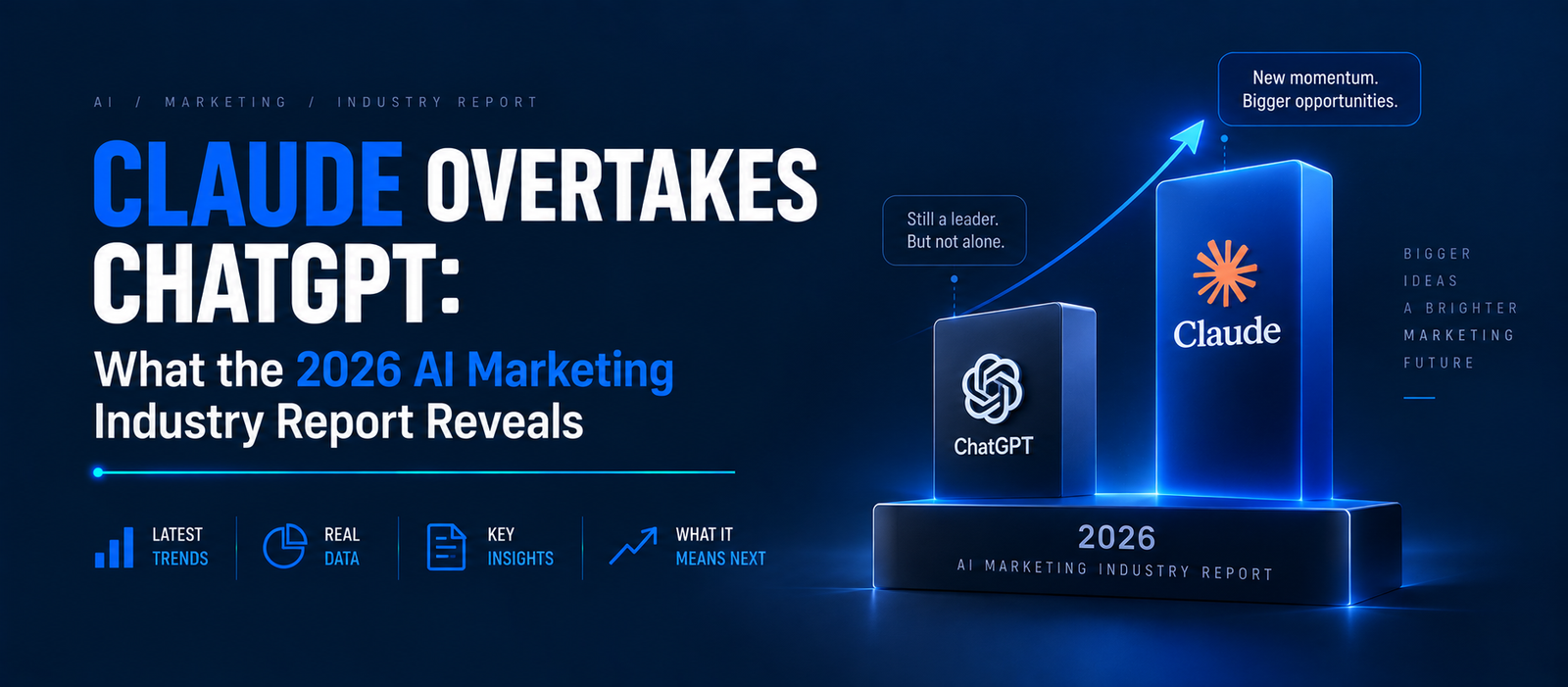
42% to 39%. That's the margin by which marketers just named Claude, not ChatGPT, their single most important AI platform — and it's the headline finding of the 2026 AI marketing industry report that's rippling through every marketing Slack channel this month. Two years ago, this wasn't close. Now it is, and marketers who assumed ChatGPT would keep running the table need to look at the actual numbers.
Social Media Examiner's 2026 AI Marketing Industry Report (681 marketers surveyed) found Claude named the single most important AI platform by 42% of marketers, edging out ChatGPT at 39% — a reversal from 2024's 68%-to-5% ChatGPT lead. B2B marketers favor Claude most. Broader consumer market-share data still favors ChatGPT overall.
1. Inside the 2026 AI Marketing Industry Report: The Headline Flip
Social Media Examiner published the third annual edition of its 2026 AI marketing industry report in July 2026, surveying 681 marketers under founder Michael A. Stelzner. Unlike raw app-store or usage rankings, this report asked something sharper: not just which tools marketers touch, but which one they'd call indispensable if forced to pick only one. That single-choice question is where the real story lives.
The Numbers: Claude 42%, ChatGPT 39%
When marketers could select every AI tool they use regularly, ChatGPT still led on raw reach — but the "most important platform" question, where respondents had to pick just one, told a different story:
- Overall usage (select all that apply): ChatGPT 81%, Claude 65%, Gemini 60%, Copilot 26%, Grok 8%, DeepSeek 4%, Llama 1%
- Most important platform (single choice): Claude 42%, ChatGPT 39%, Gemini 11%, Copilot 7%, Grok 1%
That four-point gap on the "most important" question is the entire headline, and it's a genuinely close race — not a landslide, but a flip nonetheless.
A Dramatic Reversal From 2024
The report's own framing makes the shift explicit: "Claude tripled its user base (18% → 65%) and overtook ChatGPT as marketers' most important platform—a dramatic reversal from 2024, when ChatGPT led 68% to 5%." In two years, Claude went from a niche pick to the plurality favorite, while ChatGPT's lead evaporated from 63 points to a deficit. Stelzner framed the broader moment bluntly in his opening commentary: for most of the last few years, "marketers were still deciding whether AI belonged in their work. That question has been answered — emphatically."
Pro Tip: Don't just track which AI tool your team uses most — track which one they'd defend as indispensable if budget got cut. That single question surfaces platform loyalty long before usage stats do.
2. Why Marketers Are Switching to Claude in 2026
Platform loyalty doesn't flip on a whim, and the 2026 AI marketing industry report's adoption data explains why marketers had the confidence to switch at all. This is now a mature, daily-habit technology, not an experiment — which raises the stakes on which platform actually earns the "most important" label.
AI Has Gone From Experiment to Daily Habit
Per the report, 73% of marketers now use AI daily, 90% use it at least weekly, 84% increased their AI use over the past year, and 65% now have two-plus years of hands-on experience. That level of maturity means marketers aren't guessing anymore — they've used these tools long enough on real work to have a genuine preference, which makes a 42%-to-39% swing more meaningful than it would be in a market still figuring out the basics.
The B2B Tilt: Why Serious Content Teams Reach for Claude
The clearest real-world pattern in the data is the B2B/B2C split: B2B marketers favor Claude at 48%, while B2C marketers still lean ChatGPT at 44%. That divide tracks with what B2B teams actually need — longer context windows for research-heavy briefs, technical accuracy for whitepapers and case studies, and fewer generic outputs on niche topics. It's worth noting this platform switch is happening alongside a separate but related problem: even as B2B teams adopt new AI tools, our breakdown of B2B content marketing trends 2026 found 95% of B2B marketers now use some form of AI, yet only 8% call their implementation "advanced" — a reminder that picking the better platform is only step one.
Pro Tip: If your team is B2B and still defaulting to whichever AI tool onboarded first, run a head-to-head test on your next long-form brief — the platform preference gap shows up fastest on research-dense, technical content.
3. Survey Preference vs. Global Market Share: Reading the Data Correctly
Here's where a lot of hot takes on this story get sloppy: "marketers' most important platform" and "which AI app has the most total users worldwide" are two different questions, answered by two different datasets, and conflating them misreads both. Getting this distinction right matters if you're making a real budget decision off this data.
What Global Consumer Market Share Actually Shows
Separate from the marketer survey, Sensor Tower's State of AI 2026 report tracks overall consumer app market share across the general population — a much larger, non-marketer sample. There, ChatGPT still leads by a wide margin: it held 46.4% global market share in May 2026 (down from 65.3% in December 2024, dipping below 50% for the first time in March 2026), against Gemini's 27.7% and Claude's 10.3%. On raw monthly active users, ChatGPT reported roughly 1.11 billion globally versus Claude's 245 million. Claude's growth rate is the standout figure here — a roughly fourfold jump from 3% to 10.3% share between December 2025 and May 2026 — but it's growth from a much smaller base, and it hasn't touched ChatGPT's consumer scale. That scale is also exactly why ChatGPT's new self-serve Ads Manager launched this year: a billion-plus weekly users is an advertising business on its own, regardless of what marketers say about "most important" in a survey.
| Metric | Marketers' Top Choice (SME survey, July 2026) | Global Consumer Market Share (Sensor Tower, May 2026) |
|---|---|---|
| ChatGPT | 39% | 46.4% |
| Claude | 42% | 10.3% |
| Gemini | 11% | 27.7% |
Why Two Reports Can Both Be Right
A professional-audience preference survey and a mass-market usage report are measuring different things, and both are internally consistent. Marketers — a smaller, more sophisticated user base doing structured research and content work — have plurality-shifted toward Claude. The general public, doing everything from homework help to casual chat, is still overwhelmingly on ChatGPT, even as its share erodes. Neither number contradicts the other; they're just answering different questions, and any AI marketing industry report worth citing should make that distinction explicit rather than blur it into one "winner."
Pro Tip: When you cite any AI platform stat externally — in a pitch deck, a client report, a LinkedIn post — always name which dataset it's from (a professional survey vs. total consumer market share). The two numbers get conflated constantly, and getting caught doing it undermines your credibility on everything else in the deck.
4. What the 2026 AI Marketing Industry Report Means for Your Stack
None of this data matters if it doesn't change how your team actually works. The report's budget, measurement, and emerging-tool numbers point to a practical playbook for deciding whether — and how — to shift your own AI mix in the second half of 2026.
A 5-Step Process to Re-Evaluate Your AI Platform Mix
- Audit which platform your team defaults to today, and why — habit and onboarding convenience explain more platform loyalty than most teams admit.
- Run a head-to-head test on your three most common AI tasks (long-form drafting, campaign strategy, data synthesis) using both ChatGPT and Claude before committing budget either way.
- Weight the decision by content type — the B2B tilt toward Claude suggests research-heavy, technical work is where the platform gap shows up most; consumer-facing quick-turn copy may not show the same difference.
- Build measurement in before you switch anything — the report found only 30% of marketers see significant, measurable AI results, 39% see results they can't measure, and 10% haven't attempted measurement at all, so a platform switch without a baseline will be impossible to evaluate honestly.
- Revisit the decision quarterly, especially as agentic tools mature — 11% of marketers already use AI agents in regular workflows, 24% are experimenting, and 44% plan to adopt but haven't yet, which means the platform question will keep shifting as autonomous web agents already browsing and buying online become part of the standard marketing toolkit.
Where Marketers Still Struggle: Measurement and Trust
Platform preference is only half the picture — the report also surfaces real friction. 85% of marketers now pay for AI tools in some form, and 53% spend their own money doing it, yet trust hasn't caught up to spend: 78% worry about accuracy and reliability, and 77% cite data privacy concerns, up from 67% in 2024. That's the same underlying issue behind the CMO ROI trust gap documented in marketing analytics more broadly — teams are investing heavily in a capability before they've built the confidence, or the measurement discipline, to know it's actually paying off. A platform switch driven by a survey stat is only useful if it's paired with the tracking to prove the switch worked.
Pro Tip: Before reallocating a single dollar of AI tool budget based on this report, write down the one metric you'll check in 90 days to confirm the switch was worth it — accuracy on a specific task, hours saved, or output your team actually ships without heavy rework.
Summary
The 2026 AI marketing industry report doesn't prove Claude "beat" ChatGPT in any absolute sense — it proves that among a maturing population of daily AI users, the professional preference has genuinely shifted, even while ChatGPT keeps its dominant grip on the broader consumer market. Both things are true at once, and the marketers making the smartest decisions right now are the ones reading the fine print instead of just the headline stat.
Key Takeaways
- Claude was named marketers' most important AI platform by 42% of respondents versus ChatGPT's 39%, a reversal from 2024's 68%-to-5% ChatGPT lead (source: Social Media Examiner, 2026 AI Marketing Industry Report, n=681).
- B2B marketers favor Claude at 48%, while B2C marketers still favor ChatGPT at 44% (source: Social Media Examiner, 2026 AI Marketing Industry Report).
- On overall usage rather than "most important" ranking, ChatGPT still leads at 81% versus Claude's 65% and Gemini's 60% (source: Social Media Examiner, 2026 AI Marketing Industry Report).
- Globally, ChatGPT still holds 46.4% of consumer AI-app market share versus Claude's 10.3%, even as Claude's share roughly quadrupled between December 2025 and May 2026 (source: Sensor Tower, State of AI 2026 report).
- Only 30% of marketers report significant, measurable results from AI, while 39% see results they can't measure and 10% haven't attempted measurement (source: Social Media Examiner, 2026 AI Marketing Industry Report).
- 78% of marketers worry about AI accuracy and reliability, and 77% cite data privacy concerns, up from 67% in 2024 (source: Social Media Examiner, 2026 AI Marketing Industry Report).
If your team is still deciding what this shift means for your own AI marketing stack, talk to Cross Globe Marketing about auditing your current tools against the platform your content type actually needs.
Quick Summary
2026 AI marketing industry report findings show Claude was named marketers' single most important AI platform by 42% of 681 respondents, edging out ChatGPT's 39% in a reversal from 2024's 68%-to-5% ChatGPT lead (Social Media Examiner). B2B marketers favor Claude most strongly (48%), while B2C marketers still lean ChatGPT (44%), and on raw overall usage ChatGPT still leads at 81% versus Claude's 65%. Separately, global consumer market-share data shows ChatGPT still dominant at 46.4% versus Claude's 10.3% (Sensor Tower), meaning marketers' professional preference and the broader consumer market are telling two different, equally valid stories in 2026.