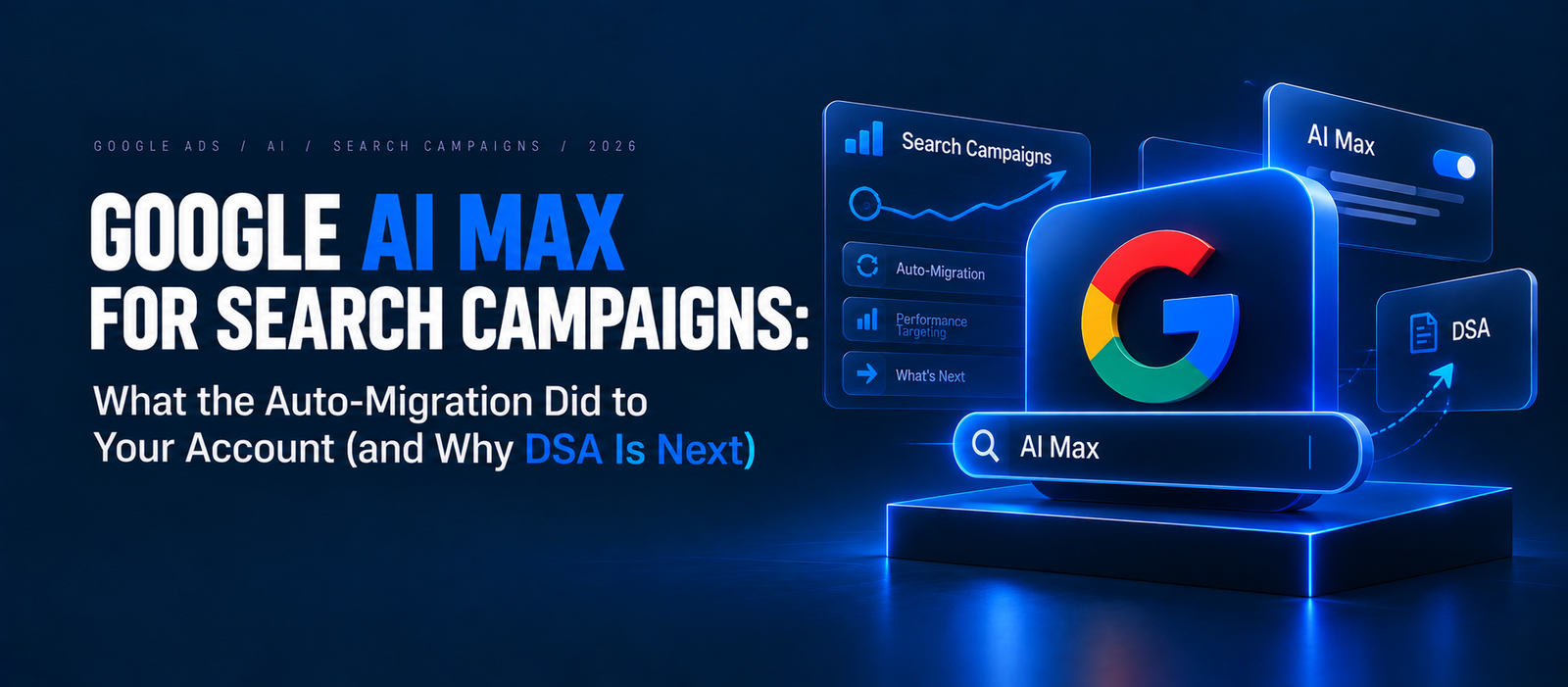
Google AI Max for Search Campaigns: What the Auto-Migration Did to Your Account (and Why DSA Is Next)
Google auto-migrated campaign-level broad match and auto-created asset campaigns into AI Max during September 2026. Dynamic Search Ads migrate automatically February 1–28, 2027. Google claims 7% more conversions at similar CPA/ROAS; independent retail data shows median CPA up 16%. Audit your settings now and migrate DSA manually before Google does it for you.
Did Google rewrite your Search campaigns last month without asking? If you ran campaign-level broad match or legacy auto-created assets, the answer is yes. Google AI Max for Search campaigns is now the default engine of Google Search advertising, and the migration is not finished. Dynamic Search Ads are next, with automatic conversion scheduled for February 1–28, 2027, according to Search Engine Land's coverage of Google's official timeline.
This is not a minor settings tweak. Alphabet stated in its Q1 2026 earnings that more than 30% of Search customer spend already runs through AI Max or Performance Max. The question is no longer whether you use AI in Search. It is whether you control it.
1. What Google AI Max for Search Campaigns Actually Changed in September 2026
AI Max is a suite of three features layered onto a standard Search campaign: search term matching (keywordless query expansion), text customization (Google-generated headlines and descriptions), and final URL expansion (Google picks the landing page). The September 2026 auto-migration moved legacy setups into this suite "in place using equivalent AI Max settings to minimize disruption," per Search Engine Land. The catch is that "equivalent" still means new reporting, new match types, and new ways to spend budget.
Which campaigns were migrated?
Two cohorts were migrated between September 1 and 30, 2026:
- Campaigns using the campaign-level broad match setting
- Campaigns using legacy Automatically Created Assets (ACA)
Creation of both legacy settings was blocked across the Google Ads UI, Ads Editor, and API on August 3, 2026. Existing brand inclusions and exclusions carried over automatically.
What defaults did each cohort receive?
| Setting | Former Campaign-Level Broad Match | Former Legacy ACA | Dynamic Search Ads (Feb 2027) |
|---|---|---|---|
| AI Max umbrella | On | On | On (auto-migration) |
| Search term matching | On | On | Core replacement for DSA targeting |
| Text customization | Off | On | Replaces DSA dynamic headlines |
| Final URL expansion | Off | Off | Replaces DSA landing page selection |
| Migration window | Sept 1–30, 2026 | Sept 1–30, 2026 | Feb 1–28, 2027 |
Defaults for the first two cohorts are drawn from Google's migration documentation as compiled by Choice OMG's research dossier. Google has not published the exact per-feature defaults for DSA auto-migrations, so treat that column as the functional mapping, not a guaranteed settings state.
Real-world example: Google cites Hilton earning one-third more clicks for one-fifth of the spend, with a 55% higher average booking value, after adopting AI Max. Google did not disclose spend levels or test methodology, so read it as a best-case signal, not a benchmark.
Pro Tip: Open every migrated campaign today and check the AI Max settings panel. If text customization switched on in a regulated or brand-sensitive account, review generated assets before they rack up impressions.
Next step: Before touching bids, audit which of your campaigns landed in which cohort.
2. The Performance Question: Does AI Max Help or Hurt ROAS?
Google's headline claim is simple: advertisers using the full AI Max feature set see 7% more conversions or conversion value at a similar CPA/ROAS compared with search term matching alone, per the Google Ads & Commerce Blog (April 2026). Independent data is messier, and that gap is exactly where your margin lives.
What does independent data say?
Smarter Ecommerce analyzed more than 250 retail Search campaigns across 600 ecommerce accounts and reported a median 13% increase in conversion value alongside a median 16% increase in CPA, with a median ROAS difference of 0%. Translation: AI Max bought more volume at a higher unit cost. That is growth for some brands and margin erosion for others.
Is click quality a concern?
Yes. Lunio, analyzing roughly 114.5 million Google Search clicks over nine months, reported AI Max's invalid-traffic rate climbing from 2.46% in Q4 2025 to 5.28% in Q2 2026, while standard Search held near 3%. Keywordless matching widens the net, and wider nets catch more junk. For a deeper framework on separating real lift from noise, see our guide on event-based measurement after perfect tracking dies.
Real-world example: Google-cited MyConnect reported 16% more leads and a 13% lower CPA, with a 30% conversion lift from net-new queries. Compare that with Smarter Ecommerce's median CPA increase and the lesson is clear: results depend on your account, not Google's slide deck.
Pro Tip: Judge AI Max on profit per conversion, not conversion count. Add the "AI Max" match type and Source column to your search terms report weekly, then negative-out non-converting expansions.
Next step: Build a baseline CPA and ROAS snapshot from August 2026 so you can measure the post-migration shift honestly.
3. Dynamic Search Ads Before February 2027: Why Manual Beats Automatic
Google originally planned to sunset DSA in September 2026, then extended the deadline to February 2027. Google Ads Liaison Ginny Marvin said the extension would "give advertisers more time to prepare and avoid major account changes during the busy Q4 season," per Search Engine Journal. Treat that extra runway as a gift, not a snooze button.
What happens to DSA on the timeline?
- September 2026: In-account notices encourage voluntary DSA upgrades
- January 15, 2027: Reminder notifications for remaining legacy DSA
- February 1–28, 2027: Automatic migration begins; new DSA ad group creation permanently removed
- Around September 2027: Older Google Ads API versions lose legacy feature support
Why migrate manually?
Search Engine Journal's guidance is direct: manual upgrades give you more oversight and control than waiting for the automatic switch. You pick the settings, the timing, and the test window. Auto-migration picks for you, in the same month many brands plan Q1 budgets.
How to migrate DSA to AI Max: a 5-step process
- Export your DSA data. Pull 12 months of search terms, landing pages, and page feeds before the ad groups change.
- Build your negative list. Turn every non-converting DSA query into a negative keyword. AI Max preserves negatives.
- Set URL controls first. Add URL exclusions at campaign level (careers, blog, login pages) and URL inclusions at ad-group level before enabling final URL expansion.
- Upgrade one campaign as a test. Run it for at least four weeks against a DSA holdout and compare CPA, ROAS, and invalid-click rate.
- Roll out in waves before January 15, 2027. Finish before Google's reminder notices so February becomes a non-event.
Real-world example: Google cites Etsy seeing 10% more search volume, with 15% coming from net-new queries. That is exactly the expansion DSA users are buying: discovery of queries you never wrote keywords for.
Pro Tip: Keep your DSA page feed. Use its URL list to build AI Max URL inclusions so Google's landing page choices stay inside pages you already trust.
Next step: Book your DSA export this week, not in January.
4. The Control Stack: How to Keep AI Max Working for You
AI Max is not all-or-nothing. Google has added controls that let you shape automation instead of fighting it, and most advertisers leave them untouched. The brands winning with automation treat these settings as strategy, not admin.
Which controls matter most?
- Brand inclusions and exclusions at campaign and ad-group level
- URL inclusions (ad group) and URL exclusions (campaign)
- Locations of interest at ad-group level
- Text guidelines to restrict messaging Google generates
- Per-ad-group search term matching toggle so exact-match ad groups stay tight
- Negative keywords, which carry over in full
Can you turn AI Max off after migration?
Yes. The AI Max umbrella can be toggled off entirely, and text customization can be disabled separately; generated assets are then marked "Removed." Final URL expansion requires text customization to remain on. Sub-settings persist when re-enabled.
Real-world example: AAA, cited by Google, reported 17% higher conversion volume and an 11% lower cost per lead. Pair that with Adalysis founder Brad Geddes' three-account test, in which about 19% of generated assets were removed early and human-written assets performed stronger in mature campaigns. The pattern: let AI find queries, but keep humans on the copy. The same tension shows up in our breakdown of Meta's AI headline updates and reporting gaps.
Pro Tip: Leave search term matching on for discovery ad groups, and switch it off for high-intent exact-match ad groups. That one split protects your best CPA while still feeding the algorithm.
Next step: Document your control settings in a shared sheet so every team member knows what automation is allowed to touch.
Summary
Google has made its direction impossible to ignore: Search advertising now runs on AI Max, and legacy targeting is being retired on a fixed calendar. The real divide is not between advertisers who use automation and those who avoid it, but between those who configure it deliberately and those who inherit Google's defaults. Treat the September migration as your audit trigger and the February 2027 DSA deadline as your hard stop, then judge performance on profit, not volume. If you are rethinking where paid search fits alongside new channels, our look at OpenAI's ChatGPT advertiser tools and our research on marketing analytics maturity and CMO ROI trust add useful context.
Key Takeaways
- Campaign-level broad match and legacy ACA campaigns were auto-migrated to AI Max from September 1–30, 2026 (Search Engine Land).
- Dynamic Search Ads migrate automatically February 1–28, 2027, and new DSA ad groups will be permanently blocked (Search Engine Land).
- Google claims the full AI Max suite drives 7% more conversions or conversion value at similar CPA/ROAS (Google Ads & Commerce Blog, April 2026).
- Smarter Ecommerce found a median 13% lift in conversion value but a median 16% rise in CPA across 250+ retail campaigns.
- Lunio measured AI Max invalid-traffic rates rising to 5.28% in Q2 2026, versus about 3% for standard Search.
- More than 30% of Search customer spend already uses AI Max or Performance Max (Alphabet Q1 2026 earnings).
Want an expert audit of how Google AI Max for Search campaigns is spending your budget before the February 2027 DSA deadline? Book a free PPC review with Cross Globe Marketing today.
Related services and guides
- Google Ads management — Search and performance campaign management.
- Budget allocation and bid strategy — Plan spend across channels with a clear bid strategy.
- Performance marketing services — Our full paid media service line.
Quick Summary
Google AI Max for Search campaigns automatically absorbed campaign-level broad match and legacy Automatically Created Assets campaigns between September 1 and 30, 2026, and Dynamic Search Ads will be auto-migrated between February 1 and 28, 2027. Google claims 7% more conversions or conversion value at similar CPA/ROAS, while Smarter Ecommerce's study of 250+ retail campaigns found a median 13% conversion value lift alongside a median 16% CPA increase. Advertisers should migrate DSA manually before January 15, 2027, set URL and brand controls first, and measure results on profit rather than conversion volume.